



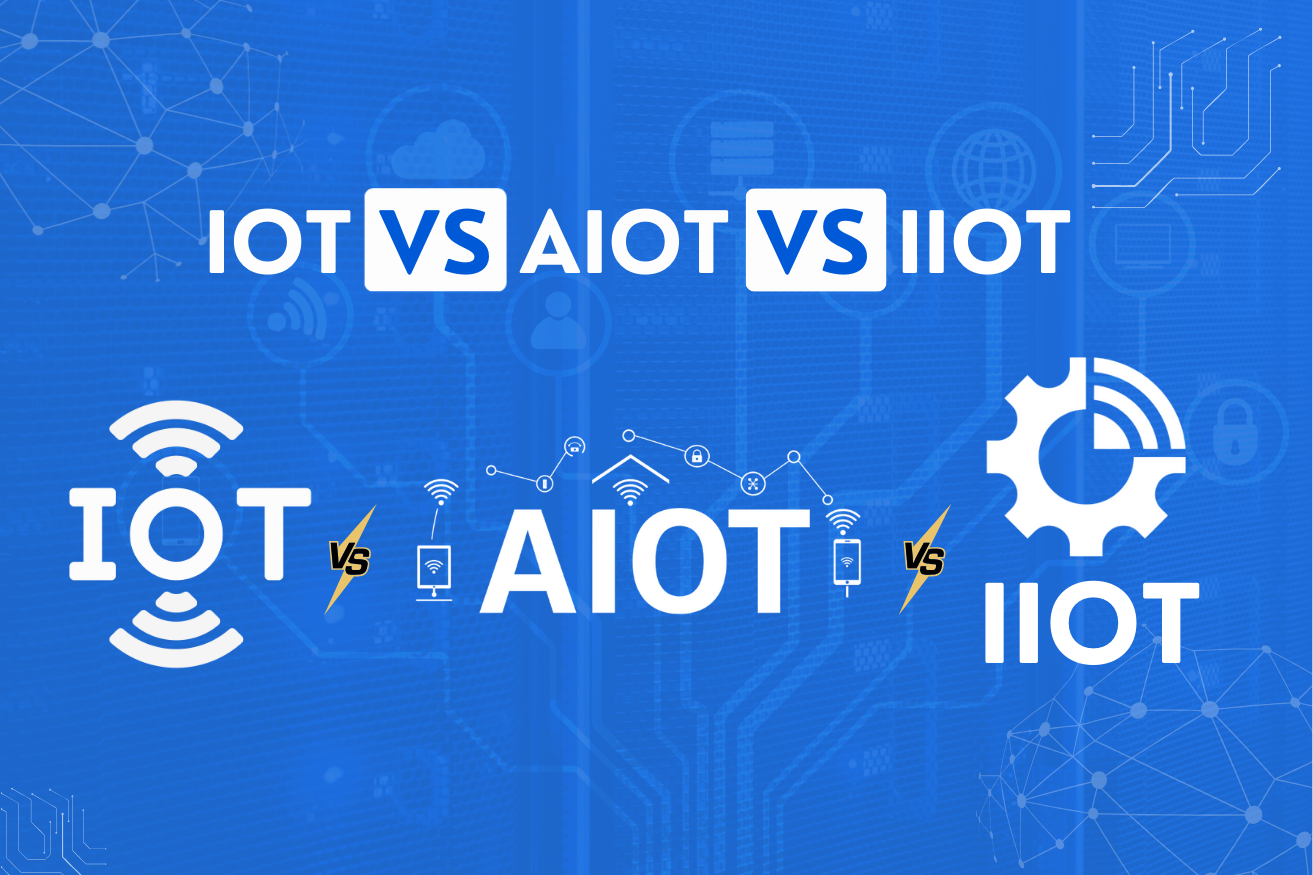
IoT, AIoT, and IIoT are frequently presented as three competing technologies, ranked from basic to advanced. They are not. They are three different kinds of statement about a system, and once that is clear the confusion mostly disappears.
IoT describes an architecture: physical things connected to networks. AIoT describes a capability added to that architecture: the system interprets its own data. IIoT describes a context in which it is deployed: industrial and operational environments, with the constraints those bring.
Because they describe different dimensions, a single system can be all three at once — and most serious industrial deployments are. This guide covers what each term genuinely means, where they overlap, and which one should shape your roadmap.
What Is IoT?
The Internet of Things is the general architecture: physical objects fitted with sensors and connectivity so their state can be observed and, often, controlled remotely.
The canonical structure is four layers — sensing, connectivity, data processing, and application — and it applies whether the object is a doorbell or a turbine. What IoT delivers on its own is visibility: someone can now see what is happening to something they could not previously observe.
- Smart home and consumer devices
- Asset tracking and logistics
- Utility metering and environmental monitoring
- Building management and access control
- Connected health and wearables
What Is AIoT?
The Artificial Intelligence of Things is IoT where interpretation happens inside the system rather than in a person reading a dashboard. Instead of comparing values to fixed thresholds, it learns what normal looks like for each asset and identifies meaningful deviation.
AIoT is a capability dimension. It can be added to consumer IoT, industrial IoT, or anything else, and its defining requirement is not the model but the data foundation beneath it: readings with provenance, honest gaps, operating context, and recorded outcomes.
- Predictive maintenance from vibration and current signatures
- Anomaly detection where no rule was written in advance
- Vision inspection at line speed
- Energy optimisation against price and demand
- Autonomous response too fast for a human loop
What Is IIoT?
The Industrial Internet of Things is IoT applied to manufacturing, energy, utilities, transport, and heavy industry. The technology overlaps heavily with consumer IoT; the constraints do not.
IoT vs AIoT vs IIoT: Key Differences
| IoT | AIoT | IIoT | |
|---|---|---|---|
| What the term describes | An architecture | A capability | A deployment context |
| Primary output | Visibility | Conclusions and predictions | Operational reliability and efficiency |
| Who interprets data | A person | The system | Either — context, not capability |
| Defining constraint | Cost and connectivity | Data quality and compute | Safety, legacy equipment, longevity |
| Failure consequence | Inconvenience | Wrong decisions, silently | Downtime, damage, or injury |
| Typical lifecycle | 2–5 years | Follows the host system | 15–25 years |
| Can combine with | Both others | IoT and IIoT | IoT and AIoT |
A vibration sensor on a pump, running a local model, in a factory, is simultaneously IoT, AIoT, and IIoT. The terms are not mutually exclusive because they answer different questions.
Which Applies to Your Roadmap?
Rather than choosing a category, answer three separate questions.
Where will it be deployed?
If the answer involves a plant floor, a substation, a vehicle fleet, or a utility network, IIoT constraints apply regardless of anything else. That means OT security review, protocol translation at the edge, environmental hardening, and a much longer support horizon — and it should shape hardware selection from the first day.
Does someone need to see it, or does it need to decide?
If a person will review the data and act, plain IoT is sufficient and considerably cheaper. If decisions must be made faster than a human loop allows, or across more assets than anyone can review, the AIoT capability is what you actually need.
Is the data foundation ready?
The AIoT capability depends on readings that carry device identity, firmware version, accurate event timestamps, explicit gaps, and operating context. Where those are missing, building them is the correct next step — and it improves the plain IoT system immediately, whether or not models follow.
The three answers combine. A programme might be IIoT by context, plain IoT by capability today, and AIoT within two years — which is a perfectly coherent roadmap, and a far more useful one than picking a label.
Practical Sequencing
The staged progression this implies is set out in detail in our guide to the IoT maturity model, and the scaling considerations specific to industrial rollouts in scaling Industrial IoT across sites.
Frequently Asked Questions
Conclusion
IoT, AIoT, and IIoT are not a ladder to climb. IoT is what the system is, AIoT is what it can work out for itself, and IIoT is where it has to survive. Treating them as competing options produces roadmaps built around labels instead of requirements.
Ask the three questions separately — where it runs, whether it must decide, and whether the data supports learning — and the right architecture describes itself. The label can be applied afterwards, if anyone still needs one.