


A digital twin is a virtual model of a physical thing — a machine, a building, a production line, even a city — that is kept in step with the real one using live data. Because the model mirrors what is actually happening, you can monitor the asset remotely, predict how it will behave, and test changes on the model before making them in the real world.
This guide explains digital twin technology in plain terms: where the idea came from, how it differs from a simulation, the types of digital twin, how one is built, real examples from industry, and how to tell whether a twin is worth building for your own assets.
What Is a Digital Twin?
A digital twin has three parts: the physical asset, a virtual model of it, and a two-way flow of data between them. Sensors on the asset update the model; insights from the model inform decisions about the asset, and in some systems adjust it directly.
The concept is usually credited to Michael Grieves, who described it in 2002 in the context of product lifecycle management, under names such as the “mirrored spaces model”. The term “digital twin” itself came from NASA’s John Vickers, who used it in a 2010 technology roadmap. Spacecraft were an early fit: engineers needed accurate models of vehicles they could not touch.
A 3D model shows what something looks like. A digital twin shows what it is doing right now, and what it is likely to do next.
Digital Twin vs Simulation vs Digital Shadow
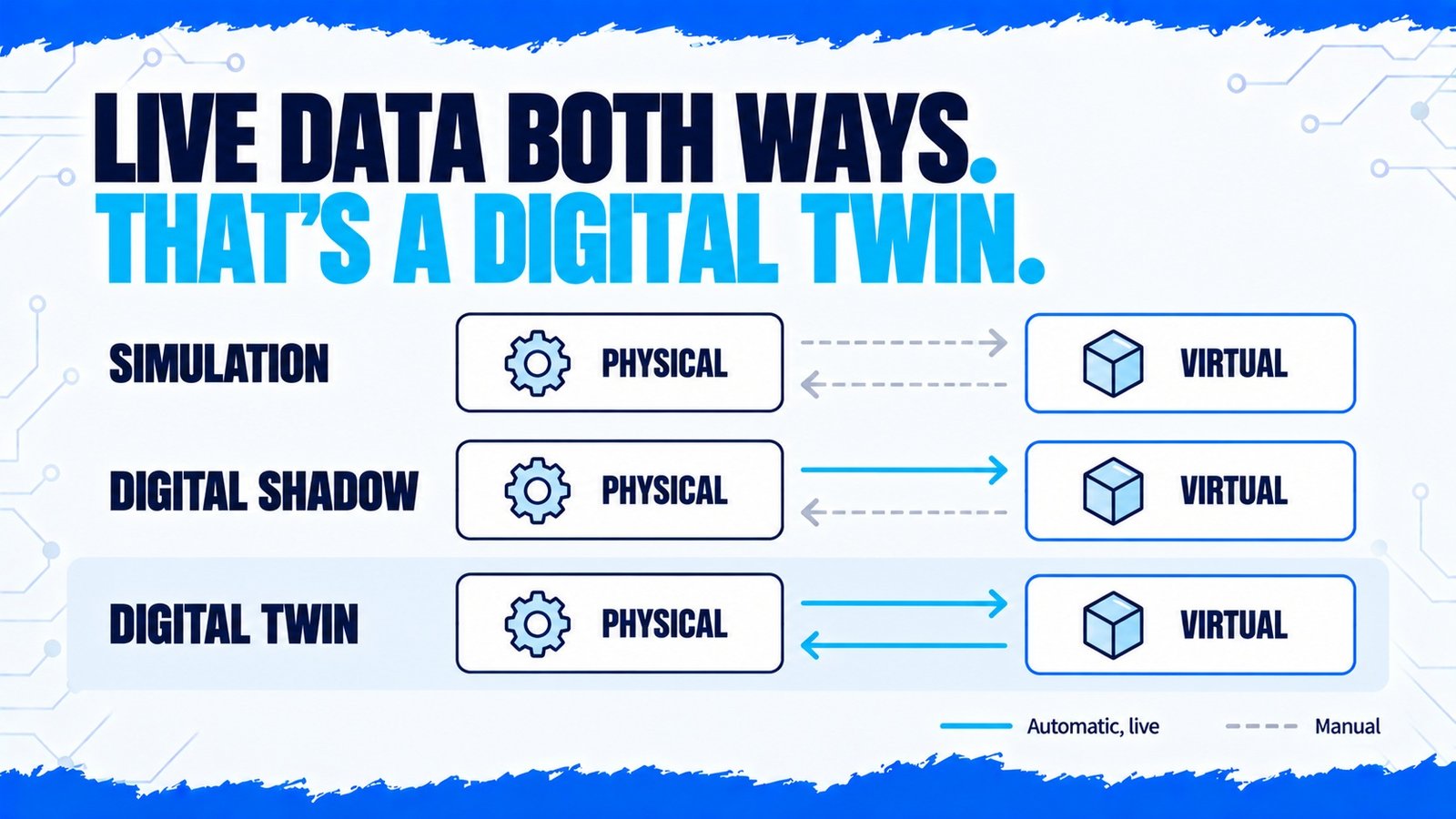
These terms are often used interchangeably, but the difference is useful. It comes down to how data flows between the physical and the virtual.
| Data from physical to virtual | Data from virtual to physical | Example | |
|---|---|---|---|
| Simulation or digital model | Manual, or none | Manual | A CAD model tested under assumed loads before anything is built |
| Digital shadow | Automatic, live | Manual | A dashboard model of a pump updated by its sensors, with people deciding what to do |
| Digital twin | Automatic, live | Automatic or closed-loop | A model that detects a fault developing and adjusts operating settings or schedules maintenance itself |
In practice many systems sold as digital twins are digital shadows, and that is often exactly the right level: live insight with a person making the call. The important distinction from a simulation is the live data. A simulation answers “what would happen if”; a twin answers “what is happening, and what happens next given the current state”.
Types of Digital Twin
How Digital Twin Technology Works
Under the visuals, a digital twin is an IoT system with a model at its centre. It is built in layers.
Sensing the physical asset
Sensors and existing control systems supply temperature, vibration, pressure, position, energy and status. Often much of this data already exists inside PLCs and SCADA systems and simply is not collected.
Connectivity and integration
Gateways bring the data out using industrial protocols such as OPC UA and Modbus and publish it upstream, commonly over MQTT. Our guide to IoT protocols covers these options.
The data platform
Time-series storage, context such as asset hierarchies and maintenance history, and data quality checks. A twin fed with poor data produces confident nonsense.
The model
Physics-based models built from engineering equations, data-driven models trained with machine learning, or a hybrid of both. Hybrids are increasingly common: physics provides structure, data corrects for how the real asset differs from its design.
Insight and action
Dashboards, 3D visualisation, alerts, what-if simulations and, in mature twins, automatic adjustments sent back to the control system.
For manufacturing, ISO 23247 provides a reference framework for digital twins, first published in 2021, and the Digital Twin Consortium brings together industry, academia and government to work on shared practices.
Digital Twin Examples
Many digital twins start life as predictive maintenance projects: once the sensor data and models exist for one failure mode, the twin grows from there. See predictive maintenance in IoT for that starting point.
Benefits, Costs and When It Is Worth It
| Benefit | Where it comes from |
|---|---|
| Less unplanned downtime | Failures predicted from the asset’s real condition |
| Cheaper changes | Layouts, settings and schedules tested on the model first |
| Better operating efficiency | Energy and throughput tuned against live conditions |
| Better next-generation designs | Field data shows how products are really used |
| Remote expertise | Specialists diagnose assets they cannot visit |
The costs are real: sensors and integration, data infrastructure, model development, and the ongoing work of keeping the model accurate as the asset ages and is modified. A twin that is not maintained drifts away from reality and becomes misleading.
Digital Twins and AI
AI and digital twins reinforce each other. Machine learning models inside a twin learn the asset’s normal behaviour and flag deviations; the twin, in turn, provides the clean, contextualised data AI needs and a safe place to test what an AI recommends before it touches real equipment. Running parts of that intelligence on the device itself reduces latency and bandwidth, a trade-off covered in edge machine learning. The wider combination of AI and connected systems is explained in AIoT: how AI and IoT work together.
Frequently Asked Questions
Conclusion
A digital twin is a live model of a real asset, built on sensors, connectivity, a data platform and a model that combines engineering and data. The best ones begin with a specific, expensive question and grow from there; the worst begin with a 3D visualisation and never answer anything.
Building one is mostly IoT and data engineering: getting reliable data out of real equipment and keeping the model honest over years. Our embedded IoT and AI and machine learning teams build the sensing, integration and models that digital twins depend on.