




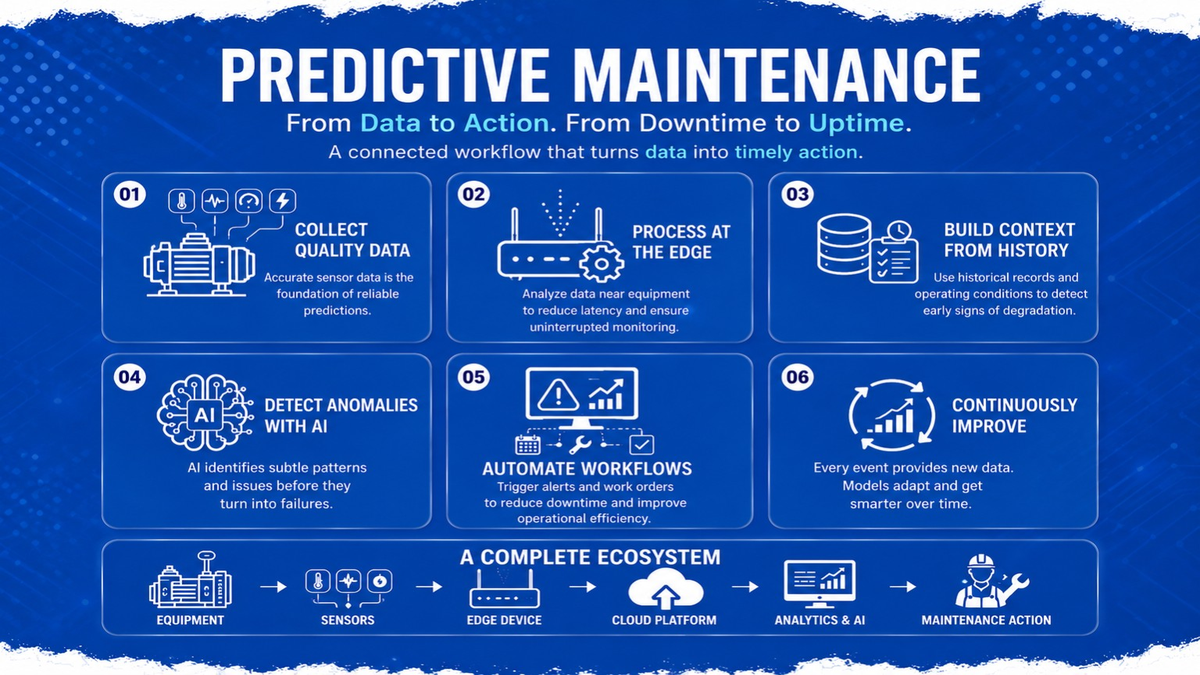
Unplanned equipment failures are among the most expensive challenges facing manufacturers, utilities, logistics companies, and industrial facilities. Every unexpected breakdown can result in production delays, increased maintenance costs, safety risks, and lost revenue.
While many organizations associate predictive maintenance with artificial intelligence, successful implementations begin much earlier — with reliable data collection, robust IoT infrastructure, and intelligent system architecture.
At MetaDesk Global, we believe predictive maintenance is not simply an AI feature. It is an end-to-end engineering ecosystem that combines Industrial IoT (IIoT), Edge AI, cloud analytics, embedded systems, and automated maintenance workflows to detect failures before they impact operations.
In this article, we’ll explore the essential building blocks of a modern predictive maintenance solution and how organizations can leverage IoT and AI to improve equipment reliability.
Overview
What Is Predictive Maintenance?
Predictive maintenance is a proactive maintenance strategy that uses sensor data, analytics, and machine learning to identify potential equipment failures before they occur. Instead of relying on fixed maintenance schedules or reacting after a breakdown, predictive maintenance continuously monitors asset health and recommends maintenance only when needed. This approach helps organizations:- Reduce unplanned downtime
- Lower maintenance costs
- Extend equipment lifespan
- Improve operational efficiency
- Increase workplace safety
- Optimize maintenance resources
Data Strategy
Why Data Is the Foundation of Predictive Maintenance
Artificial intelligence cannot compensate for poor-quality or incomplete data. Before any machine learning model can detect anomalies or predict failures, organizations must establish a reliable data pipeline. Successful predictive maintenance begins with collecting accurate operational data from connected assets.Framework
Building a Reliable Data Pipeline: 6 Key Steps
1
Capture High-Quality Equipment Data
Reliable monitoring starts with selecting the right sensors and measuring the right operating parameters. Common industrial measurements include:- Vibration
- Temperature
- Pressure
- Motor current
- Voltage
- RPM
- Flow rate
- Humidity
- Acoustic signals
- Energy consumption
2
Process Data at the Edge
Industrial environments often generate massive volumes of sensor data. Sending every reading directly to the cloud increases bandwidth costs, introduces latency, and may create unnecessary processing overhead. Edge computing addresses these challenges by analyzing data closer to the source.Benefits of Edge Processing
- Lower network bandwidth
- Faster anomaly detection
- Reduced cloud infrastructure costs
- Offline operation during network interruptions
- Improved real-time response
3
Add Historical Context
Raw sensor readings only tell part of the story. Understanding equipment behavior requires historical context. Important historical data includes:- Previous equipment failures
- Maintenance history
- Operating conditions
- Environmental factors
- Equipment age
- Production workload
4
Use AI for Intelligent Anomaly Detection
Traditional monitoring systems rely on fixed thresholds — for example, temperature above 80°C or vibration above a predefined limit. While useful, these rules often fail to identify complex failure patterns. Machine learning models can recognize subtle relationships across multiple variables simultaneously. Examples include:- Small vibration increases combined with temperature drift
- Gradual current fluctuations
- Pressure changes under specific operating loads
- Multi-sensor behavioral patterns
5
Turn Insights into Action
Predictive maintenance only creates business value when insights trigger operational decisions. A complete maintenance workflow typically includes:- Automatic anomaly detection
- Alert generation
- Maintenance scheduling
- Work order creation
- Technician assignment
- Repair tracking
- Equipment verification
6
Continuously Improve Prediction Accuracy
Industrial systems constantly evolve — equipment ages, operating conditions change, and production processes shift. As new data becomes available, predictive models should continuously learn and improve. Continuous model refinement enables organizations to:- Increase prediction accuracy
- Reduce false alarms
- Adapt to changing operating environments
- Improve maintenance planning
- Extend equipment reliability
Edge Computing
Why Edge AI Is Transforming Predictive Maintenance
Many predictive maintenance applications require immediate decision-making. Waiting for cloud analysis may introduce unacceptable delays. Edge AI enables local inference directly on industrial gateways and embedded devices. Benefits include:- Millisecond response times
- Reduced latency
- Offline operation
- Lower cloud costs
- Improved data privacy
- Greater operational reliability
Challenges
Common Challenges in Predictive Maintenance Projects
Despite growing adoption, many predictive maintenance initiatives struggle due to poor system design. Common challenges include:1
Poor Sensor Selection
Incomplete or inaccurate sensor data limits prediction quality.
2
Data Silos
Disconnected systems prevent comprehensive equipment analysis.
3
Excessive Cloud Dependency
Relying solely on cloud processing increases latency and bandwidth costs.
4
Lack of Historical Data
Without maintenance records, AI models cannot learn meaningful failure patterns.
5
No Feedback Loop
Prediction models gradually lose accuracy if they are never retrained with new operational data.
Recommendations
Best Practices for Successful Predictive Maintenance
Organizations planning predictive maintenance initiatives should consider the following recommendations:1Build a Strong IoT Infrastructure
Reliable sensors and communication networks form the foundation of every predictive maintenance system.
2Process Data at the Edge
Reduce latency and improve resilience by performing local analytics before transmitting data.
3Combine Live and Historical Data
Context significantly improves machine learning performance.
4Automate Maintenance Workflows
Ensure AI-generated insights trigger actionable maintenance processes.
5Continuously Monitor Model Performance
Regular retraining keeps prediction accuracy aligned with real-world operating conditions.
Business Impact
Business Benefits of Predictive Maintenance
Organizations implementing predictive maintenance often experience measurable improvements, including:- Reduced equipment downtime
- Lower maintenance expenses
- Improved asset utilization
- Increased equipment lifespan
- Enhanced workplace safety
- Better production planning
- Reduced operational risk
- Higher overall equipment effectiveness (OEE)
Rather than reacting to failures, organizations gain the ability to prevent them.
What’s Next
The Future of Predictive Maintenance
The next generation of predictive maintenance solutions will increasingly integrate:As these technologies mature, maintenance strategies will continue shifting from reactive repairs to intelligent, self-optimizing systems.
Wrapping Up
Conclusion
Predictive maintenance is far more than an AI dashboard. It is a comprehensive engineering solution built on reliable IoT infrastructure, high-quality sensor data, edge computing, machine learning, and automated operational workflows. Organizations that invest in the right architecture gain more than predictive insights — they improve reliability, reduce costs, and maximize equipment performance throughout the asset lifecycle.The companies achieving the greatest success aren’t collecting the most data. They’re collecting the right data, processing it intelligently, and turning it into timely action.