




Artificial Intelligence is no longer confined to cloud data centers. Today, AI models are running on industrial gateways, smart cameras, medical devices, autonomous robots, and embedded IoT hardware.
This shift toward Edge AI enables faster decision-making, lower latency, improved privacy, and reliable operation even when internet connectivity is unavailable.
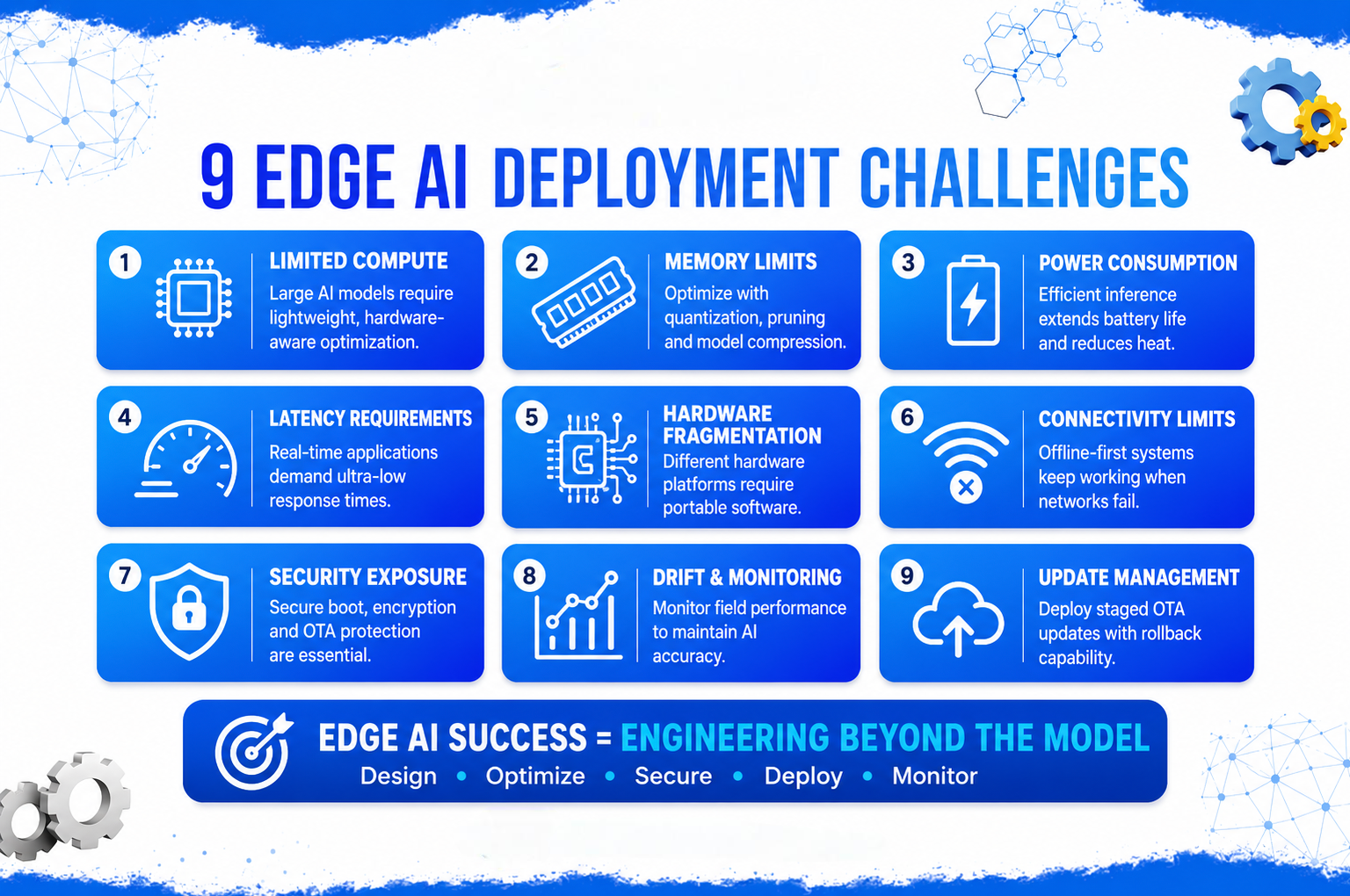
However, deploying AI models at the edge is far more complex than simply transferring a model from the cloud to an embedded processor.
The biggest challenges are rarely related to machine learning itself—they are engineering challenges.
Organizations must balance performance, power consumption, memory, hardware capabilities, security, and maintainability while delivering real-time intelligence on resource-constrained devices.
In this article, we’ll explore the key engineering challenges of Edge AI deployment and the best practices for building scalable AIoT systems.
What Is Edge AI?
Edge AI refers to running artificial intelligence models directly on edge devices instead of relying entirely on cloud infrastructure.
Typical Edge AI devices include:
- Smart cameras
- Industrial gateways
- Embedded Linux systems
- IoT controllers
- Autonomous robots
- Smart sensors
- Medical monitoring devices
- Automotive electronics
Rather than transmitting raw data to the cloud for analysis, Edge AI performs inference locally.
This enables:
- Lower latency
- Offline operation
- Reduced bandwidth usage
- Enhanced data privacy
- Faster automation
- Improved system reliability
Why Edge AI Is Growing
As IoT deployments become larger and more intelligent, organizations need systems capable of making decisions closer to where data is generated.
Edge AI helps solve several challenges associated with cloud-based processing:
- Network delays
- High cloud costs
- Bandwidth limitations
- Privacy concerns
- Unreliable internet connectivity
However, moving intelligence to the edge introduces an entirely new set of engineering constraints.
1. Designing for Limited Compute Resources
Unlike cloud servers equipped with powerful GPUs, embedded devices operate with significantly fewer computational resources.
Microcontrollers, embedded processors, and edge gateways often have strict CPU limitations that directly influence AI performance.
Engineering Considerations
To achieve acceptable inference performance, development teams should:
- Select lightweight neural network architectures
- Optimize operators for the target processor
- Leverage hardware accelerators when available
- Reduce unnecessary model complexity
The objective is not to deploy the largest model—but the most efficient model that satisfies application requirements.
2. Managing Memory Constraints
Memory is one of the most common limitations in embedded AI systems.
Many edge devices have only a few megabytes of RAM and limited flash storage.
Large AI models can quickly exceed available resources.
Common Optimization Techniques
Organizations typically improve memory efficiency using:
- Model quantization
- Weight pruning
- Knowledge distillation
- Lightweight model architectures
- Optimized inference runtimes
These techniques reduce model size while maintaining acceptable accuracy.
3. Optimizing Power Consumption
Many AI-enabled IoT products operate from batteries or energy-constrained environments.
Continuous inference can significantly reduce battery life and generate unwanted heat.
Best Practices
Instead of running AI continuously, systems should:
- Trigger inference only when events occur
- Schedule processing intelligently
- Utilize low-power hardware accelerators
- Enter sleep modes whenever possible
Power-efficient AI is essential for wearable devices, environmental sensors, and remote monitoring systems.
4. Meeting Real-Time Latency Requirements
For many Edge AI applications, timing is critical.
Industrial automation, robotics, autonomous vehicles, and medical devices often require decisions within milliseconds.
A high-accuracy model is of little value if it cannot respond quickly enough.
Optimizing End-to-End Performance
Real-time performance depends on more than the model itself.
Engineers must optimize:
- Sensor acquisition
- Data preprocessing
- Inference execution
- Memory access
- Communication delays
- System scheduling
The entire processing pipeline influences latency.
5. Supporting Diverse Hardware Platforms
Edge AI products rarely operate on identical hardware.
A single deployment may include multiple:
- Processors
- AI accelerators
- Operating systems
- Firmware versions
- Device configurations
This diversity creates significant software engineering challenges.
Improving Portability
Development teams should:
- Use hardware-independent frameworks
- Adopt standardized model formats such as ONNX
- Design modular inference pipelines
- Maintain consistent deployment workflows
Building portable AI systems reduces maintenance costs and simplifies future upgrades.
6. Building for Offline Operation
Many Edge AI deployments operate in environments where internet connectivity is limited or unavailable.
Examples include:
- Manufacturing facilities
- Mining operations
- Agricultural equipment
- Remote infrastructure
- Autonomous vehicles
Devices must continue operating safely even when disconnected.
Offline-First Design Principles
Reliable Edge AI systems should:
- Perform inference locally
- Store data temporarily during outages
- Synchronize automatically once connectivity returns
- Continue executing critical workflows independently
Offline capability should be a core architectural requirement rather than an afterthought.
7. Securing AI at the Edge
Unlike cloud servers, edge devices are physically accessible.
This makes them more vulnerable to tampering and unauthorized access.
Security must be integrated throughout the product lifecycle.
Essential Security Features
Modern Edge AI systems should implement:
- Secure boot
- Firmware authentication
- Encrypted storage
- Secure communication protocols
- Device authentication
- Role-based access control
- Secure OTA updates
These mechanisms protect both device integrity and AI models.
Monitoring Models After Deployment
Deploying an AI model is only the beginning.
Real-world environments change continuously.
Lighting conditions, user behavior, equipment wear, and environmental factors can all influence model performance.
Without monitoring, model accuracy may decline over time.
Monitoring Strategies
Organizations should collect metrics such as:
- Inference latency
- Model confidence
- Prediction accuracy
- Device health
- Resource utilization
- Error rates
These insights enable proactive maintenance and continuous improvement.
Managing AI Model Updates
AI models evolve throughout a product’s lifecycle.
New data, changing operating conditions, and improved algorithms require periodic updates.
Updating thousands of distributed devices safely presents a significant engineering challenge.
Best Practices for Model Deployment
Successful update strategies include:
- Staged rollouts
- Secure OTA delivery
- Rollback mechanisms
- Version control
- Health verification after deployment
These practices reduce operational risk while maintaining system reliability.
Best Practices for Successful Edge AI Projects
Organizations should adopt a holistic engineering approach.
Optimize for Target Hardware
Choose models that match the capabilities of the deployment platform.
Design for Reliability
Expect network interruptions, power constraints, and environmental variability.
Prioritize Security
Protect devices, firmware, and AI models throughout their lifecycle.
Monitor Continuously
Collect operational data to detect model drift and performance degradation.
Plan for Long-Term Updates
Treat AI models as evolving software components rather than static assets.
Why Edge AI Is More Than Machine Learning
Many discussions about Edge AI focus exclusively on neural networks and algorithms.
In reality, successful deployments require expertise across multiple engineering disciplines:
- Embedded firmware
- Hardware design
- PCB development
- Cloud integration
- Cybersecurity
- Device management
- System optimization
- AI lifecycle management
The intelligence delivered by an Edge AI system depends on how well these components work together.
Conclusion
Edge AI offers enormous opportunities for building faster, smarter, and more autonomous IoT systems.
However, deploying AI at the edge requires far more than selecting an accurate model.
Organizations must engineer solutions that operate efficiently within real-world constraints involving:
- Compute
- Memory
- Power
- Connectivity
- Security
- Hardware diversity
- Long-term maintainability
By addressing these challenges early in the design process, businesses can build Edge AI products that remain reliable, scalable, and valuable throughout their lifecycle.
The future of intelligent connected devices belongs to solutions that combine advanced AI with practical engineering.
About MetaDesk Global
MetaDesk Global develops end-to-end intelligent embedded solutions for startups and enterprises worldwide.
Our expertise includes:
- Edge AI Development
- AIoT Solutions
- Embedded Firmware Development
- PCB Design
- Industrial IoT Systems
- Secure OTA Infrastructure
- Cloud & Edge Integration
- AI Model Deployment
- Product Engineering
- Connected Device Development
From concept to production, we help organizations build intelligent products designed for performance, scalability, and long-term success.