



Shipping the first production run feels like the finish line. For a connected product it is closer to the starting line, because the device now has to work for years in places you cannot reach, while the software inside it keeps changing.
Most of a connected product’s total cost occurs after manufacturing. Support, firmware maintenance, connectivity, cloud hosting, replacements and eventual end-of-life all land in the period teams plan for least.
This guide covers that period: the phases a deployed fleet moves through, what each one demands, and the decisions that determine whether year three is profitable or painful.
Early Deployment: Finding What Testing Missed
The first weeks in the field surface problems no lab can reproduce, because real deployments contain conditions you did not think to test.
- Installation errors from people who did not build the product
- Network environments that behave nothing like the office
- Edge cases in provisioning that only appear at volume
- Power quality and temperature extremes at specific sites
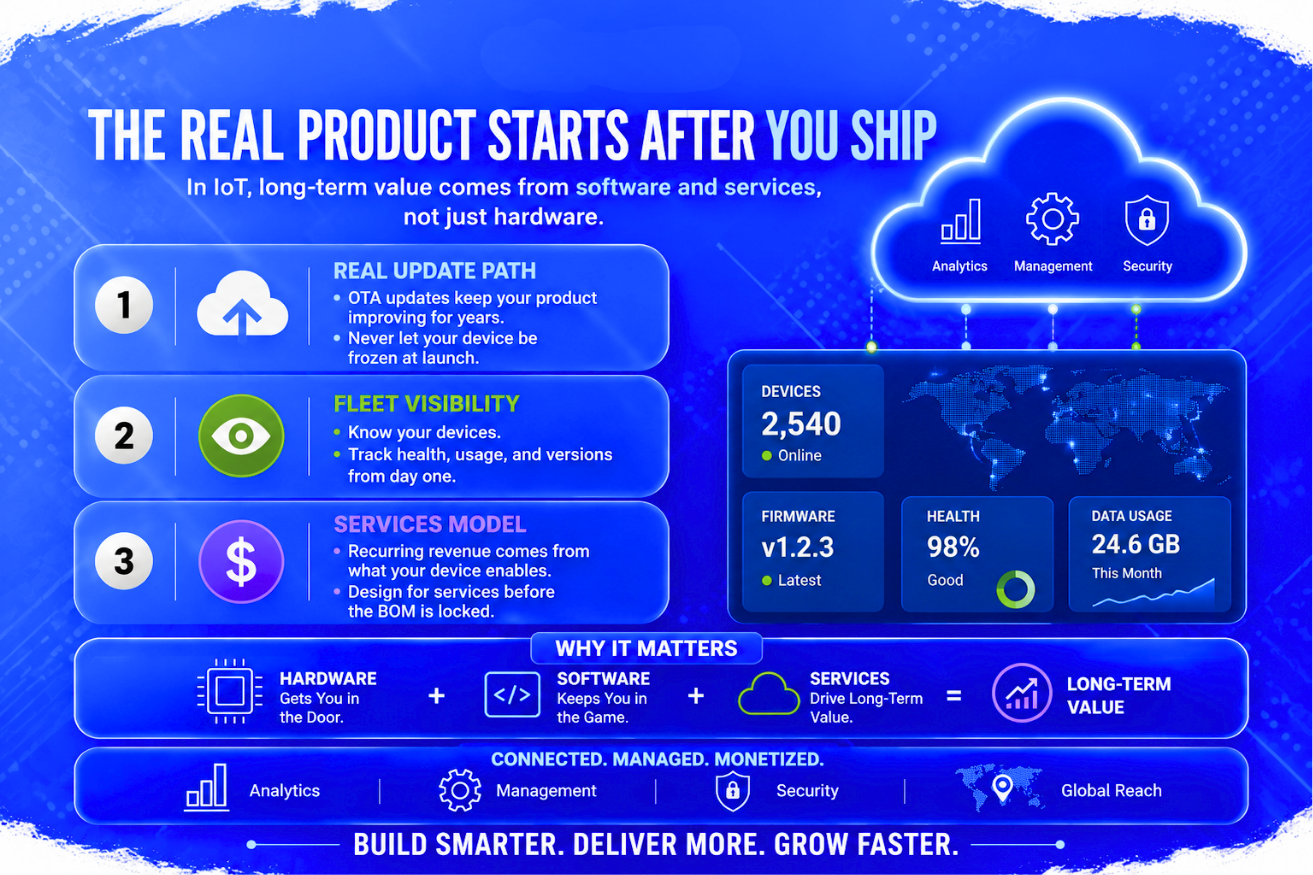
What matters here is detection speed. A fleet dashboard showing connectivity rate, data completeness, reset causes and firmware versions turns this phase into a measured activity rather than a stream of customer complaints. The first OTA update usually happens within weeks, which is why that path must ship working rather than be planned for later.
Steady State: The Long Middle
Once early issues settle, the product enters its longest phase. Nothing dramatic happens, which is exactly why it is where programmes quietly decay.
Certificate expiry deserves specific mention: it is one of the most common causes of a mature fleet going dark overnight, and it is entirely preventable with a tracked renewal plan.
Evolution: Changing a Product That Is Already Deployed
Customers ask for new capability, and the fleet constrains what is possible. Three rules keep this manageable.
New features must degrade gracefully on old hardware
Some units will lack the memory or sensors a feature needs. Decide whether it is unavailable, reduced, or a reason to replace hardware — and communicate that honestly rather than letting older devices behave unpredictably.
Data schemas only extend, never change meaning
Adding a field is safe; redefining one breaks every historical comparison and every consumer written against the old meaning. If the meaning changes, it is a new field with a new name.
Every release is staged
Internal units, a small percentage, then waves — with automatic halt conditions on check-in rate and reset counts. The discipline that protected the first OTA update matters more as the fleet grows, not less.
End of Life, Planned Rather Than Discovered
Every product eventually stops being supported. Doing that deliberately protects customers and reputation; doing it by neglect produces insecure devices still connected to your infrastructure.
- State the support window at the point of sale, including how long security updates will continue.
- Give notice well before support ends, with a migration path where one exists.
- Decide what happens to the cloud service. A device that becomes useless when a server is switched off is a reasonable grievance; local functionality that survives is a real differentiator.
- Handle data — export, retention, deletion — according to what customers were promised.
- Plan disposal and recycling, which increasingly carries regulatory obligations.
Making the Post-Launch Years Manageable
Frequently Asked Questions
Conclusion
Manufacturing is the midpoint of a connected product, not the end. The years afterwards contain most of the cost and nearly all of the reputational risk: patches to ship, certificates to renew, drift to detect, fragmentation to manage, and eventually a retirement to handle gracefully.
Budget the per-device operating cost honestly, give the fleet an owner, monitor data quality as well as connectivity, keep every hardware revision in-house for testing, and state the support window out loud. Products managed that way stay profitable; products that are shipped and forgotten become liabilities attached to your brand.