




AIoT — the Artificial Intelligence of Things — is what happens when connected devices stop simply reporting measurements and start interpreting them. An IoT system tells you a motor is running at 78°C. An AIoT system tells you that temperature is abnormal for this motor at this load, and that a bearing is likely to fail within two weeks.
The distinction is not the presence of an algorithm somewhere in the stack. It is where interpretation happens: in a person looking at a dashboard, or in the system itself.
This guide explains what AIoT actually is, the architecture that makes it work, where the intelligence should live, and the challenges that determine whether a deployment delivers value or quietly produces confident nonsense.
What Is AIoT?
AIoT is the combination of Internet of Things infrastructure — sensors, connectivity, devices — with artificial intelligence that turns the resulting data into decisions.
Each half solves a problem the other has. IoT generates enormous volumes of data that exceed human capacity to review. AI can find patterns in data but needs a continuous, trustworthy supply of it. Together they close a loop: sense, interpret, decide, act, and observe the result.
| IoT alone | AIoT | |
|---|---|---|
| What it produces | Measurements and dashboards | Conclusions and recommended actions |
| Who interprets | A person | The system, with human supervision |
| Detection method | Fixed thresholds | Learned patterns and per-asset baselines |
| Timing | Reports what happened | Anticipates what is likely to happen |
| Handles novelty | Poorly — unknown conditions have no rule | Better — anomalies surface without a predefined rule |
AIoT is not IoT with a model bolted on. It is a system designed so that interpretation happens where the data is, rather than in a human reading a chart.
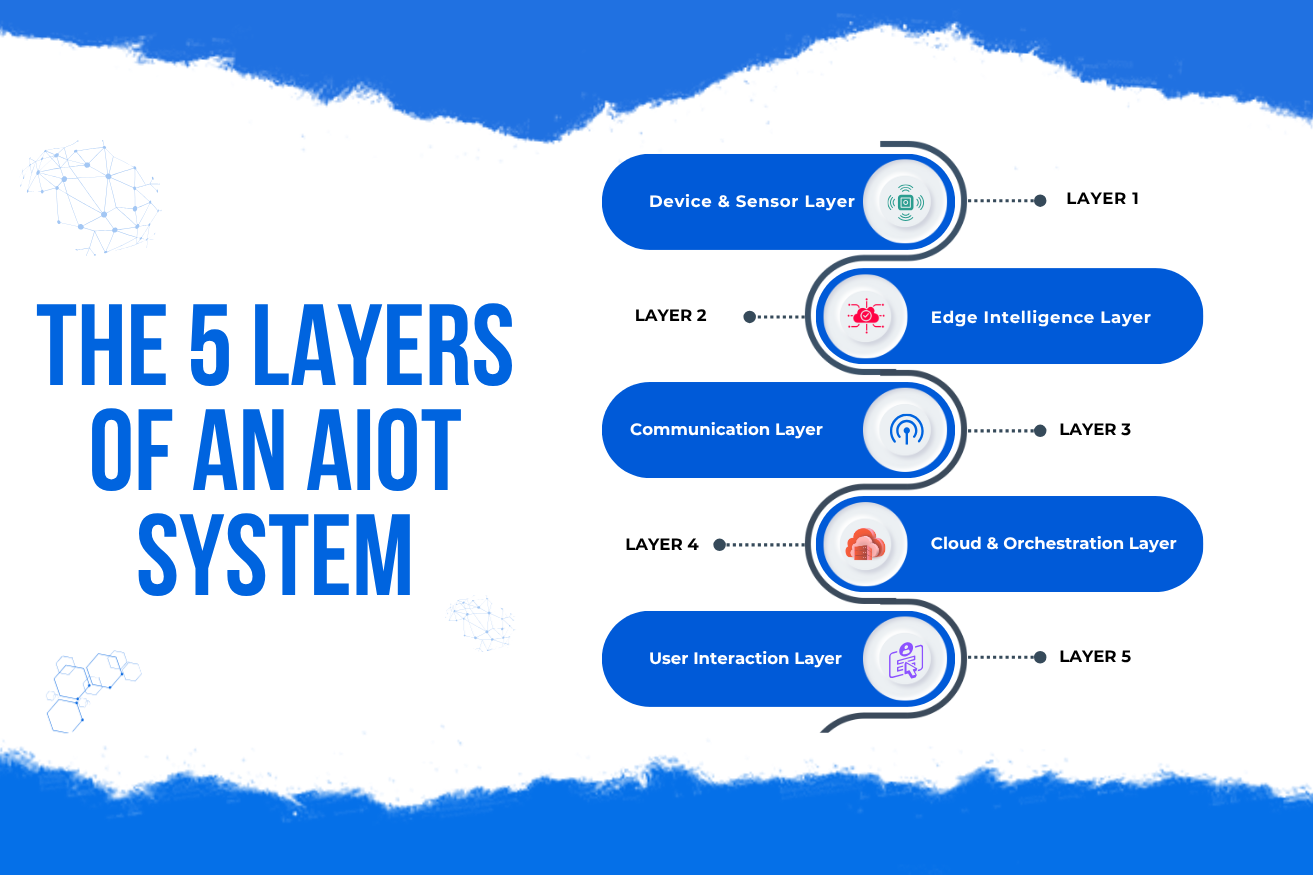
The Five Layers of an AIoT System
Sensing layer — where data begins
Sensors, embedded controllers, and firmware convert physical conditions into digital readings. In AIoT this layer carries an extra responsibility beyond accuracy: every reading must be labelled with the device identity, firmware version, and the time the measurement was actually taken.
Without that provenance, a model cannot be explained, a faulty hardware batch cannot be isolated, and bad units cannot be excluded from training.
Edge AI layer — intelligence on the device
Inference close to the sensor. This is where filtering, anomaly detection, and immediate reactions belong, because they need millisecond response and must survive network outages.
Running a small model locally also removes most transmission cost, since the device sends a conclusion rather than a continuous signal.
Connectivity layer — moving conclusions
Protocols and networks that carry data reliably. In AIoT the requirement shifts: because devices transmit summaries and events rather than raw streams, bandwidth matters less and delivery guarantees matter more. A duplicated event double-triggers an action; a lost one leaves a gap in the training record.
Cloud intelligence layer — learning across the fleet
Where long history, cross-asset comparison, model training, and retraining live. The cloud sees what no single device can: how this machine compares to a thousand others, how behaviour has changed over two years, and whether a model is still accurate.
Its output is not only analytics but improved models pushed back down to the edge — which is what makes an AIoT system improve rather than merely persist.
Application and action layer
Where conclusions become outcomes: alerts routed to the right person, work orders raised automatically, setpoints adjusted, processes stopped.
This layer must also capture what happened next. A prediction with no recorded outcome cannot be evaluated, so accuracy decays invisibly — the single most common reason AIoT deployments lose credibility over time.
Where Should the Intelligence Run?
Deciding to use AI is easy. Deciding where it executes is the choice that determines latency, cost, and resilience.
Well-designed systems use all three with a clear division: the device decides what happened, the edge decides what it means locally, and the cloud decides what it means across the fleet over time. Concentrating everything in one tier is the most common architectural error, and the trade-offs are covered in our guide to edge AI trade-offs.
What AIoT Delivers in Practice
- Predictive maintenance — detecting degradation early enough to schedule repair instead of reacting to failure
- Anomaly detection without rules — surfacing unusual behaviour that no threshold was written for
- Quality inspection — catching defects at line speed, consistently, without inspector fatigue
- Energy optimisation — adjusting operation continuously against demand, price, and conditions
- Autonomous response — acting within milliseconds where a human loop is too slow
- Reduced operating cost — because devices transmit conclusions rather than raw data
The common thread is that each replaces a decision a person could not make fast enough, consistently enough, or often enough across a large fleet.
Common Challenges in AIoT
Frequently Asked Questions
Conclusion
AIoT works when a connected system stops handing measurements to a person and starts producing conclusions that person can act on. That shift requires more than adding a model: it requires data with provenance and honest gaps, intelligence placed at the tier where it changes the economics, and a feedback path that records what actually happened.
Systems built that way get better as they run. Systems built without those foundations produce confident output that nobody can verify — and, eventually, nobody trusts.