




Connected products are becoming more sophisticated, but the core security challenge remains surprisingly simple: how does your platform know that the device connecting to it is actually a trusted device?
For a small IoT prototype, teams can sometimes get away with basic credentials, shared secrets, or manually configured authentication. That approach becomes increasingly difficult to manage when a product grows into thousands or millions of connected devices.
Every device needs an identity. That identity needs to be protected. And the organization needs a reliable way to provision, authenticate, update, revoke, and eventually retire that identity. This is where Public Key Infrastructure (PKI) and certificate-based authentication become important components of modern IoT device security architecture.
What Is IoT Device Identity?
IoT device identity is the mechanism used to uniquely identify and authenticate a physical device within a connected ecosystem. Instead of treating every device as an anonymous endpoint, each unit receives a unique cryptographic identity.
For example, a connected industrial controller may need to communicate with:
- A local gateway
- A cloud IoT platform
- A device management service
- An enterprise application
- An OTA update service
Before allowing those connections, the system needs to determine: is this device authorized to communicate with us? A strong device identity system provides the foundation for answering that question — and makes it possible to manage devices individually rather than relying on credentials shared across an entire fleet.
Why Shared Credentials Become a Problem
Shared passwords or keys may appear convenient during early development. The problem appears when the number of devices increases.
Imagine deploying 20,000 devices using the same authentication secret. If that secret is compromised, the security problem isn’t limited to one device — potentially, the entire fleet is affected. Replacing the credential can also become extremely difficult if devices are already deployed in remote locations.
One compromised device should not automatically compromise the entire fleet.
A scalable IoT security architecture therefore needs individual device credentials and controlled lifecycle management.
How PKI Supports IoT Security
Public Key Infrastructure (PKI) provides the framework for managing cryptographic identities using public and private keys, digital certificates, and trusted certificate authorities. A typical IoT PKI architecture includes:
- Device key pairs
- Device certificates
- Certificate Authorities (CAs)
- Certificate provisioning
- Authentication mechanisms
- Certificate renewal
- Certificate revocation
- Secure device retirement
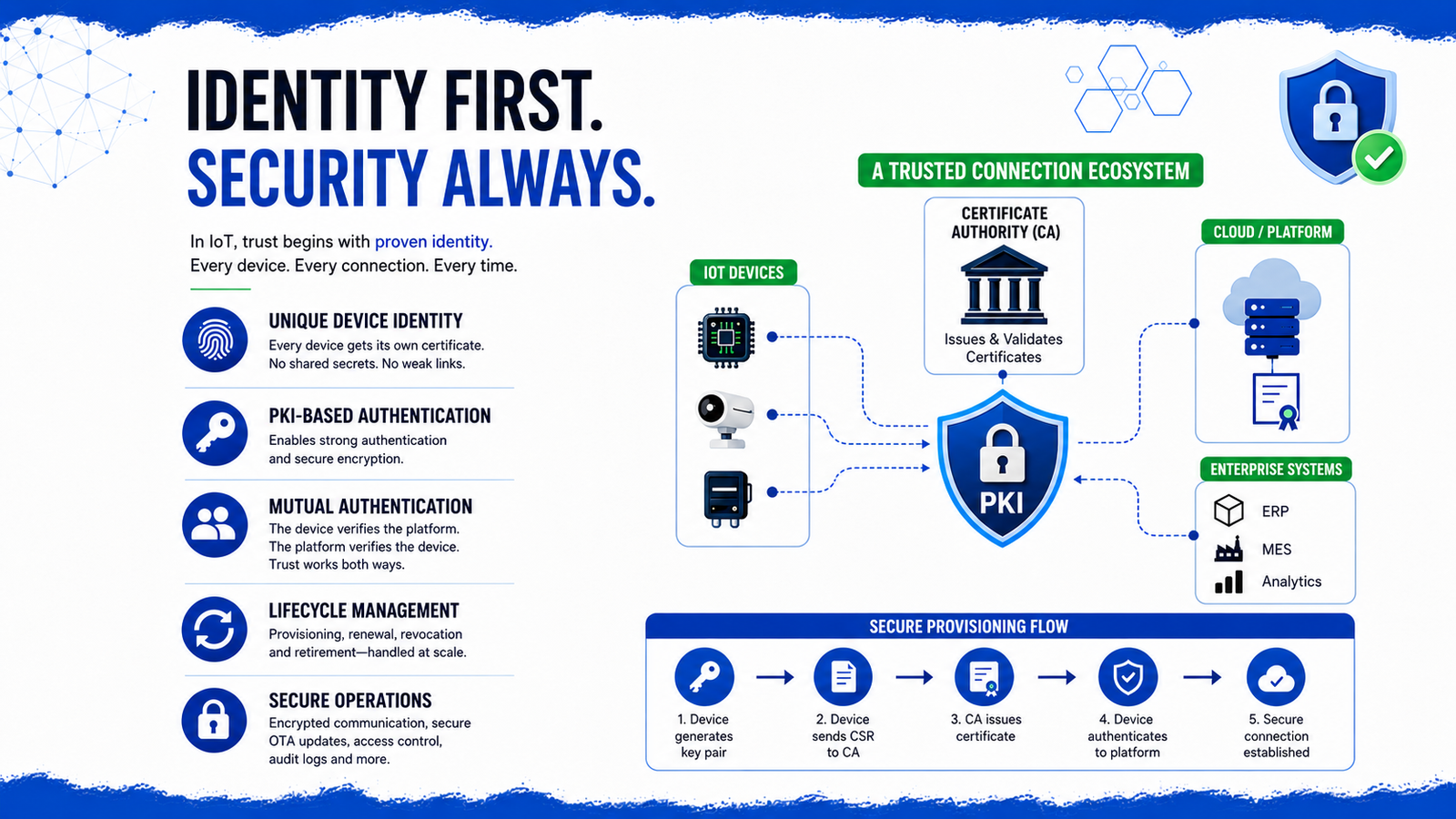
This creates a structured trust model between the physical device and the systems it communicates with. Instead of asking “Does this device know the shared password?” the system can ask “Can this device prove that it possesses the private key associated with a certificate issued by a trusted authority?” That is a much stronger foundation for large-scale device authentication.
Unique Device Certificates
One of the most important principles of certificate-based IoT authentication is unique device identity. Each device can receive its own certificate:
Device A → Certificate A • Device B → Certificate B • Device C → Certificate C
If Device B is compromised, its certificate can be revoked without necessarily invalidating every other device in the fleet. This provides much better isolation than a shared fleet-wide credential. Unique certificates can also make device management and auditing easier, because the platform can associate communication with a specific device identity.
Public and Private Keys
PKI relies on asymmetric cryptography. A device typically has a private key and a corresponding public key. The private key must remain protected — it should not be transmitted to the cloud or shared between devices. The public key can be used by other systems to verify cryptographic operations associated with the device.
In embedded systems, protecting the private key becomes particularly important. Depending on the hardware, keys may be protected using mechanisms such as:
- Secure elements
- Hardware security modules
- Trusted execution environments
- MCU security features
- Protected key storage
The exact implementation depends on the device architecture and threat model.
Secure IoT Device Provisioning
Device identity is only useful if it is established securely, which makes IoT device provisioning an important part of the security architecture. A typical provisioning flow may look like:
Manufacturing → Key generation → Certificate request → Certificate issuance → Device registration → Secure connection
The device can generate or receive its cryptographic credentials during manufacturing or initial provisioning. The platform then establishes that the device belongs to the trusted ecosystem before allowing normal communication. This process should be designed before production — trying to introduce secure identity after thousands of devices have already been manufactured can be significantly more complicated.
Mutual Authentication for Connected Devices
Traditional authentication often focuses on the client proving its identity to the server. IoT systems can benefit from mutual authentication, where both sides verify each other.
- The device verifies: “Am I communicating with the legitimate platform?”
- The platform verifies: “Is this an authorized device?”
This is particularly important for connected products because devices may operate across untrusted networks. A common implementation is mutual TLS (mTLS) using device certificates, which allows the TLS connection to establish trust in both directions while also providing encrypted communication.
Certificate Lifecycle Management
Issuing a certificate is only the beginning. A deployed device may remain operational for years, during which certificates expire, devices get replaced, keys may become compromised, security policies change, firmware is updated, and hardware eventually reaches end of life. IoT certificate management therefore needs to cover the complete device lifecycle:
Certificate Issuance
New devices receive valid credentials during provisioning.
Certificate Renewal
Certificates are renewed before expiration without requiring manual intervention.
Certificate Rotation
Credentials can be rotated when required by security policies or operational requirements.
Certificate Revocation
Compromised or unauthorized devices can be removed from the trusted ecosystem.
Device Retirement
When hardware reaches end of life, its credentials should no longer provide access to production systems.
This automation becomes critical as fleet size increases.
PKI and Secure OTA Updates
Device identity also plays an important role in secure OTA firmware updates. An update system needs to answer several questions:
- Who is receiving the update?
- Is the update intended for this device?
- Is the firmware authentic?
- Has the firmware been modified?
- Should this device be allowed to install it?
Digital signatures and cryptographic verification can help establish firmware authenticity. Device identity can then be used alongside authorization policies to control which devices receive specific firmware versions. For large IoT fleets, secure OTA shouldn’t be treated as an isolated firmware feature — it should be part of the broader device security architecture.
IoT Security Doesn’t End at the Network
Firewalls, VPNs, network segmentation, and intrusion detection are important security controls — but they don’t answer the fundamental identity question: who is the device? A device can be communicating through an encrypted connection while still being unauthorized. That is why modern IoT security needs multiple layers:
Device identity → Authentication → Authorization → Encryption → Monitoring → Lifecycle management
Network security protects the communication environment. Device identity establishes trust at the endpoint. Both are necessary.
Designing IoT Security for Fleet Scale
Security architecture should be designed with the eventual fleet in mind. A process that works for 10 devices may become impossible at 10,000.
| Small Prototype | Production Fleet |
|---|---|
| Manual credentials | Automated identity provisioning |
| Shared keys | Unique device certificates |
| Manual updates | Secure OTA |
| Manual certificate renewal | Automated lifecycle management |
| Engineer-controlled access | Policy-based authorization |
| One test environment | Multiple production environments |
| Manual device replacement | Automated device retirement |
The goal isn’t to make the prototype unnecessarily complicated. It’s to avoid creating an architecture that becomes impossible to operate when the product succeeds.
Common IoT Security Mistakes
Several security problems repeatedly appear in connected-product development.
Building a Secure Connected Product
Strong IoT device security is not a single feature. It is an engineering system that starts with device identity and continues throughout the product lifecycle. A secure connected product should be able to:
- Establish a unique identity
- Authenticate securely
- Protect private credentials
- Encrypt communication
- Control device permissions
- Provision devices automatically
- Renew credentials
- Revoke compromised devices
- Receive authenticated firmware updates
- Monitor security events
- Retire devices safely
At MetaDesk Global, we look at IoT security from the device level through the complete connected-product architecture — considering embedded firmware, hardware security, device provisioning, connectivity, cloud integration, OTA updates, and fleet management together, rather than treating security as something added after the product is already built.
Final Thoughts
The security challenge in IoT changes dramatically when a prototype becomes a fleet. At five devices, manual credentials might seem manageable. At 5,000 devices, they become an operational liability.
At that point, the question isn’t simply whether communication is encrypted. The bigger question is: can your system reliably establish and manage trust for every device throughout its entire lifecycle? PKI and certificate-based device identity provide one of the foundations for doing that.
Because at fleet scale, security cannot depend on knowing every device personally. The architecture has to know which devices it can trust — automatically.