




Connecting industrial equipment is easier than ever. Sensors can measure almost anything. PLCs and industrial controllers already generate valuable operational data. Gateways can bridge legacy protocols to modern networks, while cloud platforms can store and analyze enormous amounts of information.
Yet many Industrial IoT projects still struggle to create measurable value. The problem is often not connectivity — it is architecture.
A successful Industrial IoT (IIoT) system needs to connect physical equipment, control systems, edge computing, industrial networks, data platforms, analytics, security, and business applications into one reliable operational ecosystem. The objective should therefore not simply be “What equipment can we connect?” A much better question is:
What operational decision will become faster, safer, or more accurate because this equipment is connected?
That question changes how the entire IIoT architecture is designed.
What Is Industrial IoT (IIoT)?
Industrial IoT, commonly known as IIoT, refers to the use of connected sensors, machines, controllers, gateways, software platforms, and analytics within industrial environments. These systems collect information from physical assets and use it to improve operations. Common applications include:
- Predictive maintenance
- Machine condition monitoring
- Energy management
- Production optimization
- Quality monitoring
- Asset tracking
- Remote equipment monitoring
- Process automation
- Equipment utilization analysis
- Industrial safety monitoring
Unlike many consumer IoT applications, industrial systems often operate under much stricter requirements. Equipment may need to run continuously for years, network connectivity may be unreliable, and some control decisions need to happen within milliseconds. Failure can mean much more than an unavailable mobile app — it can result in production downtime, damaged equipment, safety risks, or significant financial losses. This makes Industrial IoT architecture especially important.
Why Industrial IoT Is More Than Connecting Machines
A machine producing data does not automatically create business value. Imagine a factory installing vibration, temperature, and current sensors across hundreds of motors. The organization can now collect millions of measurements — but unless those measurements help answer questions such as:
- Which motor is beginning to fail?
- Which machine is consuming abnormal energy?
- Which production line is losing efficiency?
- When should maintenance be scheduled?
- Which anomaly requires immediate intervention?
… the organization may have created a large data pipeline without improving operations. A successful IIoT system therefore needs to transform:
Physical signals → Data → Context → Insight → Decision → Action
Every layer of the architecture should support that journey.
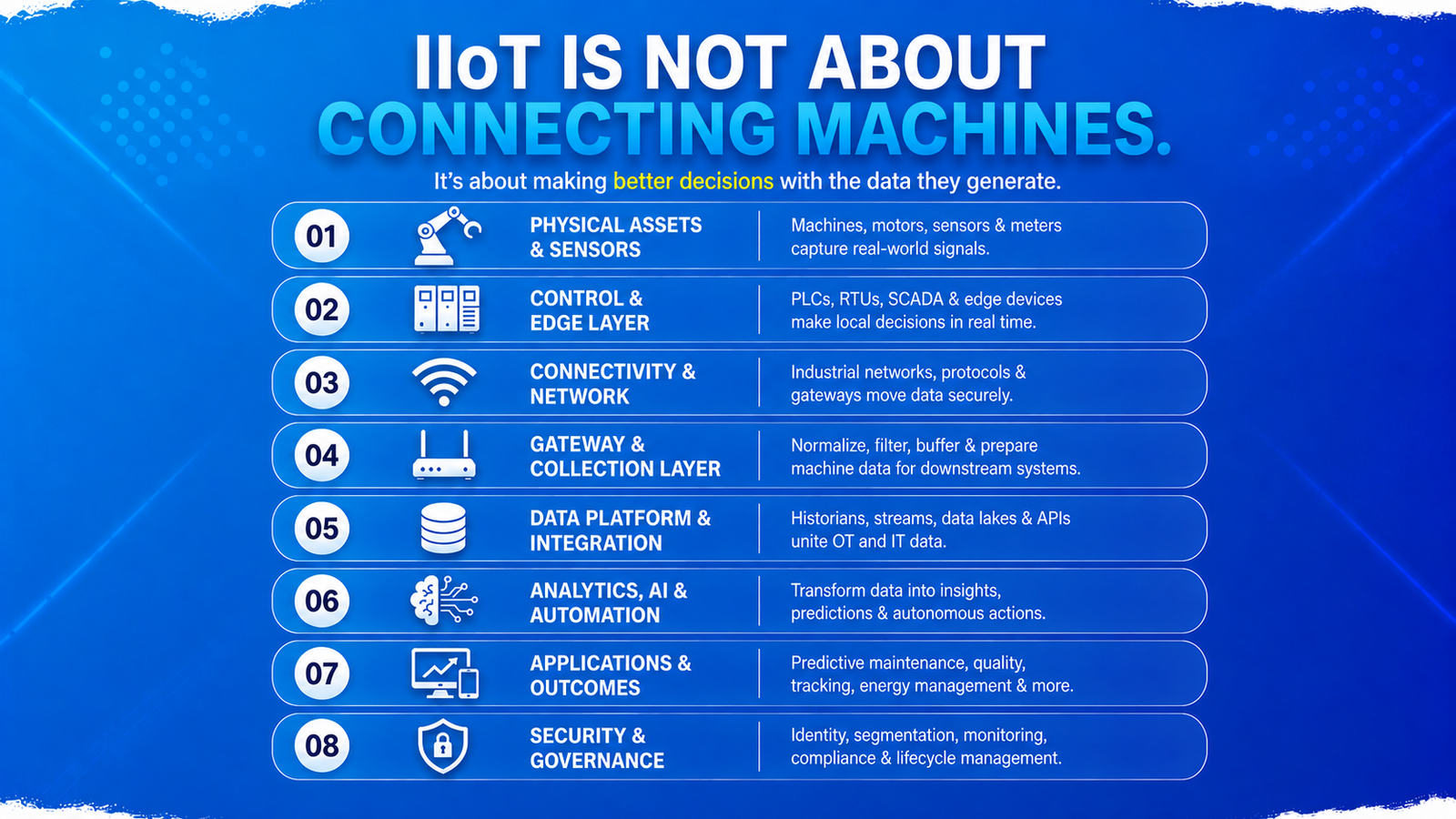
The Core Layers of an Industrial IoT Architecture
A modern IIoT architecture can be viewed as several interconnected layers, each solving a different engineering problem. The sections below walk through them from the physical world up to the cloud.
Physical Assets and Sensors
Everything begins with the physical environment. This layer can include motors, pumps, compressors, CNC machines, production equipment, energy meters, cameras, and temperature, pressure, vibration, current, and flow sensors.
These devices generate the raw information used by the rest of the system, which makes sensor quality extremely important — a sophisticated AI model cannot compensate for consistently inaccurate measurements. Sensor selection should therefore consider measurement range, accuracy, sampling frequency, environmental conditions, calibration, installation position, electrical noise, and expected operating life.
Better analytics starts with trustworthy physical data.
Control and Edge Computing Layer
Industrial environments already contain substantial computing infrastructure close to the equipment — PLCs, RTUs, SCADA systems, industrial PCs, embedded controllers, edge computers, and IoT gateways. These handle operations that should remain close to the physical process.
For example, an industrial controller may need to stop a machine immediately when a dangerous condition is detected. Sending that reading to a distant cloud, waiting for analysis, and returning a command would introduce unnecessary dependency and latency. This is where edge computing in IIoT becomes valuable. Edge systems can perform:
- Local filtering
- Signal processing
- Threshold detection
- Data aggregation
- Protocol translation
- Event detection
- Local analytics
- Machine learning inference
- Offline buffering
Critical decisions remain local, while information needed for fleet-wide analysis can still be sent upstream.
Industrial Connectivity and Network Architecture
Once data leaves the equipment, it needs to move reliably between systems. Industrial environments can contain a mixture of modern and legacy communication technologies:
- Industrial Ethernet
- Wi-Fi
- Cellular and 5G
- RS-485
- CAN
- Modbus
- OPC UA
- MQTT
- BLE
- Fieldbus technologies
There is no universal “best” industrial protocol. The correct choice depends on latency, topology, existing equipment, bandwidth, reliability, interoperability, security, and deployment environment. Modbus may still be required to talk to existing equipment, while MQTT may be useful for transmitting normalized telemetry upstream.
Protocol selection should follow system requirements — not technology trends.
The Role of Industrial IoT Gateways
An Industrial IoT gateway provides a bridge between field equipment and higher-level systems, which is especially useful when factories contain equipment from different generations and vendors. One machine may expose Modbus RTU, another may communicate through CAN, a PLC may expose OPC UA, and modern sensors may use Ethernet or wireless protocols. The gateway creates a controlled integration layer between these environments. Typical responsibilities include:
- Protocol translation
- Data normalization
- Local processing
- Filtering
- Aggregation
- Event detection
- Offline buffering
- Secure upstream communication
Instead of sending every raw measurement upstream, the gateway can transform data into information that downstream systems can actually use.
Why Edge Data Processing Matters
Sending everything to the cloud is technically possible in many deployments — but it is not always architecturally sensible. Consider a vibration sensor sampling equipment thousands of times per second. Streaming every sample creates substantial bandwidth, storage, and processing requirements. An edge system could instead extract useful features locally, detect unusual patterns, and send only periodic health summaries, relevant features, anomaly events, and selected diagnostic samples. This changes the architecture from:
Collect everything → Transmit everything → Store everything → Analyze later
… to:
Measure → Process locally → Identify what matters → Send useful information
That reduces bandwidth consumption while improving response time and system scalability.
OT and IT Integration
One of the hardest challenges in IIoT is connecting Operational Technology (OT) with Information Technology (IT). OT traditionally focuses on controlling physical processes and often prioritizes:
- Deterministic operation
- Availability
- Equipment safety
- Long hardware lifecycles
- Real-time response
IT focuses on applications, databases, enterprise infrastructure, analytics, and business workflows, and often prioritizes:
- Data accessibility
- Scalability
- Integration
- Cybersecurity
- Centralized management
Successful OT/IT integration doesn’t require one side to become the other. Instead, the architecture should create controlled interfaces between them — industrial gateways, APIs, event streams, historians, and data platforms can help establish this bridge.
Data Platforms and Industrial Integration
Once industrial data moves beyond the local environment, it needs to become usable across the organization. A modern IIoT data layer may contain industrial historians, time-series databases, event streams, data lakes, APIs, cloud IoT platforms, digital twins, and analytics platforms.
The objective is not simply centralized storage — the data platform should preserve enough context to answer meaningful operational questions. A temperature value of 75°C means very little by itself. Useful context might include:
- Which machine produced it?
- Which component was measured?
- What operating mode was active?
- What was the normal range?
- What happened immediately before the measurement?
- Was maintenance recently performed?
Industrial data becomes significantly more valuable when operational context travels with it.
Analytics and AI in Industrial IoT
Once reliable data and context are available, analytics and AI can create significant value. Industrial AI applications include anomaly detection, predictive maintenance, computer vision, failure prediction, quality inspection, energy optimization, process optimization, and production forecasting.
However, AI should not be the first architectural decision. A predictive maintenance model cannot compensate for unreliable sensors, missing historical information, poor equipment identification, or inconsistent data pipelines. A stronger progression is:
Reliable sensing → Structured data → Operational context → Analytics → AI → Automation
AI becomes significantly more useful when the foundation underneath it is trustworthy.
Predictive Maintenance as an IIoT Use Case
Predictive maintenance demonstrates how the different layers work together. Consider an industrial motor: sensors measure vibration, temperature, and electrical current; an edge device processes those signals; the gateway aggregates relevant information; the IIoT platform stores historical operating data; and analytics detect changes in the equipment’s behavior. Instead of waiting for the motor to fail, the system identifies early signs of degradation, and an enterprise maintenance system generates an inspection or work order.
Machine → Sensors → Edge → Gateway → Data Platform → Analytics → Maintenance Action
The value isn’t the sensor reading. The value is avoided downtime and better maintenance decisions.
Security Must Cross Every IIoT Layer
Industrial IoT expands the digital attack surface of physical infrastructure, so security cannot exist only at the cloud layer — it should be considered across the entire architecture.
Device Security
- Secure boot
- Signed firmware
- Protected credentials
- Hardware-backed keys
- Device authentication
- Secure OTA updates
Network Security
- Segmentation
- Firewalls
- Encrypted communication
- Access control
- Network monitoring
Platform Security
- Device identity
- Authentication and authorization
- Certificate management
- API security
- Logging and security monitoring
Lifecycle Security
- Credential rotation
- Firmware updates
- Vulnerability remediation
- Device replacement
- Certificate renewal and device retirement
A secure IIoT architecture treats security as a cross-layer responsibility, not an add-on attached at the end.
Designing IIoT for Unreliable Connectivity
Industrial systems cannot always assume continuous cloud access. Factories may experience network interruptions; mines, agricultural sites, energy infrastructure, and transportation systems may operate with limited connectivity. The architecture therefore needs to define what happens when communication disappears:
- Can the machine continue operating?
- Can the edge device continue making decisions?
- Where is data buffered?
- How much information can be stored locally?
- What happens when connectivity returns?
- How are duplicate events prevented?
- Which operations absolutely require cloud access?
Offline behavior should be an architectural requirement — not an emergency patch.
From Industrial Data to Operational Action
One of the biggest IIoT mistakes is stopping at the dashboard. A dashboard showing machine health may be useful, but greater value appears when information automatically enters operational workflows:
Anomaly detected → Equipment identified → Maintenance priority calculated → Technician notified → Work order created
Or:
Energy consumption increases → Pattern analyzed → Inefficient equipment identified → Operating schedule adjusted
The system is no longer simply reporting what happened — it is helping the organization decide what should happen next. That is where Industrial IoT becomes operational infrastructure rather than another monitoring system.
Common Industrial IoT Architecture Mistakes
How to Design a Scalable Industrial IoT Solution
A strong IIoT project should begin with operational requirements rather than a technology shopping list. Work through these questions in order:
What Decision Are We Improving?
Define the operational problem first.
What Information Is Required?
Determine which physical signals are actually necessary.
Where Should Processing Happen?
Decide which workloads belong on the controller, edge gateway, data platform, or cloud.
What Happens Without Connectivity?
Define offline and recovery behavior.
How Will OT and IT Integrate?
Establish clear interfaces between industrial and enterprise environments.
How Will Devices Be Secured and Maintained?
Plan identity, updates, monitoring, and lifecycle management before deployment.
How Does an Insight Become an Action?
Connect analytics to real operational workflows.
These questions create an architecture designed around outcomes rather than technology.
Industrial IoT and Industry 4.0
IIoT is one of the foundations of Industry 4.0 and smart manufacturing. But Industry 4.0 is not simply about adding sensors to factories — it involves creating increasingly connected and adaptive industrial operations. That may include:
The long-term objective is industrial systems capable of continuously sensing → understanding → deciding → acting → improving. IIoT provides much of the technical infrastructure required to make that possible.
Building End-to-End IIoT Solutions with MetaDesk Global
Industrial IoT projects cross several engineering disciplines. A connected industrial solution may require embedded hardware, firmware, industrial communication, edge computing, cloud infrastructure, security, analytics, and application development. At MetaDesk Global, we approach IIoT as an end-to-end engineering system rather than a collection of isolated technologies. Our connected-product capabilities span:
- Embedded systems
- Firmware development
- PCB and hardware engineering
- Industrial communication
- IoT gateways
- Edge computing
- Cloud and IoT platforms
- Secure device connectivity
- OTA and device lifecycle management
- Data integration
The goal is not simply to connect industrial equipment — it is to build systems that turn physical operations into reliable, actionable information.
Frequently Asked Questions
Final Thoughts: Successful IIoT Starts With the Decision, Not the Device
Industrial IoT can connect machines, sensors, controllers, gateways, platforms, and enterprise applications — but connectivity itself is not the outcome. A successful IIoT architecture should help an organization make a meaningful decision faster, more accurately, or more automatically. That requires every layer to work together:
- Reliable sensors generate the signal.
- Edge systems handle immediate decisions.
- Industrial networks move information reliably.
- Gateways normalize and filter data.
- Data platforms create context.
- Analytics identify opportunities and risks.
- Applications turn those insights into action.
- Security protects the entire lifecycle.
Modern IIoT isn’t about connecting every machine simply because it can be connected. It’s about building an industrial system that can sense, decide, act, and continuously improve.
Once data flows reliably through these layers, it can feed a digital twin of the line or the whole plant.