





When building an IoT product, connectivity can look like a relatively simple engineering decision. Choose Wi-Fi, cellular, LoRaWAN, Ethernet, or another network. Select a protocol. Connect the device to the cloud.
But once a connected product leaves the lab, networking becomes much more than moving data from point A to point B. Devices lose coverage. Networks become congested. Gateways restart. Cellular connections change state. Messages arrive late or twice. Credentials expire. Customers deploy products in environments the engineering team never tested.
That is why a reliable IoT connectivity architecture should not begin with “Which protocol should we use?” It should begin with:
How must this product behave when connectivity is imperfect?
The answer determines everything from protocol selection and gateway architecture to firmware retry logic, power consumption, security, and fleet management.
Why IoT Connectivity Is a Product Architecture Decision
Different connected products have fundamentally different networking requirements:
- A battery-powered agricultural sensor might transmit a few bytes several times per day.
- An industrial controller may require deterministic communication between machines.
- A vehicle tracker needs connectivity while moving between cellular networks.
- A smart building may contain thousands of constrained devices communicating through mesh networks.
- An industrial gateway might simultaneously translate Modbus data, publish MQTT telemetry, and maintain secure cloud connectivity.
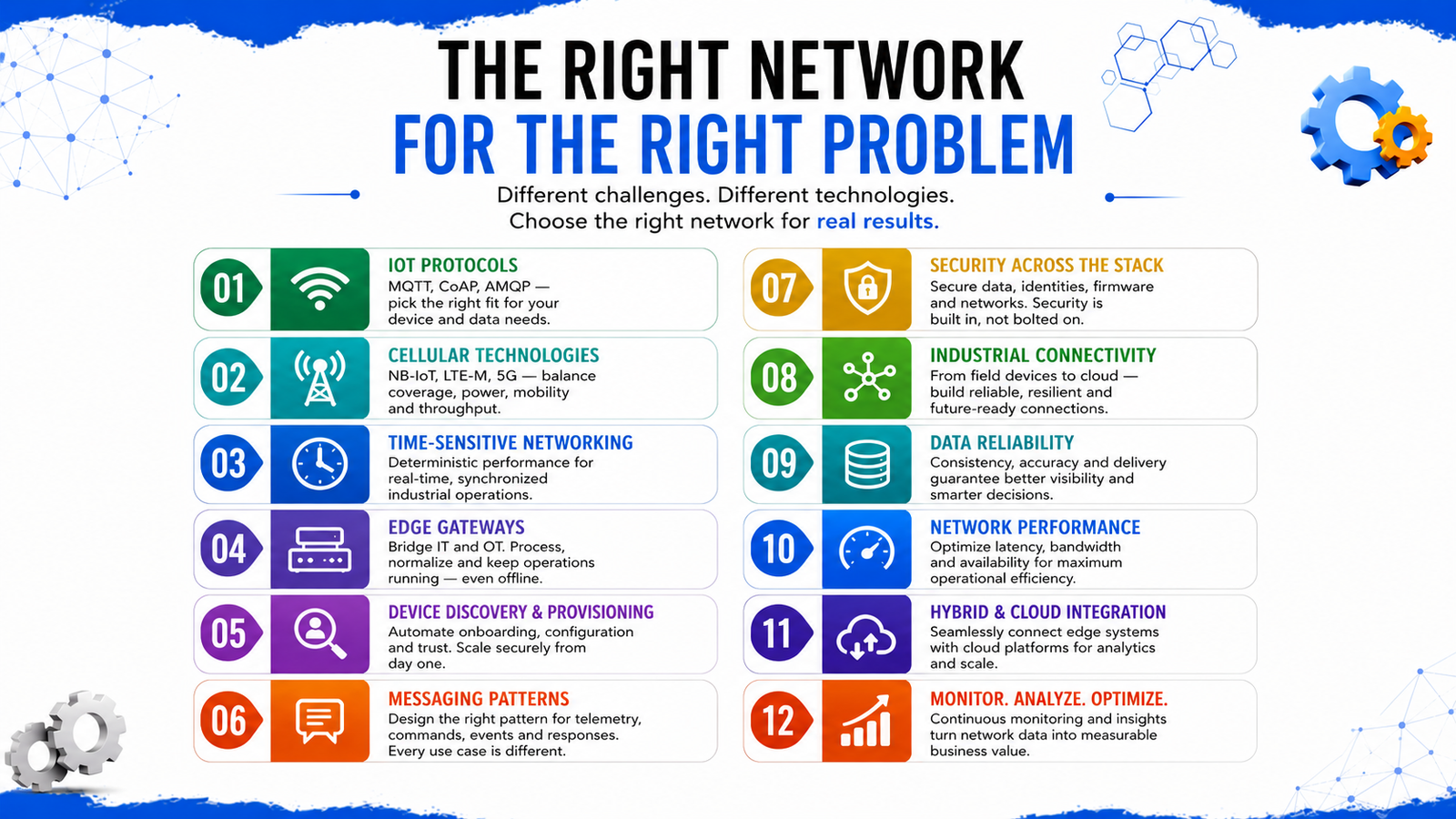
There is no single best IoT network. Instead, engineers need to evaluate several constraints — power consumption, coverage, data volume, latency, mobility, reliability, security, device density, infrastructure availability, deployment environment, product lifetime, and operating cost.
The best architecture is the one that satisfies the actual product requirements — not the one using the newest technology.
MQTT for Scalable IoT Messaging
MQTT has become one of the most widely used messaging protocols in IoT because of its lightweight publish-subscribe architecture. Instead of devices communicating directly with individual applications, messages are typically published to an MQTT broker, and applications subscribe to the topics they need. A basic architecture might look like:
Device → MQTT Broker → Cloud Services / Applications
This creates a useful separation between devices and downstream consumers. But choosing MQTT does not automatically create a reliable IoT system. Engineers still need to design:
- Topic hierarchy
- Quality of Service (QoS)
- Retry behavior
- Session management
- Message retention
- Authentication and authorization
- Offline buffering
- Reconnection logic
For embedded products, the firmware behavior surrounding MQTT can be just as important as MQTT itself.
OPC UA for Industrial IoT Integration
Industrial systems often need more than simple telemetry. Machines, PLCs, SCADA systems, and enterprise applications may need to exchange structured information while preserving context about what that information represents. This is where OPC UA can be valuable — it provides mechanisms for structured industrial information exchange along with security and interoperability features.
Instead of simply transmitting Temperature = 78, an industrial system can preserve additional context about the asset, measurement, equipment structure, and related information. This can reduce brittle, vendor-specific integrations between industrial systems. However, successful OPC UA deployments require more than enabling the protocol — the information model itself needs to be designed carefully.
LoRaWAN for Long-Range, Low-Power IoT
Some IoT products need to operate for years from batteries while communicating across significant distances. In those environments, LoRaWAN can be an effective connectivity option. Typical applications include:
- Agriculture
- Smart metering
- Environmental monitoring
- Remote sensing
- Smart cities
- Infrastructure monitoring
LoRaWAN is optimized for relatively small amounts of data transmitted over long distances with low power consumption. That also means it is not appropriate for every workload — applications requiring high throughput, frequent large messages, continuous streaming, or very low latency may require another technology. Connectivity architecture always involves trade-offs.
NB-IoT vs LTE-M for Cellular IoT
Cellular connectivity is attractive because products can communicate without requiring customers to install local network infrastructure. Two common cellular IoT technologies are NB-IoT and LTE-M.
Commonly suited to applications where priorities include:
- Low power
- Small telemetry payloads
- Stationary or low-mobility devices
- Extended coverage
Examples: meters, infrastructure sensors, and remote monitoring devices.
Better suited to products requiring:
- Greater mobility
- Higher throughput
- Lower latency
- More frequent communication
Attractive for trackers, mobile assets, and more interactive connected products.
The correct choice depends on the deployment rather than simply comparing headline specifications.
Private 5G for Industrial IoT
Private 5G is increasingly considered for factories, campuses, logistics environments, and large operational sites. It can provide organizations with greater control over wireless infrastructure and support demanding connected applications. Potential use cases include:
- Autonomous equipment
- Industrial robotics
- Machine connectivity
- Logistics systems
- Video analytics
- Large-scale industrial sensing
But deploying private 5G does not automatically solve an architecture problem. The devices, gateways, security model, applications, and operational processes still need to be engineered correctly. A faster network cannot compensate for unreliable device firmware or poor system architecture.
Time-Sensitive Networking for Deterministic Communication
Traditional Ethernet networking is generally designed around best-effort data delivery, but some industrial environments require more predictable timing. Time-Sensitive Networking (TSN) extends Ethernet with capabilities intended to support deterministic communication. This can matter when multiple machines or controllers need synchronized communication and bounded latency — applications may include industrial automation, motion control, and robotics.
If network timing directly affects production or safety, deterministic communication needs to be treated as a system requirement — not a networking optimization.
Why Industrial IoT Gateways Matter
An IoT edge gateway can become one of the most important components in a connected architecture. Industrial environments frequently contain equipment using different protocols and communication technologies. For example:
Legacy Machine → Modbus → Gateway → MQTT → Cloud
Another system might use:
PLC → OPC UA → Edge Gateway → Enterprise Platform
Gateways can provide protocol translation, local data processing, data normalization, filtering, aggregation, offline buffering, security boundaries, and cloud connectivity. They also reduce the requirement for every field device to communicate directly with cloud infrastructure.
Designing IoT for Network Failure
One of the biggest mistakes in connected-product development is designing around perfect connectivity. Real networks fail. A production IoT system should define what happens when:
- Cellular coverage disappears
- Wi-Fi becomes unavailable
- DNS fails
- The gateway restarts
- The MQTT broker cannot be reached
- Authentication fails
- The connection drops during transmission
- The cloud service becomes temporarily unavailable
Firmware needs deliberate recovery behavior:
Connection lost → Buffer data → Retry intelligently → Reconnect → Resynchronize → Resume operation
Without this architecture, intermittent networking issues can turn into permanent device failures.
Retry Logic and Backoff Matter
A disconnected device should usually not attempt to reconnect continuously without limits. Imagine 50,000 devices losing connectivity simultaneously and immediately retrying every second — when the service recovers, the infrastructure can be hit by a massive reconnect storm. Production systems often need strategies such as:
- Exponential backoff
- Randomized retry intervals (jitter)
- Retry limits
- Connection-state management
- Local buffering
- Failure escalation
These behaviors are often implemented in firmware, making network reliability an embedded-software problem as much as a cloud problem.
IoT Messaging Patterns Should Match the Data
Not every message has the same importance. A connected product might exchange several distinct data types, and treating them all identically can create unnecessary bandwidth consumption or reliability problems.
Telemetry
Regular measurements and status information.
Events
Something meaningful happened.
Alarms
Something requires immediate attention.
Commands
The platform wants the device to perform an action.
Responses
Confirmation or result of a command.
Configuration
Operational parameters.
Firmware Updates
Potentially large, security-sensitive payloads.
The messaging architecture should reflect the importance, timing, and delivery requirements of each data type.
Device Discovery and Provisioning at Fleet Scale
Connecting one prototype manually is easy. Connecting 10,000 production devices is an operational problem. A scalable IoT device provisioning process needs to answer:
- How does a new device identify itself?
- How are credentials installed?
- How does the platform determine whether the device is legitimate?
- How does it receive configuration?
- Which customer or organization owns it?
- What happens when the device is replaced?
- How are credentials renewed?
- How is a retired device removed?
Manual configuration quickly becomes impractical as the fleet grows. Provisioning therefore needs to be part of the connectivity architecture from the beginning.
Security Across the IoT Network
Connectivity also creates an attack surface, so security needs to exist across the communication lifecycle. Depending on the product, this can include:
- Unique device identity
- Certificate-based authentication
- TLS or DTLS
- Secure credential storage
- Mutual authentication
- Network segmentation
- Access control
- Secure boot and signed firmware
- Secure OTA updates
- Certificate rotation and revocation
The network should not trust a device simply because it knows how to connect. It should verify that the device is authorized to participate in the system.
Matter, Thread, 6LoWPAN, and Mesh Networking
Constrained and smart-device ecosystems introduce another category of connectivity technologies. Matter focuses on interoperability across smart-device ecosystems. Thread provides low-power IPv6-based mesh networking. 6LoWPAN enables IPv6 communication over constrained low-power networks. Routing technologies such as RPL can support constrained network environments.
These technologies can be highly effective when the product requirements match their intended use. But, as with every other IoT protocol, they should be selected because they solve a specific system constraint — not simply because they are modern.
DDS and Real-Time Distributed Systems
Some connected systems have stricter real-time and distributed communication requirements. Data Distribution Service (DDS) provides a data-centric publish-subscribe architecture commonly associated with distributed and real-time systems. It can be useful where applications require more control over factors such as reliability, latency, discovery, and Quality of Service. Again, the architecture should begin with operational requirements — the protocol comes afterward.
Edge vs Cloud Connectivity
Not every decision needs to reach the cloud. Consider an industrial safety condition: if a sensor detects a dangerous operating state, sending that measurement to the cloud and waiting for a response may be unnecessary or unacceptable — the edge device or controller may need to act immediately. Meanwhile, the cloud can receive the event for logging, analytics, fleet monitoring, reporting, and long-term optimization. This creates a hybrid architecture:
Device → Edge Decision → Gateway → Cloud Analytics
The edge handles immediacy. The cloud handles scale and broader context.
How to Choose the Right IoT Connectivity Architecture
Before selecting a networking technology, teams should answer several questions.
What Is the Power Budget?
Battery-powered devices have very different networking constraints from permanently powered gateways.
How Much Data Needs to Move?
A temperature sensor and an industrial camera cannot be treated as equivalent network endpoints.
How Fast Must the System Respond?
Some telemetry can arrive seconds later without consequence; a safety-related control message may not have that flexibility.
Will the Device Move?
Mobility can significantly influence cellular and wireless technology selection.
How Reliable Is Connectivity?
Remote sites, factories, vehicles, basements, farms, and urban environments all create different RF and network conditions.
What Happens Offline?
The product should have defined behavior when the network disappears.
How Will Devices Be Provisioned?
The onboarding process needs to work at the intended fleet size.
How Long Will the Product Be Deployed?
Connected hardware may run for years, so network availability, carrier support, certificates, firmware updates, and technology migration should be considered across the lifecycle.
Common IoT Networking Mistakes
Building Reliable IoT Connectivity with MetaDesk Global
At MetaDesk Global, we approach connectivity as part of the complete connected-product architecture. A reliable IoT system may involve:
- Embedded firmware
- PCB and hardware design
- Wi-Fi and Bluetooth
- Cellular IoT
- MQTT
- Industrial communication
- IoT gateways
- Edge computing
- Cloud integration
- Device provisioning
- Security
- OTA updates and fleet management
The objective is not simply to make the device connect once. It is to make the product connect, recover, authenticate, communicate, update, and remain manageable throughout its operational life.
Frequently Asked Questions
Final Thoughts: The Best IoT Network Is the One That Survives Reality
IoT networking is easy to underestimate because successful communication during development feels like the problem has been solved. Production tells a different story: networks disappear, devices move, coverage changes, gateways restart, credentials expire, infrastructure evolves, and fleets grow. A strong IoT connectivity architecture anticipates those conditions before deployment.
MQTT, OPC UA, LoRaWAN, LTE-M, NB-IoT, private 5G, Thread, DDS, and other technologies are tools. The architecture determines whether those tools create a reliable product. Don’t choose connectivity around a feature list — choose it around the environment, failure modes, product lifecycle, and decisions the system needs to make.
Because in a connected product, the network isn’t just how data travels. It’s part of whether the product works at all.
Connectivity is one layer of the stack. For the full picture, from MQTT and CoAP to Zigbee, Thread and LoRaWAN, see our complete list of IoT protocols by layer.