



“How much does AI automation cost?” is the question every business asks first and almost no vendor answers directly. The honest answer is that the build is rarely the expensive part — integration, data cleanup and running costs are — and that is exactly why so many budgets are wrong.
This guide gives the actual market ranges in 2026, explains what moves a project from the cheap end to the expensive end, and shows how to work out whether a specific process is worth automating before you ask anyone for a quote.
What AI Automation Actually Costs in 2026
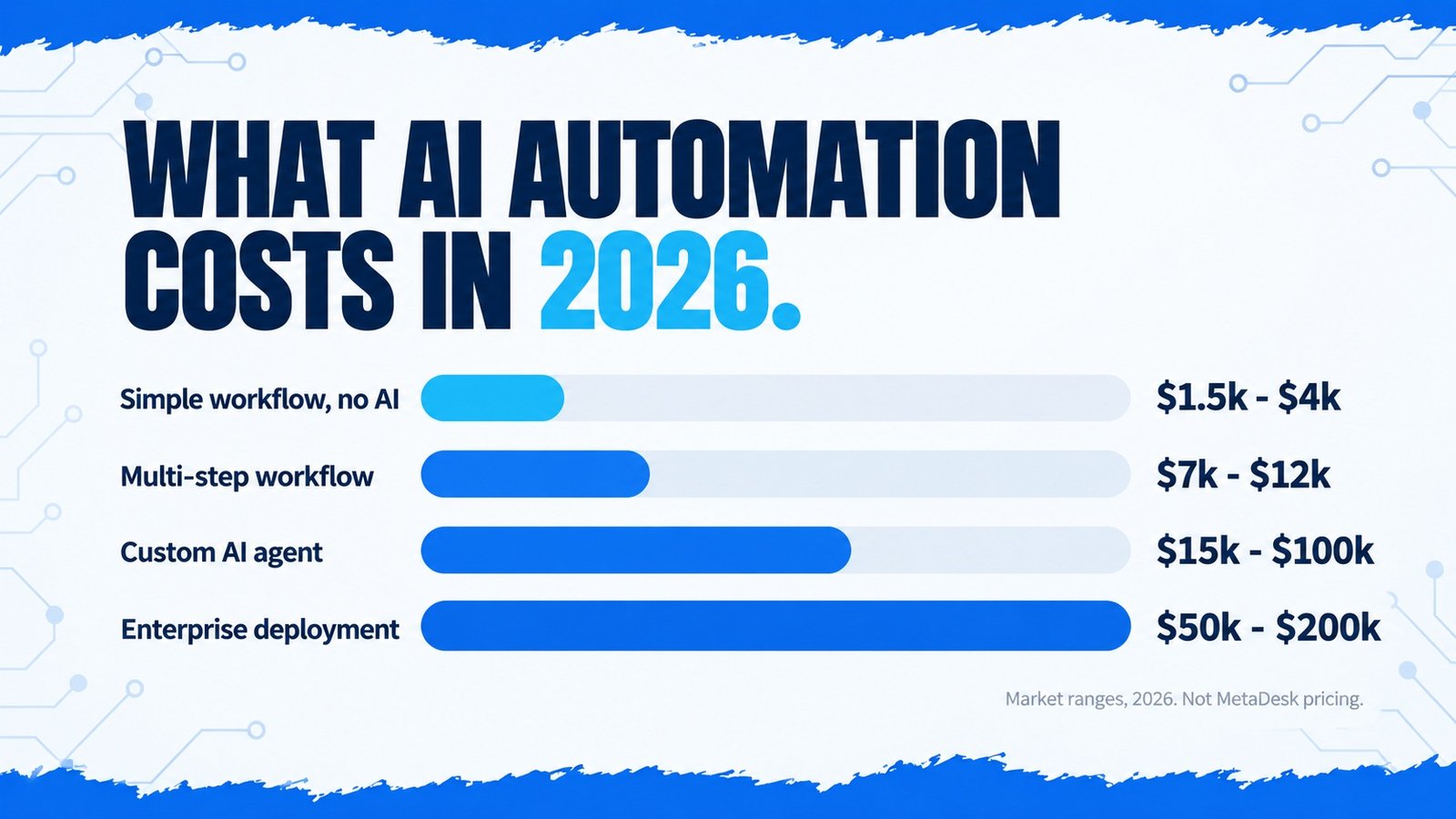
Published market data and agency pricing cluster into fairly consistent bands. Treat these as the shape of the market rather than a quote for your project.
| Scope | Typical build cost | What you get |
|---|---|---|
| Simple workflow, no AI | $1,500–$4,000 | Two or three steps connecting existing tools |
| Multi-step workflow, several systems | $7,000–$12,000 | Real integration, branching logic, error handling |
| Custom AI agent, mid-sized business | $15,000–$100,000 | Discovery, development, integration, deployment |
| Enterprise agent deployment | $50,000–$200,000 | Governance, audit, multiple integrations, scale |
| First AI project, typical enterprise | $40,000–$400,000 | Includes the organisational work, not just software |
Running costs matter as much as build costs and are more often forgotten: expect roughly $3,000–$13,000 per month for an enterprise agent deployment, and a much smaller but non-zero figure for a single workflow. Small businesses running a handful of automations frequently operate for well under that.
A build quote without a monthly running figure attached is an incomplete quote.
What Moves a Project From Cheap to Expensive
The single largest factor is which kind of automation the process actually needs — a fixed rule, a workflow with AI at the understanding step, or an agent that chooses its own actions. The difference is explained in AI automation vs RPA vs AI agents, and it can move a quote by an order of magnitude.
How many systems it has to touch
The single biggest driver. A workflow inside one platform is cheap. The same logic spanning your CRM, accounting software and a twelve-year-old internal database is a different project — most of the cost is in the connections, not the AI.
Systems with a clean, documented API are inexpensive to integrate. Systems without one need workarounds, and those workarounds are where quotes expand.
How clean and consistent your data is
Automation reads your data as it is, not as the process documentation describes it. Inconsistent formats, duplicate records, free-text fields holding structured information — each one adds handling logic.
Teams routinely discover that the automation project is partly a data cleanup project. That work is real and should be scoped rather than absorbed quietly.
What accuracy the process demands
Getting to roughly 80 percent accuracy is usually fast. Getting to 95 percent costs considerably more, and getting to 99 percent can cost more than the previous two combined.
The right target depends on consequence. Routing a support ticket wrongly is an inconvenience; mis-posting an invoice is not. Specify the number you actually need, because paying for accuracy nobody requires is one of the easiest ways to waste budget.
Whether humans stay in the loop
An automation that drafts work for approval is substantially cheaper than one trusted to act alone, because full autonomy requires guardrails, audit trails, bounded authority and a tested rollback path. Human-in-the-loop is often the better value as well as the cheaper option.
Where it has to run
Cloud SaaS platforms are quickest and cheapest to start on. If your data cannot leave your own infrastructure — a common requirement in healthcare, finance and manufacturing — self-hosting adds setup and maintenance but removes per-task platform fees, which can reverse the economics at high volume.
How much the process is about to change
Automating a process that is being redesigned next quarter means paying twice. Stability is a genuine cost factor and rarely appears on anyone’s checklist.
The Line Items Quotes Usually Miss
Surveys consistently find organisations overshooting AI budgets — one widely cited figure is that 85 percent of organisations miss their forecast by more than 10 percent, with real costs often landing several times above the initial quote. The overrun is almost always in the same places.
Working Out Whether It Is Worth It
You can do this on one page, before contacting any vendor.
- Volume. How many times per month does this process run?
- Time. How many minutes does one run take a person, honestly measured rather than estimated?
- Loaded cost. What is an hour of that person’s time worth to the business, including overhead?
- Error cost. What do mistakes in this process cost per month — rework, credits, delays?
- Realistic automation share. What proportion can genuinely be automated? Assume 70–80 percent, not 100, because exceptions stay human.
Annual saving is then roughly: volume × minutes × hourly cost × automation share, plus the error cost avoided. Compare that against build cost plus twelve months of running cost.
A worked example: 400 invoices a month, 6 minutes each, at $30 an hour loaded, 75 percent automatable. That is 400 × 0.1 hours × $30 × 0.75 = $900 a month, or $10,800 a year, before counting error reduction. Against a $9,000 build and $200 a month running cost, it pays back inside about fourteen months and saves meaningfully after that.
If the payback is longer than two years on your own numbers, automate something else first.
How to Get a Quote You Can Trust
A cheap quote for the wrong process is the most expensive outcome available, so it is worth checking the project against the usual causes of AI automation project failure before you sign anything.
Frequently Asked Questions
Conclusion
AI automation costs what the integration costs. The model is usually the cheapest component, and the expensive parts — connecting systems, cleaning data, handling exceptions, keeping it running — are the ones missing from optimistic quotes.
Work out the economics for one specific process using your own volume and time figures before you speak to anyone. If the payback is under two years, it is worth doing. If it is not, find a better first candidate rather than a cheaper vendor.