




When a company ships a connected product, it is not simply deploying hardware. Every device also becomes a new digital identity interacting with networks, cloud services, APIs, MQTT brokers, gateways, and other infrastructure.
For a prototype, managing that identity may appear straightforward. For a fleet of thousands — or hundreds of thousands — of connected devices, it becomes a fundamental IoT security architecture problem. A production system needs to know:
- Which device is connecting?
- Can we prove that it is genuine?
- What resources should it be allowed to access?
- What happens if its credentials are compromised?
This is why IoT device identity should be designed into a connected product from the beginning.
What Is IoT Device Identity?
IoT device identity is the mechanism that allows a system to uniquely identify and authenticate a physical device. Instead of every device sharing the same username, password, or API key, each unit should ideally have its own cryptographic identity. Depending on the architecture, this may involve:
- Unique device certificates
- Public/private key pairs
- Hardware-backed credentials
- Secure elements
- Device-specific secrets
- Trusted manufacturing records
Device → Present Identity → Authenticate → Authorize → Access Service
This creates the foundation for deciding whether a device should be trusted.
Why Shared Credentials Are Dangerous
One of the simplest approaches during development is placing the same credential inside every device. It is also difficult to manage securely at fleet scale. If 10,000 devices share one secret and that credential is compromised, the security problem potentially affects the entire fleet.
Unique identities limit that exposure. If one device becomes compromised, its identity can potentially be revoked without invalidating every other device. This is an important principle of scalable IoT fleet security:
One device should not represent the security boundary of the entire fleet.
The IoT Device Identity Lifecycle
Device identity should not be treated as a credential created once and forgotten — it has a lifecycle:
Manufacturing → Provisioning → Authentication → Authorization → Rotation → Revocation → Decommissioning
The first three stages establish and enforce trust every time a device connects.
Secure Device Provisioning
Provisioning establishes the initial trust relationship between the physical device and the platform — during manufacturing, first boot, installation, or customer onboarding. The system may provision device identifiers, cryptographic keys, certificates, cloud endpoints, ownership information, and initial configuration.
The important principle is that every production device should be uniquely identifiable. Manual provisioning may work for ten prototypes; it becomes an operational problem when manufacturing thousands of units.
Device Authentication
After provisioning, the platform needs to verify that a connecting device really owns the identity it claims. Certificate-based authentication is one common approach — for example, an IoT device communicating with an MQTT broker may use mutual TLS (mTLS), where the device validates the server and the server validates the device. This creates stronger trust than simply accepting a connection because it originates from the expected network.
Device Authorization
Authentication answers “who are you?” Authorization answers “what are you allowed to do?” These are different problems. A temperature sensor may need permission to publish telemetry but should not be able to modify another device’s configuration, and one customer’s device should not access another customer’s data. Permissions should follow the principle of least privilege — give each device only the access required to perform its intended function.
Protecting Device Credentials
Strong authentication becomes ineffective if private credentials can easily be extracted from the hardware. Connected-product security should therefore consider how keys are stored. Depending on the hardware and threat model, credentials may be protected using:
- MCU security features
- Secure elements
- Trusted execution environments
- Hardware-backed key storage
- Protected flash regions
- Readout protection
Where possible, sensitive private keys should be difficult to extract even if someone obtains physical access to the device. This connects PCB design, hardware selection, firmware architecture, and cloud security into the same security model.
Certificate Rotation and Renewal
Connected products may remain deployed for five, ten, or more years, and credentials should not be assumed to remain unchanged throughout that entire lifetime. Certificates can expire, security policies change, cryptographic requirements evolve, and devices can change ownership.
A scalable IoT certificate management architecture therefore needs mechanisms for credential renewal and rotation. The system should be able to securely establish new credentials without requiring technicians to physically access every deployed device — a capability that becomes increasingly important as the fleet grows.
Revoking Trust from an IoT Device
Provisioning determines how trust begins. Revocation determines how trust ends. Suppose a device is stolen, compromised, replaced, decommissioned, transferred, or behaving suspiciously — the platform needs a way to stop trusting that individual identity.
This is one of the major benefits of unique per-device credentials. Instead of changing a shared secret across an entire fleet, the organization can isolate the affected device. A complete IoT security strategy therefore needs both:
A way to establish trust — and a way to remove trust.
Device Attestation: Is the Device Still Trustworthy?
Authentication can confirm that a device possesses a valid credential. But another question may remain: is that device running the software we expect? This is where device attestation can become valuable.
Depending on the hardware and security architecture, attestation can provide evidence about the state or integrity of a device. This can help higher-security systems determine not only “which device is this?” but also “should we currently trust its software state?” Attestation is not required for every IoT product, but it can become important in higher-assurance deployments.
Secure Boot and Device Identity Work Together
Device identity should not exist in isolation. Consider a device with perfectly protected credentials but completely unverified firmware — if an attacker can replace the firmware, those legitimate credentials may be used by malicious software. Secure Boot helps prevent unauthorized firmware from running by verifying software before execution. Together, these layers form a stronger architecture than any single mechanism alone:
Secure Boot → trust the software • Device Identity → trust the device • Authentication → verify the connection • Authorization → limit what it can do
Secure OTA Updates Are Part of IoT Identity Security
Devices deployed for years will eventually need software updates, so OTA becomes another part of the trust chain. A secure OTA architecture should verify that firmware is authentic and authorized before installation. Depending on the product, this can involve:
- Signed firmware images
- Secure Boot
- Encrypted communication
- Version validation
- Anti-rollback protection
- A/B partitions
- Recovery mechanisms
The device must be able to trust the update, and the platform must also be able to trust the device receiving it. This makes OTA security and device identity closely connected lifecycle problems.
Why IoT Fleet Security Gets Harder at Scale
Securing ten development boards is different from securing 100,000 production devices. At fleet scale, teams need visibility into questions such as:
- Which devices are active?
- Which certificates are approaching expiration?
- Which firmware versions are deployed?
- Which devices have failed authentication?
- Which identities have been revoked?
- Which devices are behaving unexpectedly?
- Which units have been decommissioned?
This turns device security into an operational discipline. Security does not end when the hardware leaves the factory — in many ways, that is when the real lifecycle begins.
Common IoT Device Identity Mistakes
Designing Secure IoT Products from the Beginning
Security becomes more difficult and expensive when added late in development. Before production, teams should define:
- How will every device receive a unique identity?
- Where will private credentials be stored?
- How will devices authenticate?
- What permissions will each device receive?
- How will certificates be renewed?
- How will compromised devices be revoked?
- How will firmware updates be authenticated?
- What happens when the product reaches end-of-life?
These questions affect hardware, firmware, manufacturing, cloud infrastructure, and operational processes — so they should be considered during product architecture, not after deployment.
Building Secure Connected Products with MetaDesk Global
A secure connected product requires coordination across multiple engineering layers. At MetaDesk Global, we approach IoT development across the complete product stack:
Hardware → PCB → Embedded Firmware → Device Identity → Connectivity → Cloud → OTA → Fleet Management
Depending on the product, this can include:
- Embedded hardware and PCB development
- MCU and Embedded Linux firmware
- Secure Boot integration
- Device provisioning
- Certificate-based authentication
- Secure credential storage
- IoT connectivity and cloud integration
- Secure OTA updates
- Device and fleet management
The objective is not simply to make a device connect securely on the development bench — it is to build an architecture capable of maintaining trust throughout the product’s operational lifetime.
Final Thoughts: Every Connected Device Is an Identity
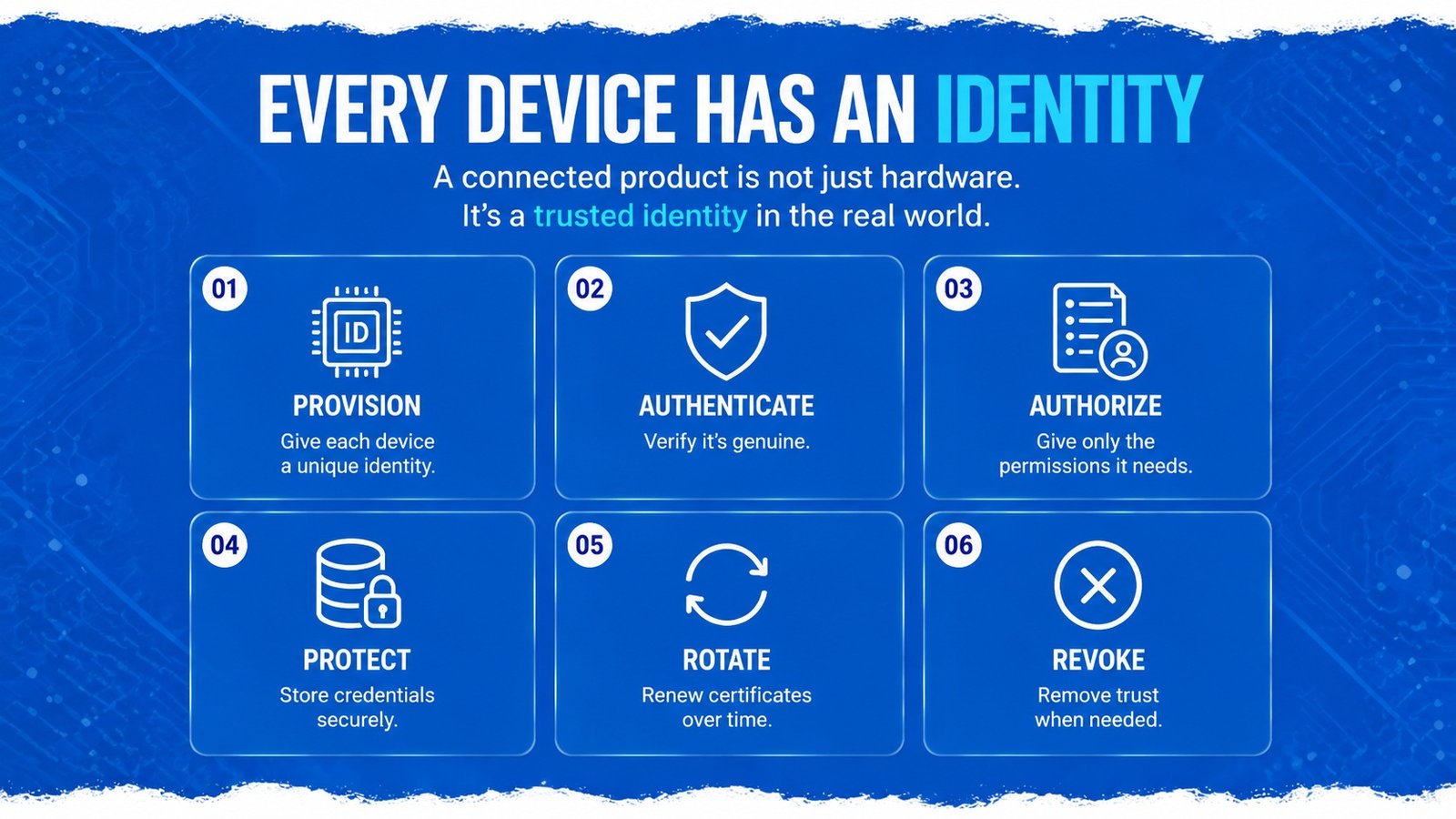
The security challenge changes when an IoT product moves from prototype to fleet. A single connected device is hardware; thousands of connected devices are also thousands of identities interacting with infrastructure every day. Those identities need to be created, authenticated, authorized, protected, rotated, revoked, and eventually retired:
Provision → Authenticate → Authorize → Protect → Rotate → Revoke
IoT security therefore isn’t only about protecting data in transit or patching vulnerabilities. It is also about knowing exactly which devices your infrastructure is trusting — and why. Because when you ship a connected fleet, you are also shipping an identity system.