




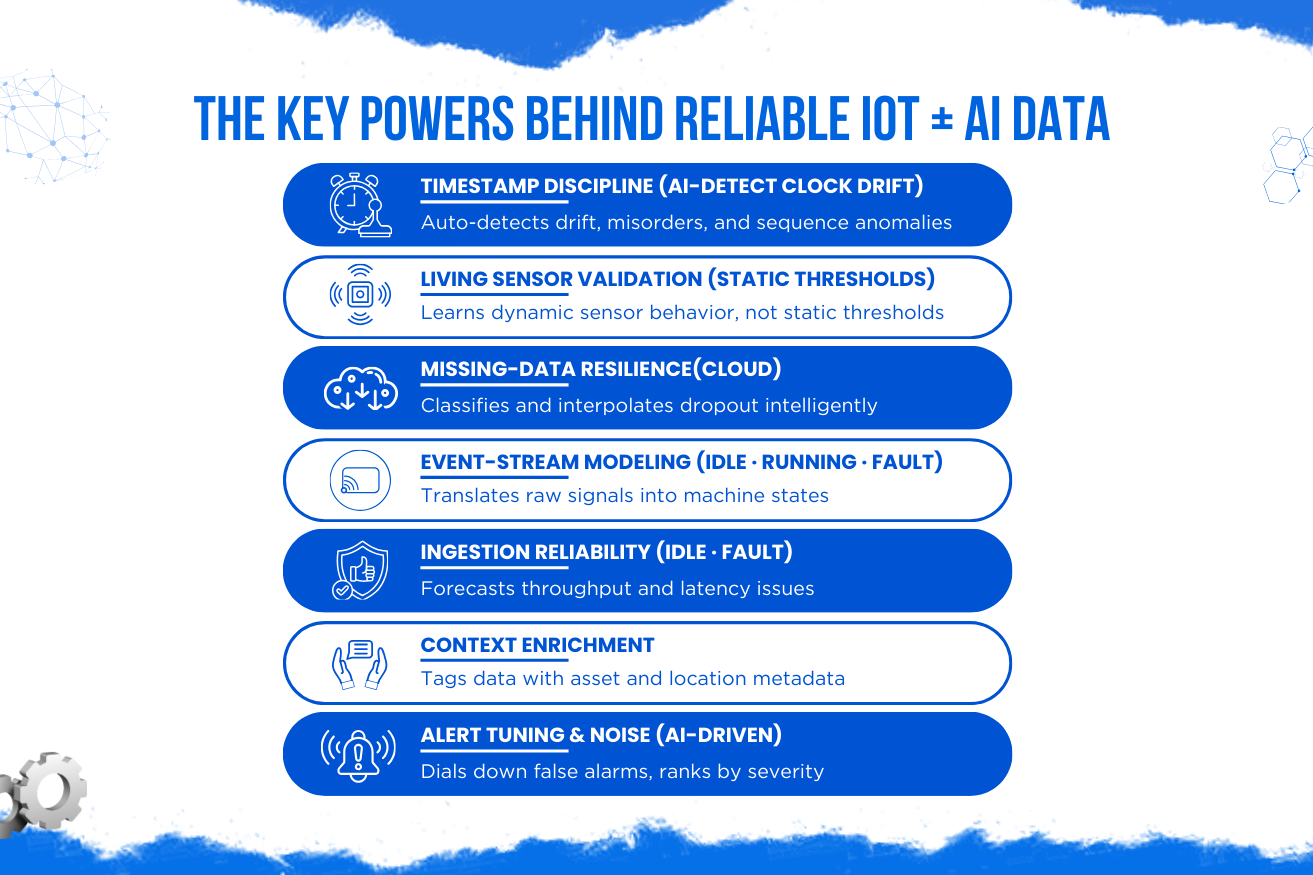
When an AIoT system behaves unpredictably in production, the instinct is to look at the model. Retrain it, tune it, swap the architecture. In our experience that is almost never where the problem lives.
The model is downstream of everything. What actually determines whether an AIoT system can be trusted is the quality of seven specific properties in the data reaching it. Get those right and a simple model performs reliably for years. Get them wrong and no amount of modelling sophistication will rescue the result.
This article defines those seven data properties — what each one means in a connected-device context, how it fails, and how to verify it before it costs you a deployment.
Why Data Properties Decide AIoT Reliability
An AIoT system makes decisions about the physical world using measurements of the physical world. Every one of those measurements passes through a sensor, a firmware routine, a radio link, a queue, and a storage layer before a model ever sees it. Each stage can distort it.
Traditional machine learning assumes a reasonably clean, static dataset. Connected systems break that assumption constantly:
- Sensors drift, age, and get installed incorrectly
- Devices lose connectivity and backfill out of order
- Firmware versions change the meaning of a field mid-fleet
- The environment itself shifts, so yesterday’s normal is not today’s
The seven properties below are the defences against exactly these effects. Treat them as system requirements, not as data-science housekeeping.
The 7 Data Powers Behind Reliable AIoT Systems
Provenance — knowing exactly where a value came from
Every reading should be traceable to a specific device, sensor, firmware version, calibration state, and physical installation. Without provenance you cannot explain a prediction, isolate a bad batch of hardware, or safely exclude a faulty unit from training.
- Device identity is assigned at install rather than in the factory, so records get reassigned
- Firmware version is not attached to the data, hiding a change in measurement behaviour
- Sensor replacements are not logged, so a step change looks like a real trend
Verify it: pick any single anomalous reading in your database and try to identify the exact hardware and firmware that produced it. If that takes more than a minute, provenance is missing.
Timeliness — the age of a value when it is used
In AIoT, a correct value that arrives too late is simply a wrong value. A vibration reading that supports a shutdown decision is useful at 200 ms and worthless at 200 seconds.
Timeliness has two separate components teams often conflate: event time (when the phenomenon happened) and ingest time (when the platform received it). Both must be recorded. Models trained on ingest time will silently learn network behaviour instead of physical behaviour.
Verify it: plot the distribution of ingest time minus event time across the fleet. A long tail means some decisions are being made on stale inputs.
Completeness — knowing what is missing and why
Gaps in IoT data are guaranteed. The problem is not the gap; it is a gap that is invisible or silently filled. A dashboard that interpolates across a six-hour outage looks healthier than reality, and a model trained on interpolated values learns a world that never existed.
- Device offline — no measurement was taken
- Measurement failed — the sensor returned an error
- Transport lost — the value existed but never arrived
These mean very different things operationally and should never collapse into a single null.
Consistency — the same field meaning the same thing everywhere
Fleets drift into inconsistency almost by default. One firmware revision reports temperature in tenths of a degree, another in whole degrees. A field renamed in a later release leaves two columns describing one quantity. A supplier change alters a sensor’s response curve without any code changing at all.
Consistency is enforced by contract: a versioned schema, validation at ingest, and a rule that meaning changes require a new field rather than a redefined one.
Context — the conditions under which a reading is valid
A raw number carries almost no information on its own. 78°C is alarming on an idle motor and unremarkable on one under full load in summer. Context is the operating state, ambient conditions, asset configuration, and duty cycle that make a measurement interpretable.
Most weak AIoT models are not weak because the algorithm is poor. They are weak because they were given readings without the context that explains them, and were therefore asked to infer something genuinely unknowable.
Governance — who may use which data, for what
Connected systems collect data about places, machines, and often people. Governance defines retention, access, residency, anonymisation, and the permissions under which data may train a model.
Teams that treat this as a launch-day legal task usually discover that their most valuable training set was collected without a basis for using it that way. Governance is cheapest when it is designed into ingestion, alongside device security, rather than retrofitted.
Feedback — recording what actually happened next
This is the property most often missing entirely. A system predicts a bearing failure. Did the bearing fail? Was maintenance performed? Was the alert ignored? If the outcome is never written back, the system can never measure its own accuracy or improve.
Feedback turns a static model into a system that learns. Without it, accuracy quietly decays and nobody can prove it, because there is nothing to compare predictions against.
Matching Symptoms to the Missing Property
When an AIoT system misbehaves, the symptom usually points to a specific missing property rather than to the model.
| Symptom in production | Property most likely missing |
|---|---|
| Accuracy was fine in testing, poor after rollout | Consistency — fleet data differs from the training set |
| Model works on some devices, not others | Provenance — a hardware or firmware cohort behaves differently |
| Alerts arrive too late to act on | Timeliness — decisions are made on stale values |
| Confident predictions during outages | Completeness — gaps are being interpolated away |
| High false-positive rate | Context — operating state is not available to the model |
| Accuracy slowly degrades over months | Feedback — drift is invisible because outcomes are not recorded |
| Legal or customer objection blocks a feature | Governance — no basis for the intended use of the data |
Working the table in this direction is far faster than retraining and hoping. It also tends to produce fixes that hold, because the underlying cause is addressed rather than compensated for.
Building the Seven Properties Into a System
These properties are established at the point of collection. Retrofitting them onto historical data is usually impossible, which is why they belong in the firmware and ingest design rather than the analytics layer.
Models are replaceable in an afternoon. The data properties beneath them take years to fix. Build for the layer that is expensive to change.
Once these seven properties hold, the intelligence layer becomes a genuine choice rather than a gamble — and progressing through the stages of AIoT intelligence stops requiring a rebuild each time.
Frequently Asked Questions
Conclusion
Reliable AIoT is far less about model sophistication than most teams expect. It is about whether every value entering the system can be traced, timed, trusted, interpreted, governed, and checked against what actually happened.
Provenance, timeliness, completeness, consistency, context, governance, and feedback are not analytics chores. They are architectural commitments made at the firmware and ingest layer, and they are what separate a system that quietly earns trust from one that quietly loses it.