




Connected devices generate enormous amounts of data. Temperature, vibration, current, pressure, energy consumption, location, equipment status, and environmental conditions can all be measured continuously. But collecting more data does not automatically create more value.
The real opportunity begins when connected systems can use that information to detect problems, predict future conditions, optimize operations, and support better decisions. That is the evolution behind AIoT — the Artificial Intelligence of Things. AIoT combines IoT connectivity with artificial intelligence and Edge AI to move connected products from passive monitoring toward intelligent action. A useful way to understand this journey is:
Monitor → Detect → Predict → Optimize → Control → Adapt
What Is AIoT?
AIoT combines Artificial Intelligence (AI) and the Internet of Things (IoT). Traditional IoT systems typically collect sensor data and send it to gateways or cloud platforms for monitoring, dashboards, alerts, and predefined automation. AIoT adds another intelligence layer — machine-learning models can analyze device data to identify patterns, detect unusual behavior, predict outcomes, and optimize decisions. A typical architecture might look like:
Sensors → Embedded Device → Edge AI → Connectivity → Cloud → Application → Action
The exact architecture depends on the product, latency requirements, connectivity, available computing resources, and business objective.
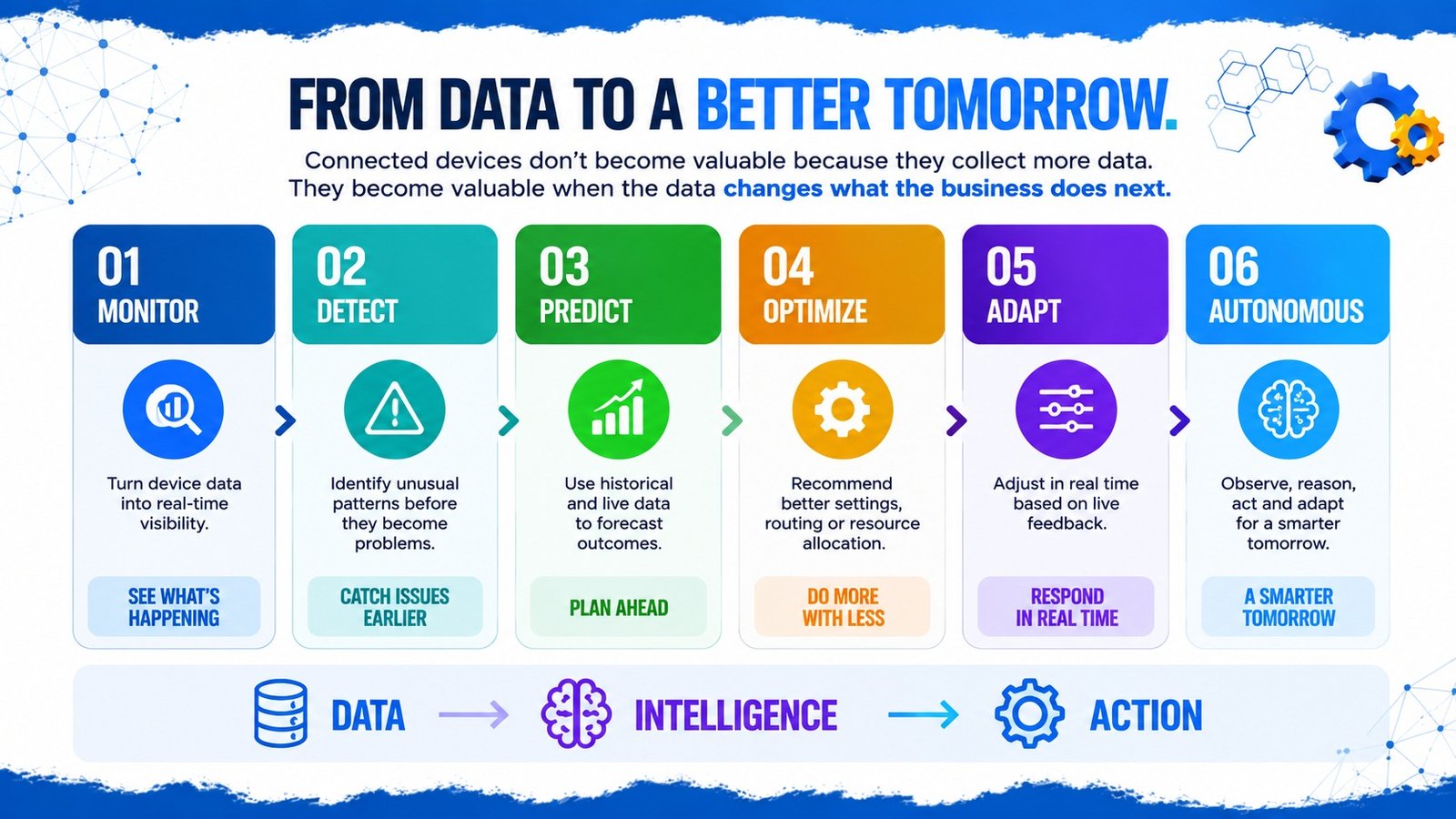
The AIoT Journey: Six Stages of Intelligence
AIoT intelligence develops in stages, each building on the reliability of the one before it. Not every product needs to reach the final stage — often, earlier stages deliver most of the value with far less complexity. For a deeper breakdown of each stage, see our guide to the levels of AIoT intelligence.
Intelligent IoT Monitoring
Reliable monitoring is the foundation of any AIoT system. Connected sensors provide visibility into equipment and environments through dashboards, alerts, trends, equipment status, and remote diagnostics. Monitoring answers what is happening? Before adding AI, the underlying sensor data must be accurate and trustworthy — poor measurements create poor intelligence regardless of how sophisticated the model is.
AI-Based Anomaly Detection
Traditional IoT systems frequently depend on fixed thresholds — for example, Temperature > 80°C → send alert. But many problems develop gradually and involve relationships between multiple signals. An anomaly detection model could analyze temperature, vibration, current, load, and operating history together to identify behavior that differs from normal operation, providing earlier warning before a developing issue becomes downtime or equipment failure.
Predictive Intelligence & Predictive Maintenance
Once a system can understand current behavior, the next step is anticipating what may happen next. AIoT systems can combine historical and live data to forecast:
- Equipment degradation and failure risk
- Maintenance requirements
- Energy demand
- Battery health
- Operational conditions
This makes predictive maintenance one of the most valuable industrial AIoT applications — instead of maintaining equipment only after failure or on a fixed schedule, teams can decide based on the actual condition of the asset.
AI-Driven Optimization
Prediction tells teams what might happen. Optimization asks what should we change? AI-enabled connected systems can use operational data to recommend improvements to machine settings, energy consumption, maintenance schedules, production processes, resource allocation, and routes/logistics. This is where connected-device analytics starts moving beyond visibility and toward measurable operational improvement.
Adaptive Control with Edge AI
Some systems need to do more than recommend an action — they need to respond. The feedback loop becomes:
Sense → Analyze → Decide → Act → Measure
This is where Edge AI becomes especially useful. Running inference on the device or a nearby edge gateway can reduce latency and keep important functions running when cloud connectivity is unavailable (for example, Machine Sensors → Edge AI → Local Decision → Machine Control), while the cloud handles heavier tasks such as historical analytics, model training, fleet monitoring, and long-term optimization.
Toward Autonomous AIoT
The most advanced AIoT systems can potentially observe their environment, make decisions, act, evaluate the result, and adapt — observe → reason → act → evaluate → adapt. However, autonomy should not be the goal of every IoT product. As systems receive greater control over physical processes, requirements around safety, cybersecurity, model validation, fail-safe operation, monitoring, and human oversight become increasingly important. Sometimes reliable anomaly detection or prediction creates more value than full autonomy.
Edge AI vs Cloud AI in AIoT
One of the most important architectural decisions is determining where intelligence should run.
Processing close to the device can provide:
- Lower latency
- Offline operation
- Reduced bandwidth
- Faster local decisions
- Better privacy
Valuable for industrial equipment, vehicles, and remote monitoring that need immediate responses.
Cloud infrastructure is useful for:
- Model training
- Historical analytics
- Fleet-wide intelligence
- Large-scale data processing
- Cross-device pattern analysis and model management
Many production systems therefore use a hybrid architecture — the edge handles fast local intelligence while the cloud handles fleet-wide intelligence:
Edge AI → Fast local intelligence • Cloud AI → Fleet-wide intelligence
The question should not simply be edge or cloud? It should be: where does each decision need to happen?
Why Reliable Embedded Engineering Still Matters
AI cannot compensate for unreliable hardware or poor data. An AIoT system still depends on the full chain:
Sensors → PCB → Firmware → Connectivity → Data → AI
Problems with sensor placement, calibration, sampling, power integrity, connectivity, or firmware can directly affect AI performance. This is why AIoT development requires coordination across embedded hardware, firmware, networking, cloud infrastructure, and machine learning — the intelligence layer is only as reliable as the engineering underneath it.
Common AIoT Development Mistakes
Several problems appear repeatedly when teams add AI to connected products.
Building AIoT Solutions with MetaDesk Global
Building a production AIoT product requires more than connecting a machine-learning model to sensor data. The complete engineering stack can include:
Sensors → Electronics → PCB → Firmware → Connectivity → Edge AI → Cloud → Application
At MetaDesk Global, we work across connected-product development, including embedded hardware and PCB design, firmware development, IoT connectivity, Edge AI integration, cloud communication, IoT security, OTA updates, and device management. Our focus is on building intelligent connected products where the hardware, firmware, connectivity, and intelligence layers work together as one system.
From IoT Data to Real-World Action
The evolution of AIoT can be summarized simply:
Monitor → Detect → Predict → Optimize → Control → Adapt
Not every connected product needs to reach the final stage. The right level of intelligence depends on the problem being solved, the available data, system constraints, and the value each additional layer creates. The goal should not be to put AI into every IoT device — it should be to identify where intelligence can make the product or operation meaningfully better.
Because the future of connected products is not about generating more data. It is about turning the right data into better decisions — and better decisions into real-world action.