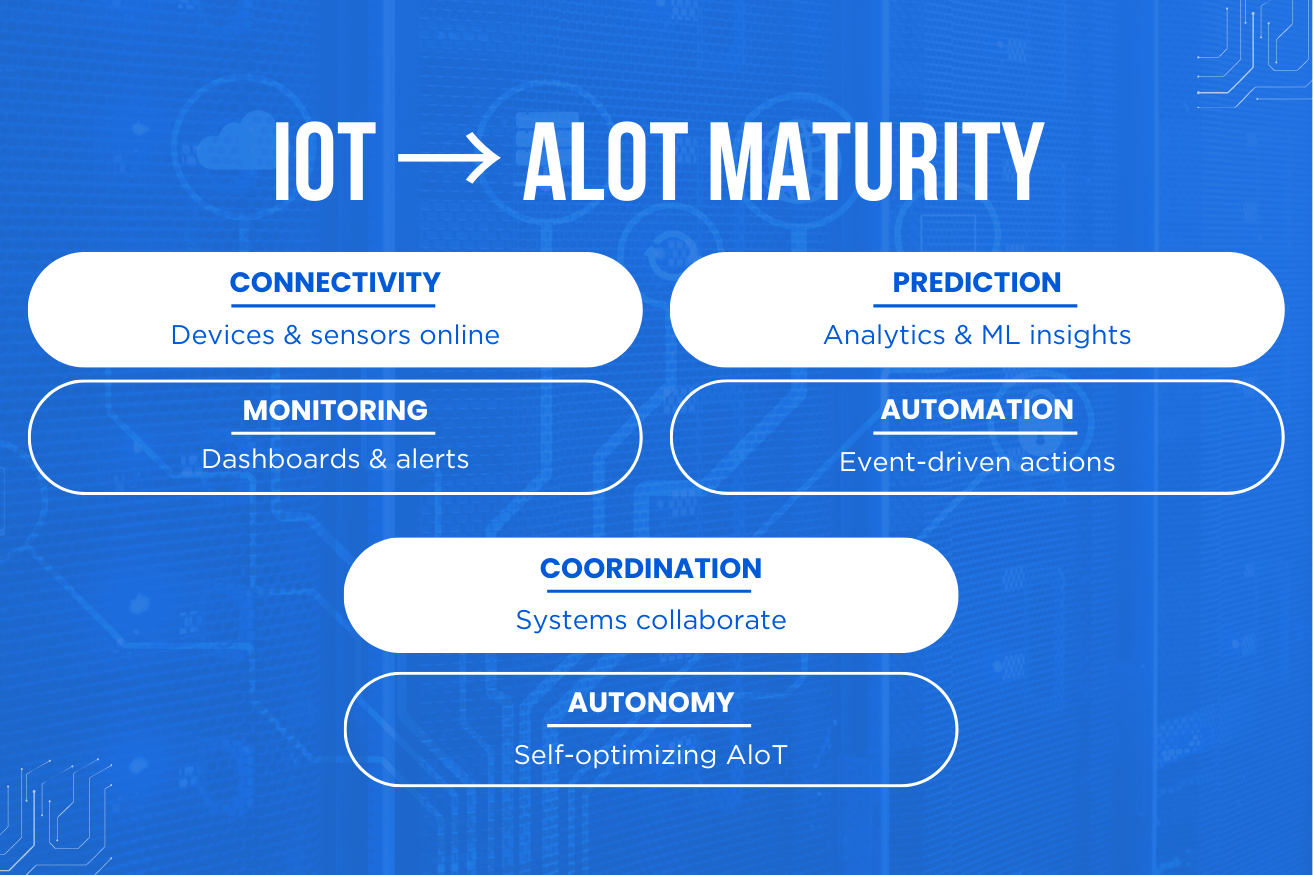
The journey from basic IoT connectivity to fully autonomous AIoT systems does not happen overnight. Many organizations invest in connected devices and dashboards expecting automation to naturally emerge. In reality, IoT intelligence evolves in structured layers — each adding awareness, prediction, and operational autonomy.
Understanding where your architecture sits in this maturity curve is critical for scaling IoT successfully and unlocking real ROI.
This guide explains the six layers of IoT intelligence maturity and how businesses can progress toward autonomous AIoT systems.
Why IoT Projects Stall Before Reaching Automation
Across industries, many IoT deployments stop at data collection and visualization. Sensors stream telemetry, dashboards display metrics, and alerts notify operators — but operations remain manual.
The reason is simple: automation is not a feature — it is an architectural progression.
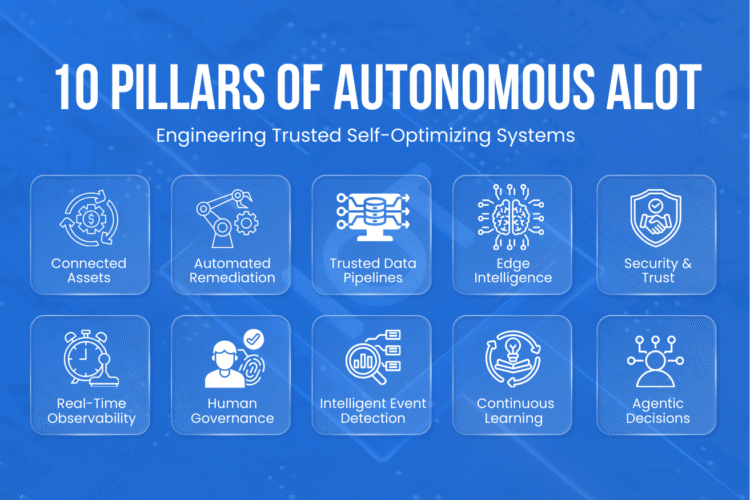
Autonomous IoT requires:
- Reliable connected devices
- Clean and contextualized data pipelines
- Predictive analytics and AI models
- Event-driven automation frameworks
- Cross-system orchestration
- Continuous learning loops
Without these layers, IoT remains reactive instead of intelligent.
The 6 Layers of IoT Intelligence Maturity
Layer 1 — Connected Devices (Reactive IoT)
At the foundation of every IoT system are connected assets and sensors transmitting telemetry.
Capabilities:
- Device connectivity (Wi-Fi, BLE, LoRaWAN, cellular)
- Sensor data acquisition
- Basic telemetry streaming
Limitations:
- No interpretation
- No automation
- Human-driven decisions
Layer 2 — Monitoring Intelligence (Descriptive IoT)
The next stage introduces dashboards, alerts, and real-time visibility into device behavior and system performance.
Capabilities:
- IoT dashboards and visualization
- Threshold-based alerts
- Operational monitoring
Value: Teams gain situational awareness and can react faster to issues.
Layer 3 — Analytical Intelligence (Predictive IoT)
Historical data becomes actionable when analytics and machine learning models begin predicting failures, trends, and performance degradation.
Capabilities:
- Predictive maintenance models
- Failure forecasting
- Pattern detection and anomaly analysis
Value: Shift from reactive maintenance to predictive operations.
Layer 4 — Adaptive Intelligence (Autonomous Response IoT)
At this stage, IoT systems move beyond prediction into automated response using event-driven architectures and rule-based AI decisions.
Capabilities:
- Event-triggered automation
- Closed-loop control actions
- Autonomous operational responses
Examples:
- Machines self-adjusting parameters
- Smart buildings optimizing energy use
- Equipment auto-restarting after faults
Layer 5 — Collaborative Intelligence (AIoT Ecosystem)
Mature AIoT systems integrate multiple devices, platforms, and enterprise systems into coordinated workflows.
Capabilities:
- Cross-device coordination
- Multi-system orchestration
- Context sharing across assets
Examples:
- Factory lines optimizing production flow
- Fleet systems coordinating logistics decisions
- Smart infrastructure synchronizing subsystems
Layer 6 — Autonomous Intelligence (Agentic AIoT)
The highest maturity level introduces goal-driven AI agents capable of planning, optimizing, and continuously learning from operational data.
Capabilities:
- Agentic decision engines
- Self-optimizing operations
- Continuous learning loops
- Human-in-the-loop governance
Examples:
- Self-healing industrial systems
- Autonomous logistics optimization
- AI-driven infrastructure management
Moving from IoT to AIoT: What Enterprises Must Build
Transitioning through IoT maturity layers requires deliberate architecture evolution.
Organizations progressing toward AIoT autonomy typically invest in:
Reliable Edge Connectivity
Stable device communication across environments and networks.
Scalable Data Pipelines
Structured, time-synchronized telemetry with contextual metadata.
Predictive Analytics & ML Models
Applied machine learning for operational intelligence.
Event-Driven Automation Frameworks
Systems capable of real-time decisions and actions.
Cross-System Integration
ERP, cloud, and operational technology alignment.
AI Governance & Observability
Trust, explainability, and continuous monitoring.
How to Assess Your IoT Intelligence Stage
Ask these questions:
- Are devices only reporting data, or acting on it?
- Are insights predictive or descriptive?
- Do systems coordinate across platforms?
- Can operations continue autonomously?
Your answers reveal your maturity layer.
Why IoT Maturity Determines ROI
Connecting devices alone does not deliver transformation. Real value emerges when IoT systems evolve toward autonomy.
Organizations that progress through intelligence layers achieve:
- Reduced operational cost
- Predictive maintenance savings
- Autonomous optimization
- Higher system reliability
- Scalable digital infrastructure
IoT transformation happens not when devices connect — but when intelligence matures.
MetaDesk Global: Enabling the Journey from IoT to Autonomous AIoT
At MetaDesk Global, we help enterprises design and build IoT and AIoT architectures across all maturity layers — from connected embedded devices to autonomous intelligent systems.
Our expertise spans:
- Embedded firmware & edge AI
- IoT device engineering
- Data pipeline architecture
- Predictive analytics & AIoT
- Autonomous system design
Whether you are starting with connected devices or scaling toward autonomous operations, we help accelerate the journey with production-ready IoT engineering.
Conclusion: IoT Success Depends on Intelligence Progression
IoT evolution follows a clear path: connectivity → visibility → prediction → automation → coordination → autonomy.
The key question for any organization is not how many devices are connected — but how intelligent those systems have become.
Understanding and advancing through IoT maturity layers is what transforms connected products into autonomous AIoT platforms.