




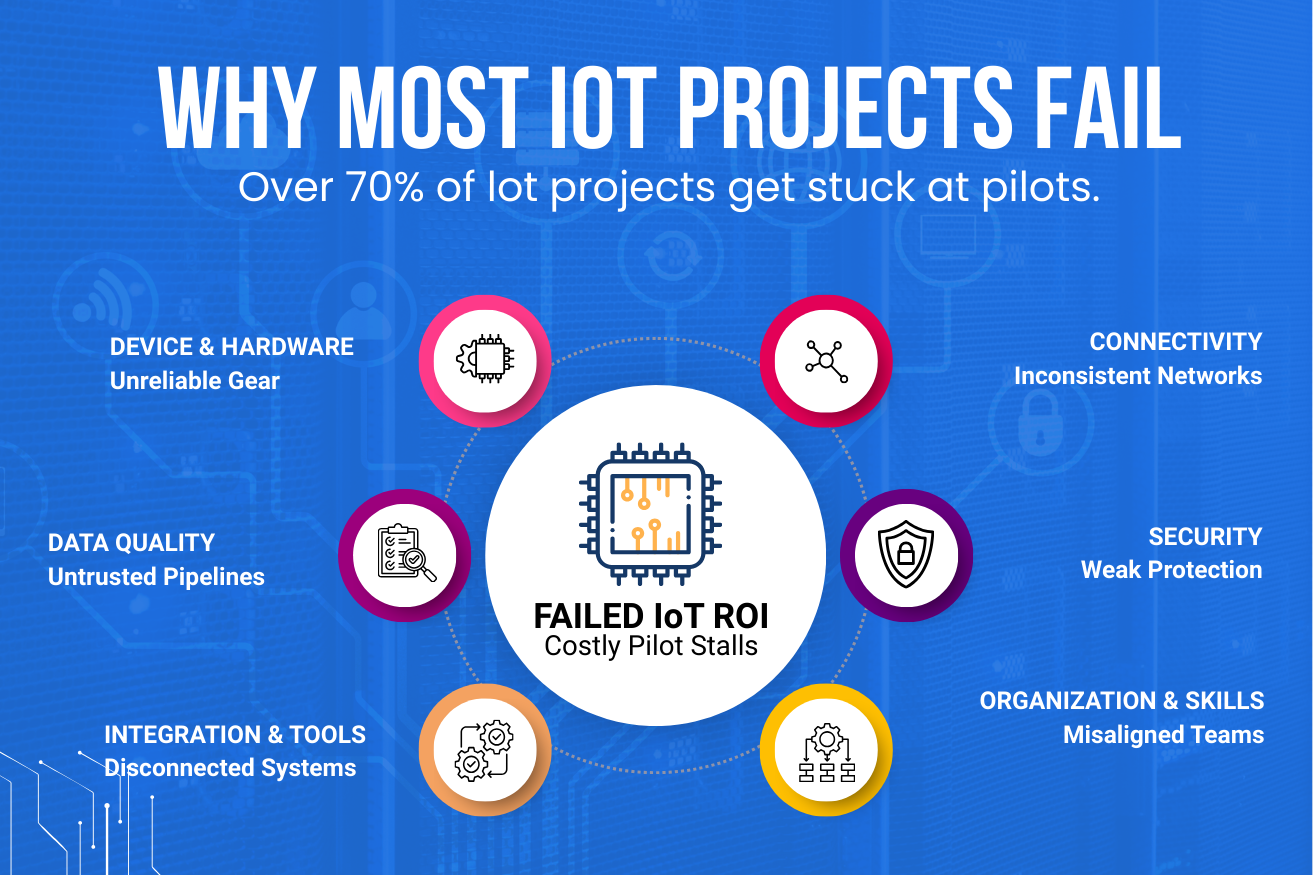
Almost every IoT pilot succeeds. That is the uncomfortable truth behind the industry statistic everyone quotes about failed IoT projects. Ten devices in a controlled environment, watched by the engineers who built them, will nearly always produce a convincing demo and a happy stakeholder.
The failure happens later — somewhere between device eleven and device one thousand. The pilot proved the concept worked. It did not prove the system worked, because a pilot deliberately removes every variable that makes production hard.
This article looks specifically at the pilot-to-production gap: what changes when you scale, why those changes are structural rather than technical bad luck, and what to build into a pilot so it actually predicts the rollout.
Why a Successful Pilot Predicts Almost Nothing
A pilot is optimised for one outcome: proving that the idea is possible. To do that quickly, teams remove friction — and every piece of friction they remove is a production requirement they have deferred rather than solved.
| Condition | In the pilot | In production |
|---|---|---|
| Installation | Done by the engineering team | Done by third-party technicians or end users |
| Environment | One site, known conditions | Dozens of sites, unknown RF, power, and temperature |
| Connectivity | Reliable, often on the office network | Intermittent, shared, sometimes firewalled |
| Failures | Fixed by hand within hours | Must be detected remotely and repaired at scale |
| Data volume | Small enough to inspect manually | Too large to inspect at all |
| Cost per device | Irrelevant | Determines whether the business case survives |
None of these are edge cases. They are the default state of a deployed fleet. A pilot that does not test them is not a smaller version of production — it is a different system that happens to share firmware.
Six Ways Projects Break After the Pilot
Across post-pilot rollouts, the same six patterns account for the overwhelming majority of stalled programmes.
Unit economics that only work at pilot scale
Pilots are funded as innovation projects, so nobody scrutinises the cost of a SIM, a cloud message, or a support call. At a thousand devices those line items become the business case.
- Cellular data plans priced per device rather than pooled
- Cloud ingestion billed per message, with devices reporting every few seconds
- A truck roll costing more than the device it repairs
The fix is to model total cost of ownership per device per year during the pilot, using real message rates — not planned ones.
Installation quality collapses
In a pilot, the person mounting the sensor understands the physics. In a rollout, they are following a one-page instruction sheet on their eleventh install of the day.
Sensors end up misaligned, mounted on the wrong side of a machine, or fitted where a metal enclosure kills the radio link. The data still arrives, so dashboards look healthy — but the readings are wrong, which is far more dangerous than no readings at all.
Environmental variance nobody budgeted for
One site behaves consistently. Fifty sites do not. Temperature swings, condensation, vibration, dust, mains noise, and RF congestion all vary, and each one exposes a margin the design never had.
This is the single most common source of the field failures that only appear months after deployment — the pattern we cover in depth in why IoT devices fail in the field.
No operational layer underneath the product
A pilot is operated by its builders. Production needs provisioning, onboarding, fleet monitoring, alerting, firmware rollout, RMA handling, and a support process. If none of that exists, growth becomes limited by how many devices one engineer can personally babysit.
Teams frequently discover this only when they try to update a fleet and realise they have no safe, staged way to do it.
Architecture that cannot absorb the load
Ten devices forgive almost any design. A thousand devices punish every shortcut: chatty protocols, unbounded payloads, synchronous cloud calls in the firmware path, a single database table doing everything.
Scaling problems rarely appear gradually. Systems tend to work fine and then fall over inside a narrow band, which is why load characteristics belong in the pilot rather than after it. Choosing the right IoT deployment architecture early is far cheaper than migrating a live fleet.
No owner for the outcome
Pilots are sponsored by innovation teams. Rollouts must be owned by operations, and operations are measured on uptime and cost, not novelty. When no operational leader has agreed to own the result, the project quietly loses its budget after the pilot celebration.
The Pilot Should Be a Rehearsal, Not a Demo
The most useful mental shift is to stop treating the pilot as proof that the technology works, and start treating it as a rehearsal of the operating model.
A pilot answers “can this work?” A rehearsal answers “can we run this?” Only the second question predicts the rollout.
Practically, that means deliberately reintroducing the friction a pilot normally strips away. Let someone outside the team install the devices. Put units in the worst site, not the best one. Run the update process end to end even though you could flash by hand. Let the data flow through the real pipeline, at the real rate, into the real dashboard, and see whether anybody can act on it.
A rehearsal that fails is a cheap, extremely valuable result. A demo that succeeds and then collapses at scale is the expensive outcome.
Eight Things to Build Into the Pilot
These are the items that most reliably separate rollouts that scale from those that stall.
A Realistic Path From Pilot to Fleet
Rather than jumping from ten devices to a full rollout, most successful programmes pass through a deliberate intermediate stage.
Stage 2 is where the money is saved. It costs a fraction of a full rollout and surfaces almost every structural problem that would otherwise appear at maximum expense.
Frequently Asked Questions
Conclusion
IoT projects do not usually fail because the technology was wrong. They fail because a pilot answered an easier question than the one the business actually needed answered, and everyone treated that answer as sufficient.
Design the pilot to rehearse the rollout — hardest site, outside installers, real update path, real cost model, named operational owner — and the transition to production stops being a cliff. It becomes the next step in something that was already running.