




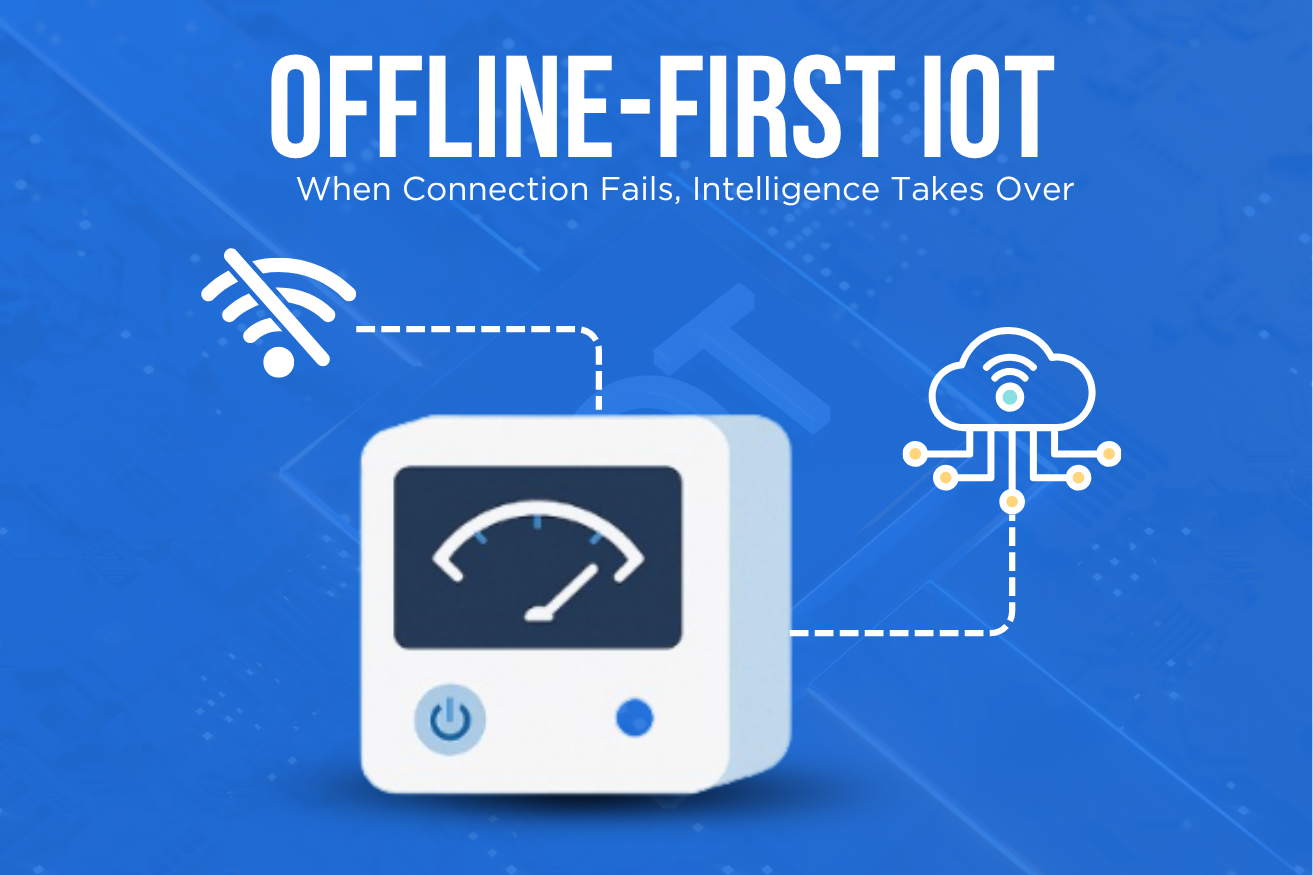
Most IoT systems are designed as if the network is present and handle its absence as an error. Offline-first inverts that assumption: the device is designed to work alone, and connectivity is treated as an opportunity to synchronise rather than a precondition for functioning.
This is not a resilience feature to add later. It is a structural decision that touches firmware, storage, data model, and cloud logic simultaneously — which is exactly why retrofitting it onto a deployed fleet is so painful.
This guide covers what offline-first actually requires: how devices behave without a link, how data survives and reconciles, how time works when there is no server to ask, and how to test any of it before customers do.
Why Connectivity Always Fails Eventually
Teams often treat outages as rare events worth handling crudely. In deployed fleets, disconnection is not an exception — it is a routine operating state with entirely mundane causes.
- Physical — metal enclosures, basements, cold rooms, tunnels, dense buildings
- Infrastructure — a router rebooted, a site fibre cut, a cellular tower congested at shift change
- Commercial — a SIM data cap reached, a subscription lapsed, roaming refused
- Administrative — an IT policy change closing an outbound port nobody documented
- Environmental — weather, harvest machinery, interference from equipment installed after you
Across a fleet of thousands, some meaningful percentage of devices is offline at any moment. The question is never whether the network fails, only what the product does while it is failing.
A connected product that stops being useful when it disconnects is not a product. It is a terminal.
What Offline-First Actually Guarantees
Offline-first is a promise made to the user, and it is worth stating explicitly because it drives every technical decision that follows.
| Guarantee | What it means in practice |
|---|---|
| Core function continues | The primary job of the device works with no uplink at all |
| Nothing is silently lost | Readings and events are persisted locally until confirmed delivered |
| Nothing is duplicated | Replay after reconnection produces one record, not several |
| Order is recoverable | Events can be reconstructed in the sequence they occurred |
| State is honest | Users can tell what is live, what is queued, and what is stale |
| Recovery is automatic | Reconnection needs no human intervention on site |
Notice that four of these six are about data integrity rather than availability. That is the part teams underestimate: staying alive offline is comparatively easy, while reconciling correctly afterwards is where the genuine engineering lives.
The Building Blocks of an Offline-Ready Device
Local decision-making
Any logic the product needs in order to be useful has to run on the device. If a threshold alarm, a safety interlock, or a control loop depends on a cloud round trip, the product is offline-intolerant by construction.
The practical rule is to separate policy from evaluation. The cloud may decide what the threshold should be; the device must be the thing that evaluates it. Policy can arrive whenever the link allows, and the device keeps using the last policy it received.
Durable local storage sized for the real outage
Buffer capacity should be derived from a stated target, not from whatever memory happened to be free. Multiply your data rate by the longest outage you intend to survive and design storage for that.
- Drop oldest — correct for continuous telemetry where recency matters most
- Drop lowest priority — correct when alarms must survive even if routine samples do not
- Degrade resolution — keep summaries once raw samples no longer fit
- Stop and flag — correct where a gap is a compliance failure and must be visible
The one unacceptable option is overflowing silently, which converts a network problem into a permanent, invisible hole in the record.
Idempotent, identified messages
Every record needs a stable unique identifier generated on the device. When a link drops mid-transmission, the device cannot know whether the server received the message, so it must retry — and the server must be able to recognise the repeat.
Without this, every outage inflates counts, double-triggers automations, and corrupts any analytics built on event totals. Idempotency is the single highest-value property in an offline-first design.
Time that survives disconnection
Timestamps have to be applied when a measurement is taken, not when it is uploaded — otherwise a week of buffered readings all arrive stamped with the moment of reconnection.
That requires the device to hold time without a server. In practice: a real-time clock with a backup cell, a monotonic counter that never jumps, and a recorded clock-quality flag so the platform knows whether a timestamp is trustworthy or merely plausible. When the device later learns the true time, historical records can be corrected rather than discarded.
Prioritised, resumable synchronisation
When connectivity returns, a naive device dumps everything at once. Across a fleet reconnecting after a regional outage, that produces a thundering herd that can overwhelm the ingestion tier precisely when it is least able to cope.
- Send alarms and state changes before routine history
- Resume from the last acknowledged record rather than restarting
- Apply randomised backoff so devices do not reconnect in lockstep
- Rate-limit backfill so live data is never blocked behind a queue
A defined conflict resolution rule
If both device and cloud can change the same state — a setpoint adjusted locally while also being changed remotely — they will eventually disagree. The resolution rule must be chosen explicitly rather than emerging from whichever write happens to land last.
The simplest robust approach is single ownership: each piece of state has exactly one authoritative writer, and the other side proposes rather than sets. Where genuine two-way editing is required, version each change and reconcile deterministically.
Degraded Modes Users Can Understand
Offline-first is as much an interface problem as a firmware one. A device that keeps working but cannot say so produces support calls and, worse, decisions made on stale information.
How to Test Offline Behaviour Properly
Offline paths are the least exercised code in most IoT products and, correspondingly, the most likely to contain serious bugs. They need deliberate testing rather than incidental coverage.
These are the same field conditions that cause otherwise well-built products to fail after deployment, and they belong in the test plan rather than in a post-launch incident review.
What Offline-First Costs, and When to Skip It
Offline-first is not free. It adds non-volatile storage, a real-time clock, more complex firmware, a sync protocol, and server-side deduplication. On a very low-cost device those additions are material.
It is genuinely unnecessary when the device is permanently powered and wired in a controlled environment, when a gap in data has no operational consequence, or when the device is a pure display with no independent function.
It is close to mandatory whenever the device is battery-powered or mobile, whenever data has compliance value, whenever a failure has physical consequences, or whenever devices are installed anywhere you cannot easily reach. The design also pairs naturally with edge data reduction: a device already summarising locally has most of the machinery offline operation requires.
Frequently Asked Questions
Conclusion
Offline-first is not about surviving a rare disaster. It is about accepting that disconnection is a normal operating state and designing so that it produces a delay rather than a loss.
The mechanics are well understood: decide locally, persist durably, identify every record, keep honest time, synchronise with priority and resumption, and resolve conflicts by a rule you chose rather than one that emerged. The difficulty is that all of it has to be decided before hardware is fixed — which is why offline behaviour belongs in the first architecture conversation, not the first incident review.