Building strong AIoT systems isn’t about choosing the latest sensor or training the most complex model.
In production, AIoT succeeds or fails based on how trustworthy the data pipeline is.
The most resilient AIoT platforms don’t just move data — they validate it, enrich it, and learn from it continuously.
At MetaDesk Global, we’ve seen AIoT systems outperform expectations not by upgrading models, but by strengthening the data foundations underneath them.
This article breaks down the seven critical data capabilities that make IoT + AI systems reliable, scalable, and production-ready.
Why Data Pipelines Matter More Than Models in AIoT
AI models evolve quickly.
Data pipelines must endure for years.
In AIoT systems:
- Devices operate in unpredictable environments
- Connectivity is imperfect
- Sensors degrade over time
- Decisions often affect real-world operations
Without intelligent data handling, even the best models will fail in the field.
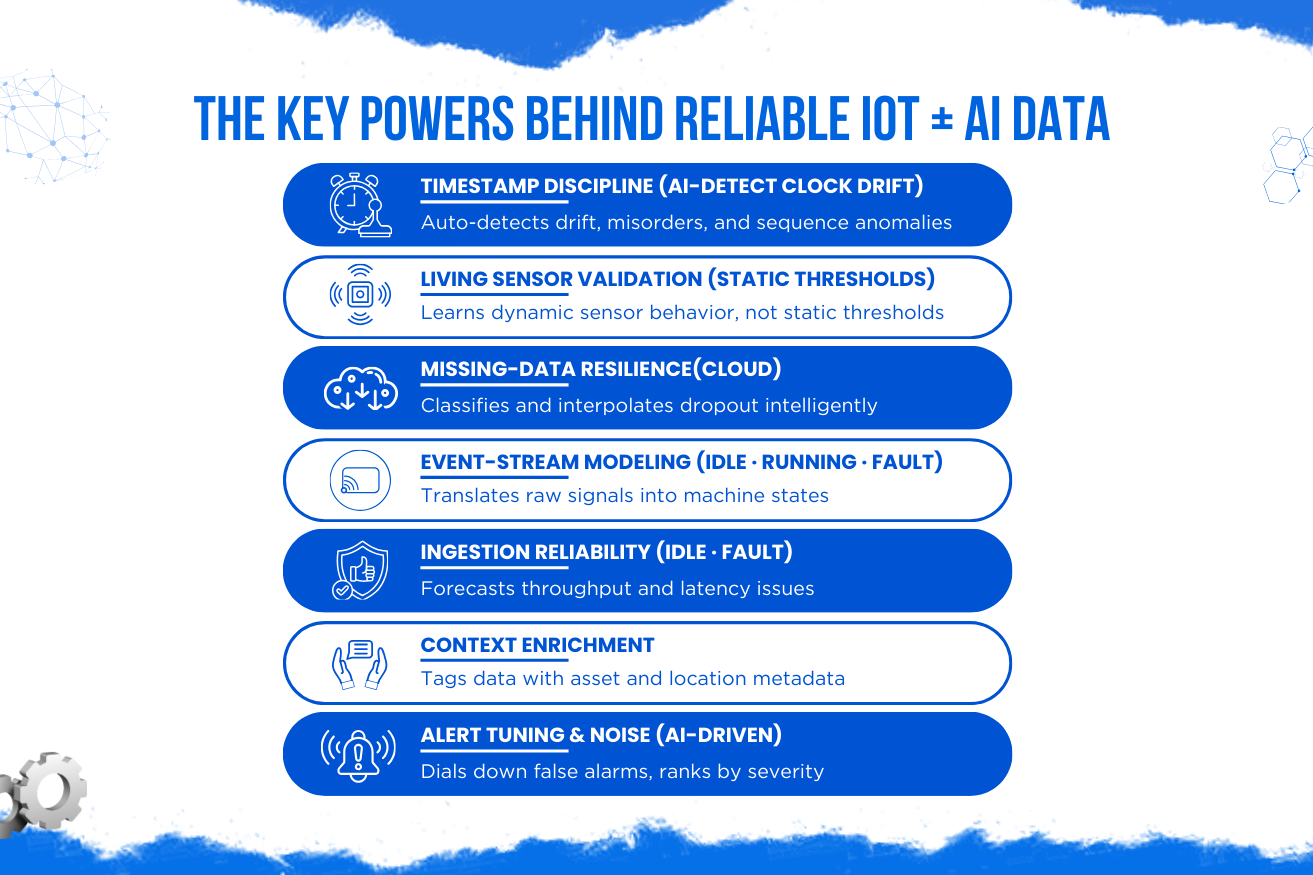
The 7 Powers That Make AIoT Data Trustworthy
1. Timestamp Discipline
Time alignment is foundational to AIoT intelligence.
Real-world systems suffer from:
- Clock drift
- Out-of-order events
- Network-induced delays
Best practice:
Use anomaly detection on time sequences to identify drift and reorder events early — before modeling or decision logic runs.
2. Living Sensor Validation
Static thresholds fail in dynamic environments.
Instead of fixed limits, AIoT systems should:
- Learn normal sensor behavior over time
- Detect deviations relative to historical patterns
- Flag degrading or misbehaving sensors
Best practice:
Implement sensor health scoring models that adapt as operating conditions change.
3. Missing-Data Resilience
Data gaps are inevitable in distributed systems.
Reliable AIoT pipelines:
- Identify when data is missing
- Classify the reason (device failure, network loss, power issues)
- Recover intelligently instead of blindly interpolating
Best practice:
Use models that distinguish temporary dropouts from structural failures.
4. Event-Stream Modeling
Raw telemetry has limited value on its own.
AIoT systems become powerful when they translate signals into machine states, such as:
- Idle
- Running
- Fault
- Maintenance
Best practice:
Train classifiers that convert raw events into operational states that teams can act on.
5. Real-Time Ingestion Reliability
At scale, data pipelines themselves become systems that must be monitored.
Advanced AIoT platforms:
- Predict ingestion bottlenecks
- Detect latency buildup early
- Trigger auto-scaling or throttling
Best practice:
Use throughput and latency metrics as features to forecast pipeline health.
6. Context Enrichment
Raw sensor values lack meaning without context.
AIoT systems gain clarity by enriching data with:
- Asset identity
- Location
- Machine type
- Operational mode
Best practice:
Automate metadata attachment so every data point carries context for downstream analytics.
7. Alert Tuning vs Noise
Too many alerts destroy trust.
AIoT platforms must:
- Deduplicate similar alerts
- Rank incidents by business impact
- Reduce false positives over time
Best practice:
Train alert prioritization models using historical tickets and operator feedback.
AIoT Success Formula
Trustworthy Data + Adaptive Models = Sustainable Intelligence
When data pipelines validate themselves, models become easier to maintain, explain, and improve.
Common AIoT Failure Pattern
Many AIoT projects fail because:
- Sensors are trusted blindly
- Pipelines lack observability
- Alerts overwhelm operators
- Feedback loops are missing
The result is impressive demos that collapse in production.
How MetaDesk Global Builds Production-Ready AIoT Pipelines
At MetaDesk Global, we help teams design AIoT systems that scale beyond pilots by focusing on:
- Intelligent data validation
- Edge-aware pipeline design
- Secure ingestion and observability
- Feedback-driven learning loops
- Governance, privacy, and auditability
We believe AIoT intelligence starts below the model layer — in the data infrastructure itself.
Final Thoughts
AIoT is not about adding AI on top of IoT.
It’s about building data pipelines that can observe, adapt, and explain themselves.
When the data layer is strong:
- Models improve faster
- Decisions become trustworthy
- Systems scale with confidence
If you’re building AIoT systems today, ask yourself:
Where is your data pipeline still fragile?