
Category
Embedded IoT Solutions
Read Time
7 min read
Published
October 25, 2024
Status
Published

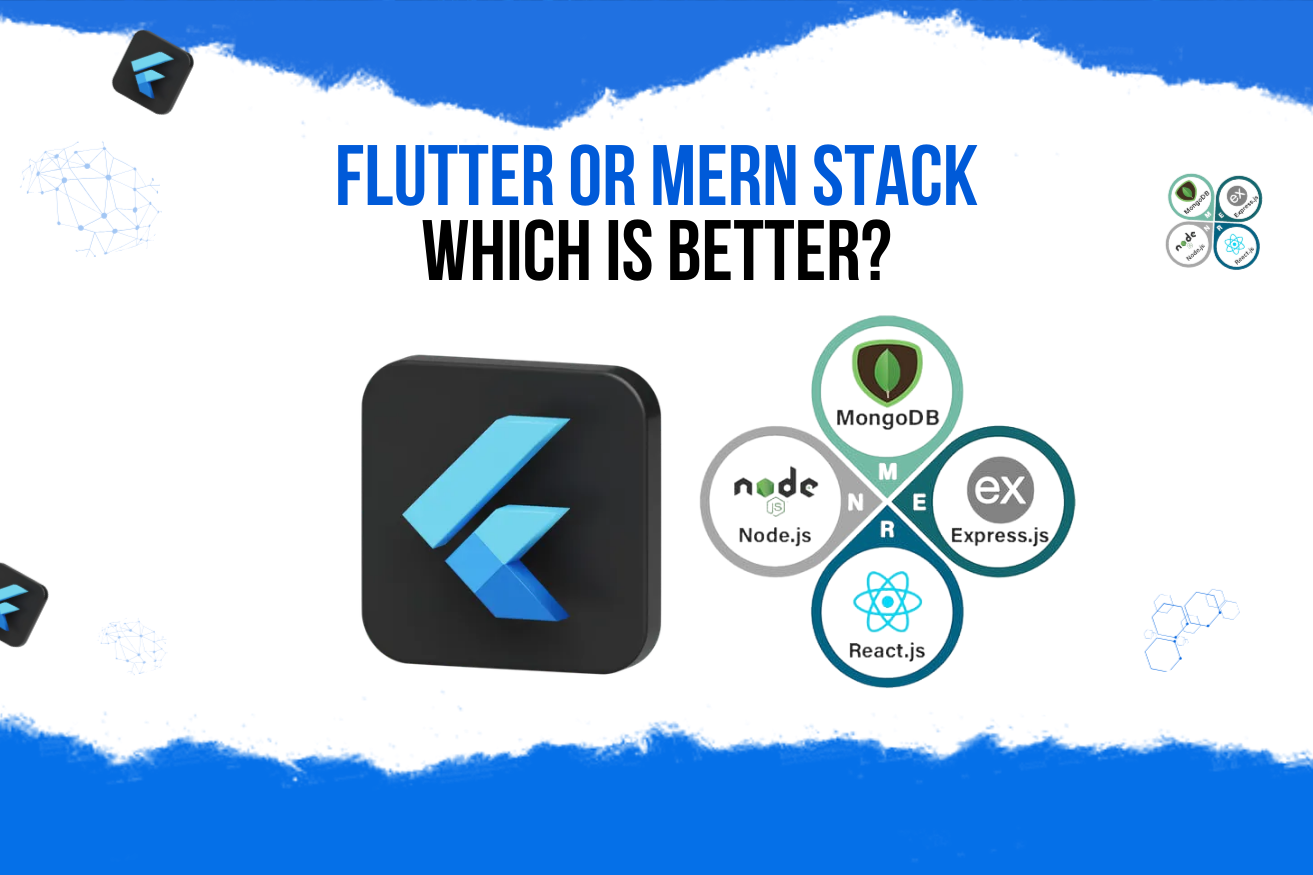
Flutter is a UI framework. MERN is a full stack. They overlap in exactly one place - the interface - which is why many products sensibly use both.

Flutter and the MERN stack are compared constantly, and the comparison is slightly malformed. Flutter is a UI framework for building client applications. MERN — MongoDB, Express, React, Node.js — is a full-stack combination covering database, server, and web front end.

They overlap in exactly one place: the user interface. Everywhere else they answer different questions, which is why a great many real products use both, with Flutter on mobile and a Node backend serving it.

This guide sets out what each actually covers, compares them where they genuinely compete, and gives a clear recommendation for the situations teams most often face.

Scope

What Each One Actually Covers

LayerFlutterMERN
DatabaseNot includedMongoDB
Server / APINot includedExpress on Node.js
Web front endSupportedReact
iOS and Android appsNative compiled, primary strengthRequires React Native or a wrapper
Desktop applicationsSupportedRequires Electron
LanguageDartJavaScript or TypeScript throughout

Reading down the table, the choice becomes clearer. If the question is how to build a mobile app, Flutter answers it and MERN does not. If the question is how to build a web application with a backend, MERN answers it and Flutter covers only part.

Flutter and MERN are not competitors in most projects. They are candidates for different halves of the same product.

Flutter

Where Flutter Is the Stronger Choice

Flutter compiles Dart to native code and draws every pixel with its own rendering engine rather than using platform widgets. That design produces specific, real advantages.

  • Genuine cross-platform consistency. Because Flutter renders its own widgets, an interface looks and behaves identically on iOS and Android without per-platform adjustment.
  • Native performance for animation. Compiled ahead of time, with no JavaScript bridge in the rendering path — noticeable in complex, animation-heavy interfaces.
  • One codebase across mobile, web, and desktop. Coverage is genuinely broad, though mobile remains where it is strongest.
  • Fast iteration. Stateful hot reload keeps the development loop very tight.
  • Strong hardware integration. Direct platform channels make Bluetooth, sensors, and camera work practical, which matters for connected-product companion apps.

The costs are real too: Dart is another language for the team to learn, app binaries are larger because the engine ships with them, and the web output is heavier than a conventional React application — which matters when search engines and first-load time do.

MERN

Where MERN Is the Stronger Choice

MERN’s advantage is coherence. One language spans the browser, the server, and the tooling, which has genuine organisational consequences.

  • One language end to end. Developers move between front end and backend without context switching, and types can be shared across the boundary.
  • Complete stack out of the box. Database, API layer, and UI are covered by a well-understood combination.
  • Exceptional ecosystem depth. The JavaScript package ecosystem is the largest available, and React expertise is easy to hire.
  • Mature web rendering options. Server-side rendering and static generation give strong first-load performance and search visibility.
  • Efficient for I/O-heavy services. Node’s event loop suits APIs, real-time features, and high-concurrency workloads well.

Its limits are equally clear: MongoDB is a poor default for genuinely relational data, Node is not suited to CPU-bound work, and mobile requires bringing in React Native or a wrapper, which reopens the platform question rather than answering it.

Decision

Which Should You Choose?

Mobile-first product
Flutter for the app, with a backend chosen separately — Node, Python, or Go. This is the most common correct answer, and the backend decision should be made on its own merits.
Web application or SaaS dashboard
MERN, or React with a different backend. Flutter web is capable but produces a heavier initial load and is weaker where search visibility matters.
Both web and mobile from day one
React for web plus Flutter for mobile, sharing one API, is usually better than forcing a single framework across both. Each platform gets the tool suited to it.
IoT or hardware companion app
Flutter. Bluetooth, sensor access, and background behaviour are better supported, and a consistent interface across iOS and Android reduces support burden for a physical product.
Small team, tight deadline
Whichever the team already knows. Framework differences are minor next to the cost of learning a new language and ecosystem under schedule pressure.
Relational, transactional data
Keep React and Node if you like them, but replace MongoDB with PostgreSQL. The M in MERN is the component most often chosen by default and most often regretted.
Guidance

Questions That Settle It Faster Than Feature Lists

1Where do users actually spend their time?
If the answer is a phone, optimise for mobile quality and treat web as secondary. If it is a desk, the reverse. Build for the primary surface rather than compromising both.
2Does search visibility matter?
If organic discovery drives the business, server-rendered React has a clear advantage over Flutter web. If the product sits behind a login, this consideration disappears entirely.
3What shape is your data?
Relational data with transactions belongs in a relational database. Choose the database on the data model, not because a stack acronym included one.
4Do you need device hardware?
Bluetooth, sensors, background location, and camera pipelines are markedly easier in Flutter than in a web application, which matters for any connected product.
5Who will maintain it in three years?
JavaScript developers are more numerous than Dart developers. If long-term staffing is a concern, that difference is a legitimate input to the decision.
6Are you choosing a stack or a habit?
Stack acronyms bundle decisions that should be made separately. React, Node, and MongoDB can each be adopted or replaced independently — and frequently should be.
FAQ

Frequently Asked Questions

Is Flutter better than the MERN stack?
They largely solve different problems. Flutter is a UI framework strongest on mobile; MERN is a full stack covering database, server, and web front end. They overlap only at the user interface, which is why many products use Flutter for mobile and a Node backend behind it.
Can Flutter replace React for web development?
Technically yes, but usually it should not. Flutter web produces a heavier initial load because the rendering engine ships with the application, and it is weaker where search visibility matters. React with server-side rendering remains the stronger choice for public-facing web.
Which is better for a mobile app, Flutter or MERN?
Flutter. MERN has no mobile story of its own — it requires React Native or a wrapper, which reopens the platform question. Flutter compiles to native code, renders consistently across iOS and Android, and integrates well with device hardware.
Do you need a backend with Flutter?
Yes, for anything beyond a purely local app. Flutter covers only the client, so the backend is a separate decision — Node, Python, Go, or a managed backend service. That separation is an advantage, since the backend can be chosen on its own merits.
Is MongoDB the right database for a MERN application?
Only if the data is genuinely document-shaped. For relational data with transactions and joins, PostgreSQL is usually a better fit. The M in MERN is the component most often adopted by default and most often regretted later.
Which is better for an IoT companion app?
Flutter. Bluetooth Low Energy, sensor access, and background behaviour are considerably better supported than in a web application, and a consistent interface across both mobile platforms reduces the support burden for a physical product.
Wrapping Up

Conclusion

Flutter or MERN is rarely the real question. The real questions are where users spend their time, whether search visibility matters, what shape the data is, and whether the product needs device hardware.

Answer those and the stack assembles itself — frequently as Flutter on mobile with a Node or Python API behind it, and React for web if there is one. Stack acronyms bundle decisions that deserve to be made separately, and unbundling them almost always produces a better result than adopting the whole package.

About MetaDesk Global

Engineering the Next Generation of Connected Products

MetaDesk Global helps startups and enterprises develop intelligent connected products that combine embedded systems, Industrial IoT, Edge AI, and cloud technologies. Our expertise includes:

Industrial IoT (IIoT) Solutions Embedded Firmware Development Edge AI Development Predictive Maintenance Systems PCB Design IoT Gateway Development Cloud Integration OTA Firmware Updates AIoT Product Development End-to-End Product Engineering

From hardware design to AI-powered industrial platforms, we build scalable solutions for the next generation of connected products.

Start Your Project

Building a Connected Product?

We design IIoT sensor networks, Edge AI pipelines, and secure cloud platforms — from prototype to production.

Request a Free Quote →