




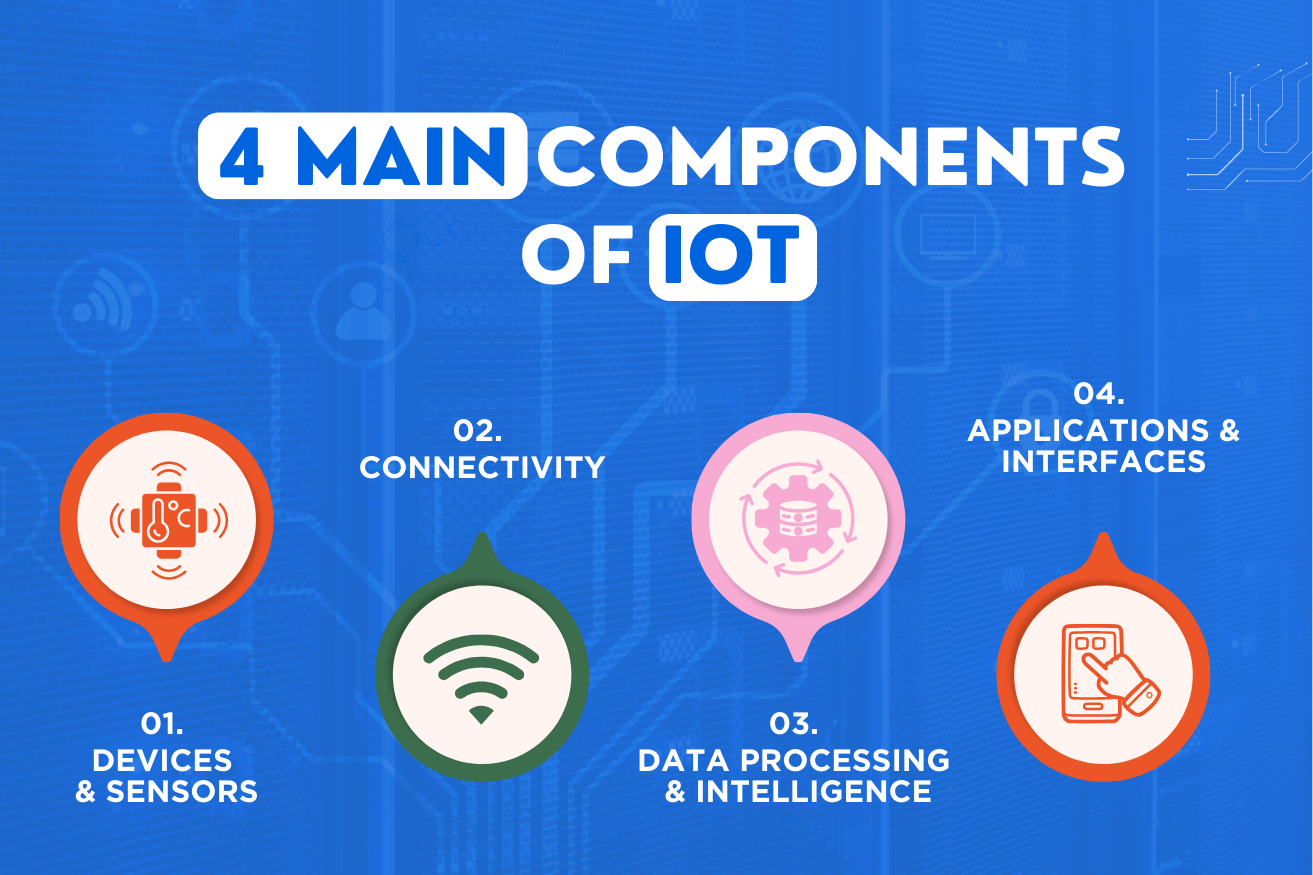
The Internet of Things is more than a collection of connected gadgets. Every IoT product — a fitness band, a factory sensor, a smart meter — is built from the same four building blocks, and understanding them is the fastest way to understand how any connected system actually works.
So what are the 4 main components of IoT? They are sensors and devices, connectivity, data processing, and applications. Data is captured by the first, carried by the second, interpreted by the third, and made useful by the fourth.
This guide explains each component in plain terms, shows how they work together in a real product, and covers the mistakes that most often trip up first-time IoT teams.
The Foundation of Every IoT System
Every successful IoT product relies on the same chain: something senses the world, something carries that reading somewhere, something makes sense of it, and something presents it to a person or a machine that can act.
The four components map directly onto that chain, and each one has a job that no other component can do for it.
| Component | Its job | If it is weak |
|---|---|---|
| Sensors and devices | Turn physical conditions into digital readings | Everything above it is built on wrong numbers |
| Connectivity | Move readings reliably and securely | Data arrives late, duplicated, or not at all |
| Data processing | Turn readings into meaning | You collect a lot and learn nothing |
| Applications | Turn meaning into action | Insight exists but nobody acts on it |
Get one wrong and the whole system suffers. A great sensor is useless without reliable connectivity, and rich data means nothing without an application to act on it. Let us look at each in turn.
The 4 Main Components of IoT
Sensors and Devices: The Sensing Layer
The first and most visible component is where sensors and devices collect real-world data. This is the point at which the physical world becomes digital.
- Temperature, humidity, and pressure
- Motion, proximity, and GPS location
- Heart rate, SpO², and ECG in health wearables
- Industrial vibration and current sensors
- Cameras and microphones for vision and audio sensing
Role: convert physical phenomena into digital signals that can be processed. In healthcare wearables, sensors track SpO² and ECG. In agriculture, soil moisture and light sensors optimise irrigation. Without this component, IoT has no data to work with.
Sensor choice matters less than placement, calibration, and electrical design. A well-specified sensor mounted in the wrong place produces confident, useless readings — and no amount of later processing can recover the measurement it never took.
Connectivity: The Network Layer
Once data is captured it must travel from the device to the cloud or an edge server. Connectivity is the glue that holds IoT ecosystems together.
- Wi-Fi and Bluetooth Low Energy (BLE)
- Zigbee and Thread for mesh networks
- LoRaWAN and NB-IoT for long-range, low-power links
- Cellular 4G and 5G
Role: transmit data securely and reliably while balancing speed, power, and cost. For low-power BLE tags, Bluetooth is ideal. For long-range field sensors, LoRaWAN or NB-IoT is preferred. Choosing the right protocol is a key part of your overall IoT deployment architecture.
Not peak speed, but behaviour when the link fails. Every field deployment loses connectivity, so buffering and ordered, duplicate-free replay matter far more than headline bandwidth.
Data Processing: The Intelligence Layer
Here raw signals turn into meaningful insight. Processing happens on the edge, close to the device, or in the cloud — and this stage determines whether IoT adds value or just streams data nobody uses.
- Filtering noise and validating data
- Running ML models and anomaly detection
- Storing readings in time-series databases
- Edge AI: chips such as the nRF52 and ESP32 run lightweight models (TinyML, TensorFlow Lite) directly on-device
- Cloud processing: platforms such as AWS IoT Core or Azure IoT Hub enable large-scale analytics
The metrics you track at this stage make or break a deployment — see our guide to the essential IoT platform KPIs and the real-world trade-offs of Edge AI deployment.
Honesty about gaps. A pipeline that fills missing readings by interpolation makes outages invisible and teaches any model a version of reality that never happened.
Applications: The User Layer
The final component answers the user’s question: what does this data mean to me? Applications turn processed data into dashboards, alerts, and automated actions.
- A mobile app that notifies you when a wearable detects an abnormal heart rate
- An industrial dashboard tracking machine uptime
- Smart home apps controlling lights or HVAC systems
- An API that pushes readings into an existing maintenance system
This is where IoT finally becomes useful to a person or a business process.
Restraint. An interface that raises more alerts than an operator can act on is quickly ignored, and an ignored system delivers exactly the same value as no system at all.
How the Four Components Work Together
The components are easiest to understand through a single product. Take a cold-chain monitor that protects vaccines in transit.
Remove any one component and the product fails in a different way. Without local buffering, the tunnel erases the evidence. Without on-device detection, the alert arrives after the vaccine is already compromised. Without the application, the data exists but nobody acts on it in time.
IoT value is produced by the weakest of the four components, never by the strongest.
Are the 4 Components the Same as the 4 Layers?
Almost, and the difference is worth knowing because both terms appear constantly in IoT documentation.
Components describe what a system is made of: the sensors, the network, the processing, the app. It is a parts list.
Layers describe how those parts are stacked and what each one guarantees to the one above it. It is an architecture.
They map one to one — sensing, network, processing, application — but layers add the idea of a contract between tiers, which is what matters once you are designing rather than learning. If you are ready for that level of detail, our guide to the 4 layers of IoT architecture covers the contracts, failure propagation, and where each decision belongs.
Mistakes Teams Make With Each Component
Building Balanced IoT Systems
At MetaDesk Global we design across all four components rather than optimising one, because a system only performs as well as its weakest link:
- BLE-powered tags with 2+ years of battery life on nRF52-class silicon
- Smart health wearables with real-time apps for caregivers
- Industrial dashboards with secure cloud integration
By balancing each component, IoT solutions stay efficient, reliable, and scalable. The technology around them keeps moving — you can see where it is heading in our overview of IoT trends in 2026 — but these four fundamentals have not changed and are unlikely to.
Frequently Asked Questions
Conclusion
So, what are the 4 main components of IoT? Sensors and devices, connectivity, data processing, and applications. Together they form the backbone of every IoT system, from a consumer wearable to a multi-site industrial deployment.
If you are planning your own IoT product, the important lesson is that success comes from balancing all four rather than excelling at one. Want to bring your IoT idea to life? At MetaDesk Global we specialise in end-to-end IoT development — from firmware and PCB design to mobile apps and cloud integration.