



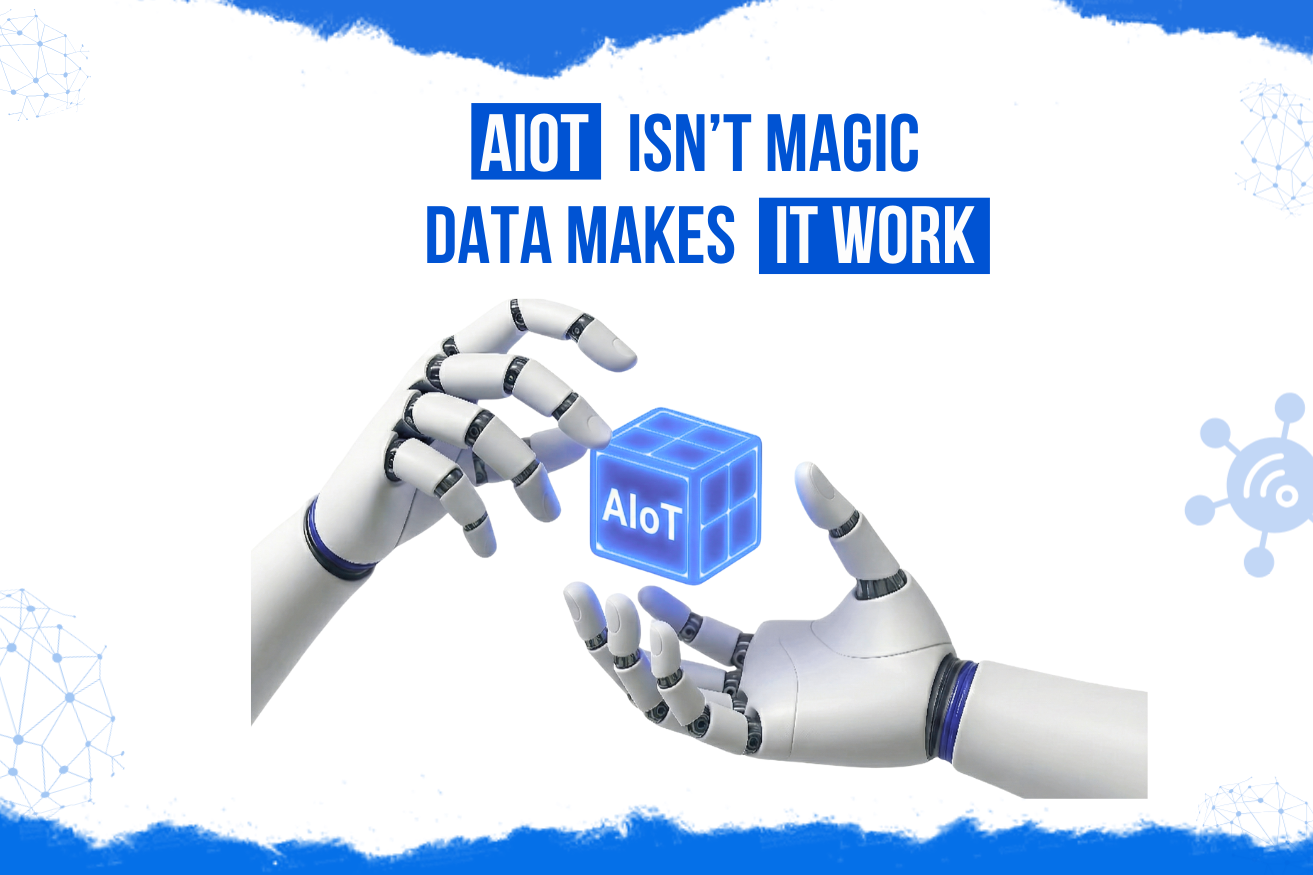
AIoT projects are usually sold as AI projects. They succeed or fail as data engineering projects. The model that performed well in a notebook is only one stage in a chain that starts at a sensor bolted to a machine and ends with an action someone takes — and a weakness at any earlier stage caps what the model can achieve.
This article walks through that chain as a technical architecture: the eight stages of an AIoT data pipeline, what each stage must guarantee, the technologies commonly used, and where pipelines typically break in production.
It focuses on the runtime pipeline. For the properties the data itself must have, see the 7 data powers behind reliable AIoT systems; for the project methodology of building models, see why AIoT systems are built on data pipelines, not just smart models.
Why AIoT Isn’t a Model Problem
In a demo, data is clean, complete, and already sitting in a file. In production, every reading has travelled through hardware, firmware, a radio, a queue, and several services before a model sees it — and each hop can delay, duplicate, distort, or drop it.
That is why most AIoT failures show up as model problems but originate upstream:
- Predictions degrade because a firmware update changed a unit of measurement
- Alerts fire twice because retries were not deduplicated
- Decisions lag because readings sat in a device buffer for an hour
- Accuracy cannot be measured because outcomes were never recorded
A model can only be as reliable as the least reliable stage of the pipeline feeding it.
The 8 Stages of an AIoT Data Pipeline
Sensing and acquisition
Sensors and firmware convert physical conditions into samples. This stage sets the ceiling for everything after it.
- A sampling rate matched to how fast the phenomenon changes
- Calibration and a known accuracy tolerance
- A timestamp taken at the moment of measurement
- An explicit error code when a reading fails, never a default value
Edge preprocessing
On the device or a gateway, raw samples become something worth transmitting: filtered, windowed, summarised, or classified.
- Noise filtering and outlier rejection
- Windowed statistics that keep minimum and maximum, not only averages
- Feature extraction for high-rate signals such as vibration or audio
- On-device event detection with TinyML models
This stage decides most of the pipeline’s cost, because every downstream stage only handles what the edge chose to send. The trade-offs are covered in smart IoT data reduction.
Buffering and secure transport
Data moves from device to backend over MQTT, CoAP, HTTPS, or LwM2M, authenticated per device and encrypted in transit.
- Durable local buffering during connectivity loss
- A unique, device-generated ID on every message so retries can be deduplicated
- Prioritisation so alarms travel before routine telemetry after an outage
- Per-device identity, so any message is attributable to one physical unit
Ingestion and validation
The platform’s front door: an IoT broker or managed service such as AWS IoT Core or Azure IoT Hub, feeding a durable queue or event stream.
Ingestion should do very little work: accept the message, validate it against a versioned schema, persist it durably, and acknowledge. Non-conforming messages are quarantined rather than silently coerced, and any heavy processing happens downstream of the queue so it can scale independently.
Stream processing and enrichment
Events are deduplicated, reordered by event time, joined with context such as asset metadata, operating mode, and location, and turned into features.
Two design details prevent many production bugs: handling late-arriving data explicitly with event-time windows, and recording both event time and ingest time so buffered data is placed correctly in history.
Storage
Different consumers need different stores. A time-series database serves dashboards and recent history; a data lake holds raw and historical data for training; a feature store keeps the values models use consistent between training and inference.
Retention and downsampling policies belong here from day one. Without them, queries slow down every month as history accumulates.
Inference and decision
Models run where their latency and availability requirements dictate: on the device for immediate reactions, at the edge for site-level correlation, or in the cloud for fleet-wide analysis.
A decision layer then turns model output into action: thresholds on confidence, business rules, suppression of duplicate alerts, and routing to a person or an automated system. Predictions should always carry a confidence value and the model version that produced them.
Action and feedback
The decision reaches an operator, a work order system, or an actuator — and the outcome is recorded. Did the predicted failure happen? Was the alert useful or ignored?
This closes the loop. Without recorded outcomes there is no ground truth, no accuracy measurement, and no way to detect model drift.
Where AIoT Pipelines Break in Production
| Symptom | Stage usually responsible |
|---|---|
| Model accuracy dropped after a firmware release | Ingestion — no schema versioning or validation |
| Duplicate alerts or inflated counts | Transport and stream processing — retries not deduplicated |
| Decisions based on hour-old data | Transport — buffering without event-time handling |
| Dashboards smooth over outages | Edge or storage — gaps interpolated instead of flagged |
| Training and live results disagree | Storage — features computed differently in each path |
| Queries slower every quarter | Storage — no retention or downsampling |
| Nobody can state current model accuracy | Feedback — outcomes never recorded |
Building a Pipeline That Holds Up
Frequently Asked Questions
Conclusion
AIoT isn’t magic, and the model is rarely where it breaks. Reliable systems come from eight well-engineered stages, each with a clear guarantee: accurate sensing, sensible edge reduction, durable and deduplicated transport, validated ingestion, event-time stream processing, disciplined storage, versioned inference, and a feedback loop that records what actually happened.
Build and instrument that chain first. Then the model becomes the easiest part of the system to improve, instead of the part everyone blames.