




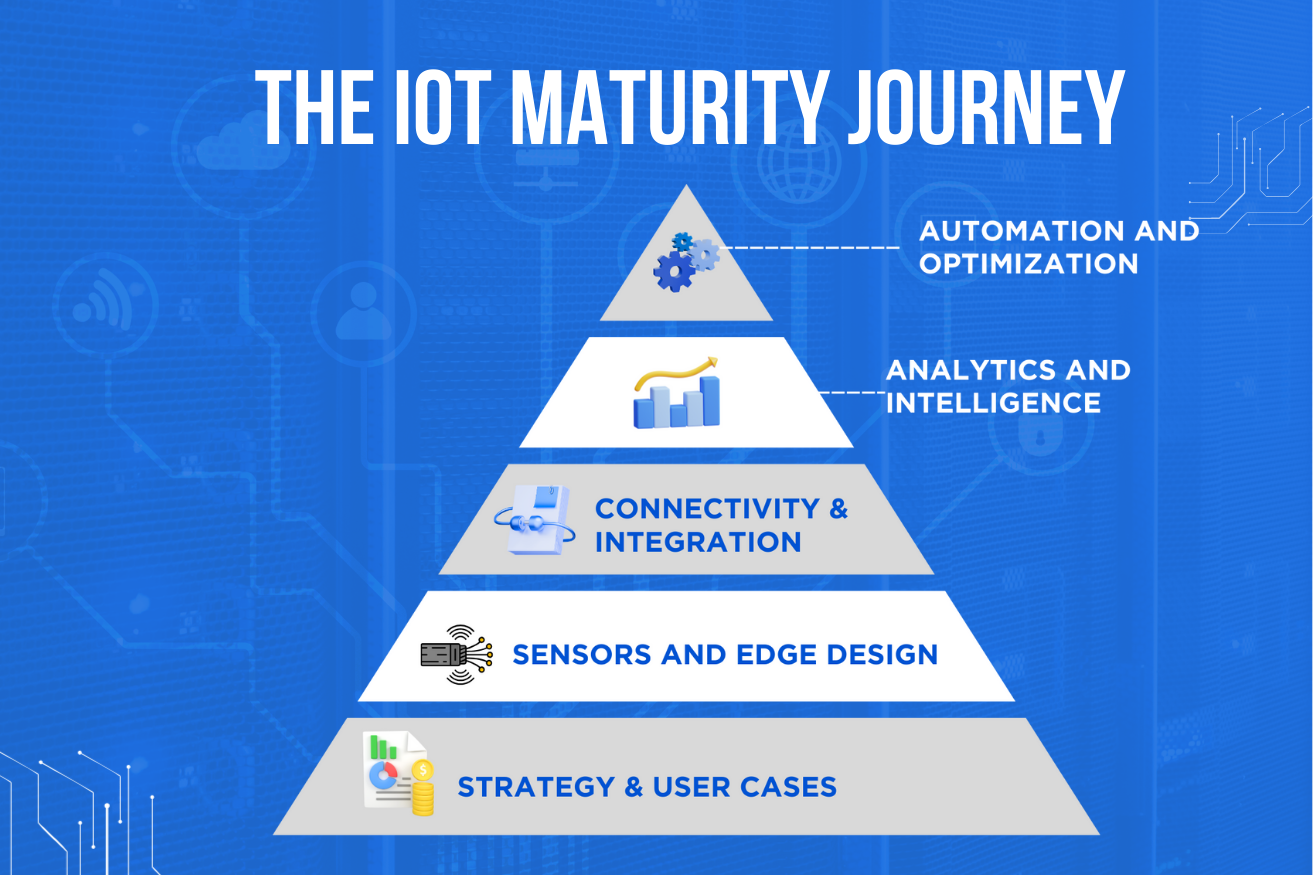
Organisations rarely fail at IoT because they picked the wrong platform. They fail because they attempted a capability their foundations could not support — predictive maintenance on data that was never validated, autonomous control on a fleet with no reliable update path.
An IoT maturity model exists to prevent exactly that. It describes the stages a connected programme moves through, what each stage requires before it can work, and what it delivers when it does. Its practical value is diagnostic: it tells you which stage you are actually at, which is usually one lower than assumed.
This guide sets out the five stages and their entry conditions, a way to assess honestly which level your system has reached, what has to be built before each step up, and where the intelligence should run.
Why Maturity Is a Sequence, Not a Choice
Each stage of an IoT programme produces the raw material the next one consumes. Connectivity produces the data that monitoring displays. Monitoring produces the history that prediction requires. Prediction produces the track record that justifies automation.
Skipping a stage does not accelerate the programme. It produces a capability with nothing underneath it, and the failure is usually delayed and expensive:
- Predictive models trained on data whose gaps were silently interpolated
- Automation acting on readings that no one ever validated against reality
- Dashboards presenting fleet-wide figures from devices that are hours behind
- Optimisation tuned against a baseline that was never measured properly
Every stage is cheap to build in order and extremely expensive to retrofit out of order.
The Five Stages of IoT Maturity
Connected — assets report their existence
Devices are deployed and sending data. The achievement is coverage, not insight.
- Every device has a unique, factory-assigned identity
- Messages carry firmware version and event-time timestamps
- Connectivity rate and data completeness are measured per device
- A tested update path exists before the fleet grows
The most common mistake here is treating connectivity as a solved problem once data appears. If nobody measures completeness, silent loss goes unnoticed and every later stage inherits it.
Monitored — people can see what is happening
Dashboards, threshold alerts, and reports turn data into visibility. Someone can now answer questions about assets they previously could not observe.
- Readings have been validated against physical reality, not just rendered
- Data age is visible, so stale values are never shown as live
- Gaps appear as gaps rather than being interpolated away
- Alert volume is low enough that alerts are actually read
Stage 2 is where most programmes stop, and for many that is a legitimate resting point. The failure mode is alert fatigue: a system producing more notifications than anyone can process has become decorative while still appearing healthy.
Analytical — patterns emerge across assets and time
Comparison begins: this machine against its peers, this month against last year, this site against the fleet. Analysis moves from what is happening to why.
- Field names and units mean the same thing across every firmware version
- Enough clean history exists to establish a baseline, typically many months
- Operating context is recorded alongside measurements
- Queries stay fast as history accumulates — retention and rollups are defined
The blocker here is almost always consistency. Fleets drift into having several definitions of the same field, and cross-asset comparison quietly becomes meaningless.
Predictive — the system anticipates
Models forecast likely future states: a component degrading, demand rising, quality drifting. Work moves from reactive to scheduled.
- Outcomes are recorded, so predictions can be evaluated against reality
- Model drift is monitored, not assumed away
- Predictions carry confidence and the signals behind them
- A specific action is defined for each prediction, with an owner
The characteristic failure is a prediction nobody acts on. A forecast without a defined response and an accountable owner is an interesting number, not an operational capability — and the data properties required at this stage are unforgiving.
Autonomous — the system acts
The system closes the loop, adjusting setpoints, scheduling work, or halting a process without waiting for a human decision. Humans supervise rather than operate.
- A demonstrated track record of prediction accuracy over time
- Bounded authority — explicit limits on what the system may change
- A reliable override and a safe fallback state
- Complete audit trail of every automated decision and its outcome
- Local autonomy, so behaviour is defined during connectivity loss
Very few programmes need to reach this stage, and fewer should attempt it early. Autonomy is justified when the decision must happen faster than a human loop allows, or too often for people to make it consistently.
Which Stage Are You Actually At?
Self-assessment tends to be optimistic. These symptoms indicate a stage was skipped rather than completed.
| Symptom | Stage actually missing |
|---|---|
| Nobody can say what percentage of expected data arrives | Stage 1 — connectivity is unmeasured |
| Dashboards are open but alerts are routinely ignored | Stage 2 — monitoring has become decorative |
| Cross-site comparisons produce results nobody trusts | Stage 3 — field definitions are inconsistent |
| Model accuracy cannot be stated with a number | Stage 4 — outcomes are not recorded |
| Automated actions are quietly disabled by operators | Stage 5 — trust was never established |
| Reports get slower every quarter | Stage 3 — retention and rollups were never defined |
The most useful diagnostic question is simple: can you state, as a number, how complete and how fresh your data is right now? Programmes that cannot answer that are at Stage 1 regardless of what they have built above it.
Assess Your Level With Evidence
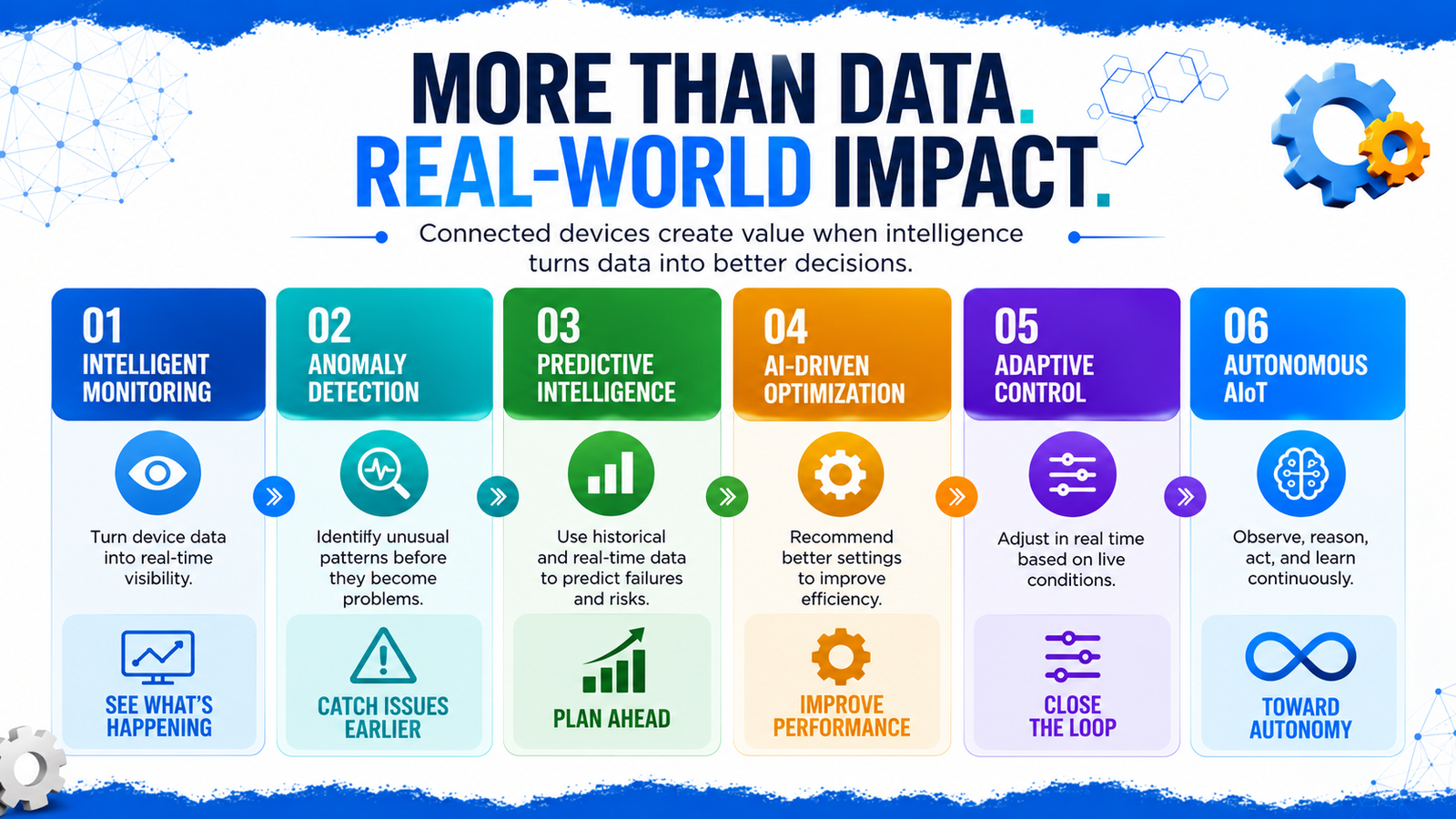
The five stages describe the journey. For an honest assessment it helps to split them into six testable levels — monitoring, detection, diagnosis, prediction, optimisation and autonomy. Connected and monitored systems sit in the first two, analytical systems reach diagnosis, predictive systems reach prediction, and autonomous systems cover optimisation and autonomy.
The rule that makes this useful: you are at the highest level for which you can produce the evidence, not the highest level you have built something toward. A model running in a notebook is not level four, and a pilot on two machines is not fleet-wide anything.
If you cannot show the artefact, you are at the level below.
The Six Levels and Their Evidence
Monitoring — the system reports what is happening
- Current data completeness per device, as a number
- Delivery latency between event time and ingest time
- A validation that readings match physical reality, done at commissioning
Common failure: dashboards exist but nobody can say what share of expected data actually arrives. That is level zero with a user interface.
Detection — the system identifies abnormal conditions
- Alerts that fire on conditions, with hysteresis so they do not oscillate
- An alert volume somebody actually reads — measured, not assumed
- A record of how many alerts led to an action
Common failure: alerts fire reliably and are muted. Detection that nobody acts on is detection in name only.
Diagnosis — the system explains why
- Alerts carrying probable cause, not only the triggering value
- Related alerts grouped into one incident rather than fifty notifications
- Comparison against peer assets, so “unusual” is defined relative to similar equipment
Common failure: the system reports symptoms and a human performs all the correlation. That is still level two.
Prediction — the system anticipates
- A stated accuracy figure measured against recorded outcomes
- Predictions carrying confidence and the signals behind them
- Monitoring for model drift, with an alert when accuracy degrades
Common failure: predictions are produced but outcomes are never recorded, so accuracy cannot be stated. Without that number this level cannot be claimed at all.
Optimisation — the system recommends the best action
- Recommendations ranked by expected value, not just severity
- Constraints encoded — cost, availability, scheduling, safety limits
- Evidence that recommendations are accepted more often than overridden
Common failure: a list of problems presented as a list of priorities. Prioritisation requires modelling consequence, not just confidence.
Autonomy — the system acts
- Authority limits enforced in code, not described in a document
- A complete audit trail of automated decisions and their outcomes
- A tested override and a defined safe state
- Specified behaviour during connectivity loss
Common failure: automation exists but operators have quietly disabled it, which means trust was never established. The requirements are set out in the 10 pillars of autonomous AIoT systems.
What Your Result Means
| Assessed level | The right next investment |
|---|---|
| Below 1 | Data completeness and validation. Nothing above works without it. |
| 1 | Alerting with discipline: hysteresis, grouping, measured action rate |
| 2 | Context and correlation so alerts explain themselves |
| 3 | A feedback loop recording outcomes — the prerequisite for prediction |
| 4 | Encoding constraints and consequence so recommendations can be ranked |
| 5 | Bounded authority, audit trail and tested override |
Two honest observations. Most systems assessed this way land at level one or two, and most organisations do not need to reach six — levels two and three deliver a large share of the available value at a fraction of the cost and risk.
What to Build Before Each Step Up
Each level depends on specific things existing in the system. Skipping one does not save time; it produces a level that cannot be trusted.
Monitoring Requires Trustworthy Ingestion
- Per-device identity, provisioned at manufacture
- Event-time timestamps recorded on the device, kept separately from ingest time
- A versioned, validated message schema with quarantine for non-conforming data
- Explicit gap markers rather than interpolation
- Durable local buffering with deduplicated replay
Skip it and: every layer above inherits data nobody can trust, and the failure appears much later as analytics that quietly disagree with reality.
Detection Requires Context and Alert Discipline
- Operating context stored alongside measurements — machine state, load, mode, ambient conditions
- Hysteresis and dwell time on every threshold
- Alarm lifecycle states: raised, acknowledged, cleared
- Grouping so one root cause produces one incident
- A measured alert action rate
Skip it and: alert volume exceeds what anyone reads, and the organisation concludes the system does not work when in fact nobody is looking at it.
Diagnosis Requires History and Comparability
- Time-series storage with retention and downsampling policies defined
- A canonical asset model so equipment can be compared like for like
- Consistent field definitions across firmware versions and sites
- Enough clean history to establish a baseline, typically many months
Skip it and: cross-asset comparison produces results nobody trusts, usually because the same field means different things in different places.
Prediction Requires a Feedback Loop
- A mechanism for operators to record what actually happened after each prediction
- Model version recorded with every inference
- Accuracy measured continuously against those recorded outcomes
- Drift monitoring on both inputs and accuracy
- A model update path that does not require a full firmware release
Skip it and: you cannot state accuracy, cannot detect degradation, and cannot improve — which is why so many predictive deployments are abandoned after a year without anyone being able to say whether they worked.
The feedback loop is the single piece of infrastructure most often missing and least often missed until it is needed.
Optimisation Requires Constraints and Consequences
- A cost model: what downtime, a callout, a spare part and a false alarm each cost
- Encoded constraints — parts availability, scheduling windows, crew capacity, safety limits
- Ranking by expected value rather than by confidence alone
- Integration with the planning or maintenance system that executes the work
Skip it and: the system produces a prioritised list that ignores whether the recommended action is even possible this week.
Autonomy Requires Bounded Authority and Evidence
- Authority limits enforced in code at the point actions are issued
- A deterministic safety layer independent of any learned component
- Defined behaviour during connectivity loss
- A complete audit trail: inputs, model version, confidence, action, outcome
- A tested override and a defined safe state
Skip it and: the organisation will not grant authority, and it is right not to. The full set is covered in the 10 pillars of autonomous AIoT systems.
How to Advance a Stage
That last point matters. Maturity models are frequently read as a ladder everyone should climb. They are better used as a diagnostic that tells you what is missing beneath what you already have — a distinction explored further in traditional IoT vs AIoT.
Where the Intelligence Should Run: Edge or Cloud
One of the most important architectural decisions is determining where intelligence should run.
Processing close to the device can provide:
- Lower latency
- Offline operation
- Reduced bandwidth
- Faster local decisions
- Better privacy
Valuable for industrial equipment, vehicles, and remote monitoring that need immediate responses.
Cloud infrastructure is useful for:
- Model training
- Historical analytics
- Fleet-wide intelligence
- Large-scale data processing
- Cross-device pattern analysis and model management
Many production systems therefore use a hybrid architecture — the edge handles fast local intelligence while the cloud handles fleet-wide intelligence:
Edge AI → Fast local intelligence • Cloud AI → Fleet-wide intelligence
The question should not simply be edge or cloud? It should be: where does each decision need to happen?
Why Reliable Embedded Engineering Still Matters
AI cannot compensate for unreliable hardware or poor data. An AIoT system still depends on the full chain:
Sensors → PCB → Firmware → Connectivity → Data → AI
Problems with sensor placement, calibration, sampling, power integrity, connectivity, or firmware can directly affect AI performance. This is why AIoT development requires coordination across embedded hardware, firmware, networking, cloud infrastructure, and machine learning — the intelligence layer is only as reliable as the engineering underneath it.
Common AIoT Development Mistakes
Several problems appear repeatedly when teams add AI to connected products.
Frequently Asked Questions
Conclusion
The IoT maturity model is most useful as a diagnostic rather than an ambition. Connected, monitored, analytical, predictive, autonomous — each stage builds something the next one needs, and each is cheap in order and expensive out of order.
Measure where you actually are. Fix what is missing beneath the capability you already have. Advance one asset class at a time, earn autonomy with a track record, and stop when the value stops. That approach produces programmes that keep working, which is a far better outcome than programmes that reached a stage nobody could sustain.