




IoT is the rare field where a team can be excellent at its own discipline and still ship a product that fails. A firmware engineer optimises power, a cloud engineer optimises throughput, an app developer optimises the interface — and the device still drains its battery in the field because nobody owned the interaction between all three.
Connected products fail at boundaries. The skills that matter most are therefore not the deepest specialisms but the ones that span them, and they are consistently the hardest to hire for.
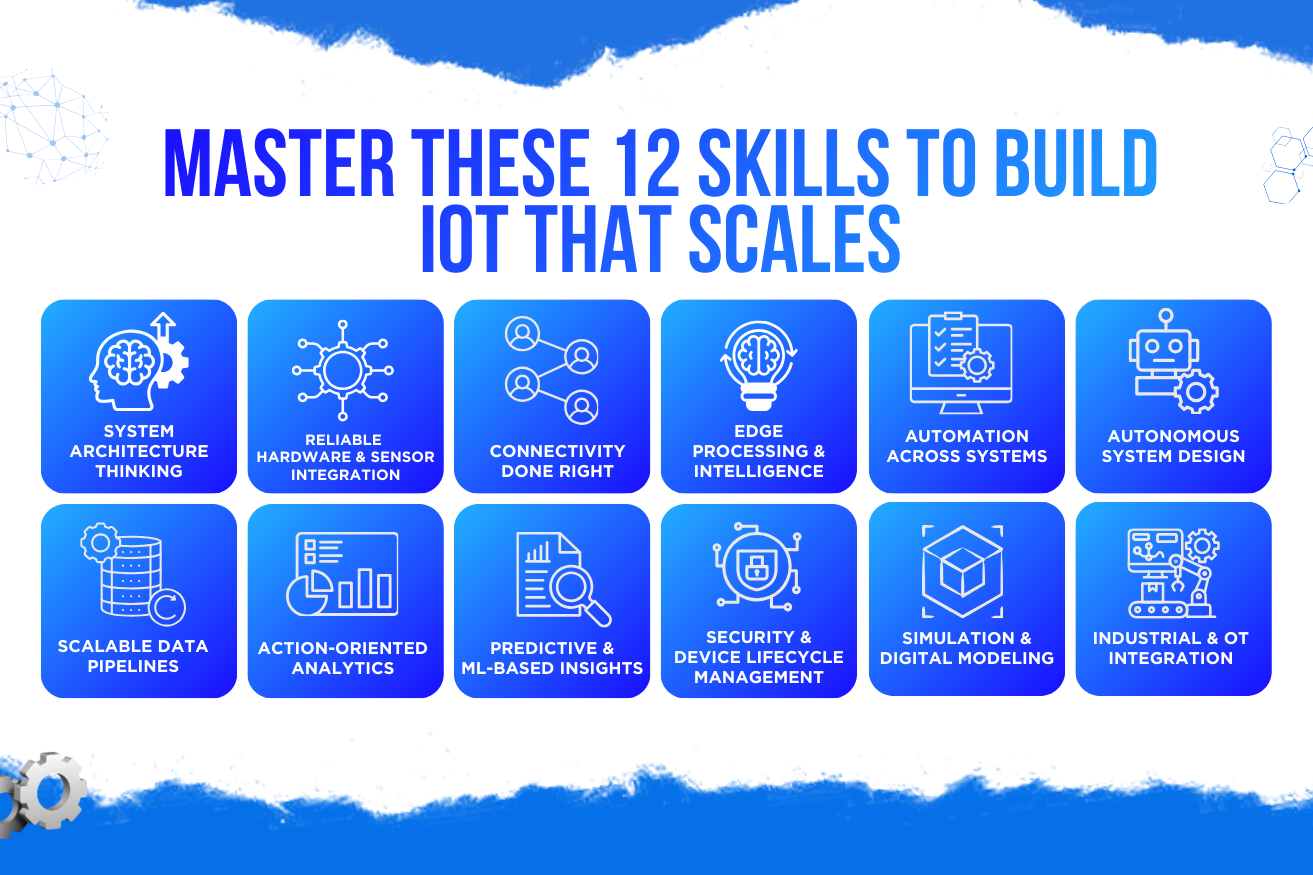
This is the set of twelve capabilities a team needs in order to build IoT systems that survive past the pilot — what each one covers, and what goes wrong when it is missing.
Skills at the Physical Layer
Embedded firmware under real constraints
Writing code that runs for years without a reboot, in limited memory, with no operating system to fall back on. This includes watchdogs, safe state machines, atomic flash writes, and handling every peripheral failure explicitly.
Without it: devices lock up in the field and require power cycling by someone on site.
Power budgeting and measurement
Calculating and then physically measuring energy per operation, understanding sleep modes, and knowing that transmitting costs far more than computing.
Without it: battery life estimates built from datasheet averages, and a product that lasts four months instead of three years.
Sensor selection and signal integrity
Knowing that placement, calibration, grounding, and noise matter more than sensor specifications. This skill is what prevents a system built on confidently wrong measurements.
Without it: plausible data that describes something other than what anyone intended to measure.
Design for the environment
Thermal behaviour, sealing, vibration, EMI, and mechanical stress. Understanding that a sealed enclosure breathes as it cycles, and that IP ratings describe a test rather than a lifetime.
Without it: devices that pass every bench test and fail months after installation.
Skills at the System Layer
Protocol and network judgement
Choosing between BLE, LoRaWAN, NB-IoT, Wi-Fi, and cellular based on range, power, cost, and the realistic worst-case link — not on peak throughput.
Without it: a radio choice that cannot be changed after deployment and constrains the product permanently.
Designing for disconnection
Buffering, ordered replay, idempotent records, and defined behaviour during outages. Treating disconnection as the normal state rather than an exception.
Without it: silent data loss, duplicated events, and reconnection storms that overwhelm ingestion.
Data modelling and schema discipline
Versioned payloads, explicit units, honest gaps, and the rule that a changed meaning always gets a new field. Understanding that a fleet always contains several firmware generations at once.
Without it: cross-asset comparison quietly becomes meaningless, and analytics produce confident errors.
Scalable backend and time-series design
Partitioning, retention, downsampling, backpressure, and asynchronous ingestion. Knowing that query performance degrades with accumulated history regardless of device count.
Without it: a platform that works beautifully for a year and then gets slower every month.
Skills That Decide Whether It Scales
Security across the whole path
Device identity provisioned at manufacture, secure boot, encrypted transport, signed updates, and credential rotation across a live fleet.
Without it: shared credentials across every device, and no way to revoke one that is compromised.
Fleet operations and update engineering
Provisioning, monitoring, staged rollout with automatic rollback, and remote diagnosis. This is the skill that determines how quickly any problem can be corrected.
Without it: every fix becomes a site visit, and growth is limited by how many devices one engineer can personally manage.
Field validation and manufacturing awareness
Understanding that installers are not designers, that unit-to-unit variation is real, and that commissioning checks catch problems no dashboard will. Designing for calibration and test at production scale.
Without it: silent data errors introduced at installation, invisible in every metric.
Systems thinking across boundaries
The ability to reason about how a firmware decision affects cloud cost, how a schema choice constrains future analytics, and how an architecture choice fixes battery life. Someone must own the whole path.
Without it: every component is locally optimal and the product still fails — the most common outcome of all.
The twelfth skill is the one that makes the other eleven add up. Without it a team has specialists; with it, it has a system.
Diagnosing the Gaps in Your Team
| Symptom | Missing skill |
|---|---|
| Battery life far below the estimate | Power budgeting and measurement |
| Devices reboot with no explanation | Embedded firmware discipline |
| Data looks fine but decisions are wrong | Sensor selection and signal integrity |
| Failures cluster at one site | Field validation and environment design |
| Gaps and duplicates in history | Designing for disconnection |
| Cross-site comparison is not trusted | Data modelling and schema discipline |
| Dashboards slow down every quarter | Time-series and backend design |
| Every fix requires a site visit | Fleet operations and update engineering |
| Each component works, the product does not | Systems thinking |
Read the table as a diagnostic rather than a hiring plan. Most teams have several of these symptoms, and they usually trace to two or three genuine gaps rather than twelve.
Building the Capability
Frequently Asked Questions
Conclusion
Building IoT systems that scale is less about assembling twelve specialists than about ensuring twelve capabilities are covered and, critically, connected. The physical layer decides what data is possible. The system layer decides whether it survives the journey. The operations layer decides whether anything can be fixed after launch.
Name someone accountable for the whole path, make firmware and cloud review each other, get engineers into the field, and treat fleet operations as a product in its own right. Teams that do this ship connected products that keep working — which is the only measure of success that outlasts the pilot.