




Most autonomous AIoT initiatives stall in the same place. The models work, the accuracy is defensible, the pilot produces a good number — and then the organisation declines to let the system act without a human confirming each decision. The technology was never the obstacle. Trust was.
Autonomy in connected systems is an engineering property before it is an AI capability. A system earns the right to act by being predictable, bounded, observable, and reversible — and none of those come from a model.
This guide sets out the ten pillars that determine whether an autonomous AIoT system can be trusted with real operations, and what each one requires in practice.
Why Autonomy Initiatives Fail to Scale
The gap between a working model and an operating autonomous system is filled with questions that have nothing to do with machine learning.
- What exactly is this system allowed to change, and what is it not?
- What happens when it is uncertain rather than wrong?
- How does anyone reconstruct why it acted as it did, three months later?
- What does it do when it loses connectivity mid-decision?
- How does an operator stop it, and what state does it fall back to?
- How would we know its accuracy had degraded?
An organisation that cannot answer these will not grant autonomy, and it is right not to. The pillars below are the answers.
Autonomy is not permission to act. It is a set of guarantees strong enough that permission becomes reasonable.
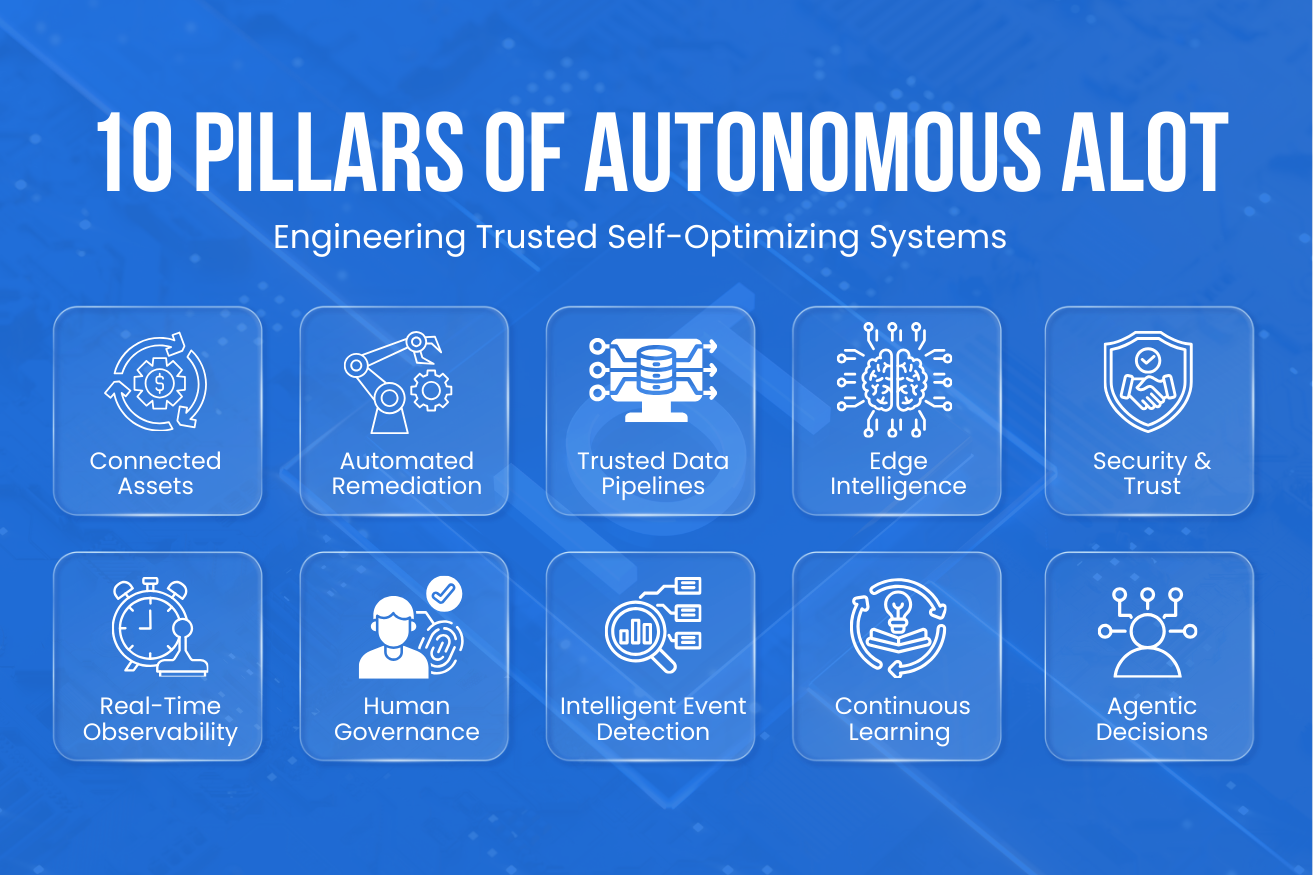
The 10 Pillars of Autonomous AIoT Systems
Trustworthy sensing
Autonomy multiplies the consequence of a bad reading, because no human filters it. Sensors need calibration strategy, drift detection, plausibility checks, and firmware that reports an explicit fault rather than a default value. A convincing wrong number is far more dangerous in an autonomous system than a missing one.
Data provenance and integrity
Every reading carries device identity, firmware version, calibration state, and the time it was measured. Gaps are explicit and never interpolated. Without this, no automated decision can be explained after the fact — and explanation is the precondition for trust.
Bounded authority
A written specification of what the system may change, within what limits, and at what rate. Not a policy document but an enforced constraint in code: this setpoint may move within this range, no more than this often, never beyond these absolute bounds.
Bounded authority is what converts autonomy from an open-ended risk into a defined one, and it is usually the pillar that unlocks organisational approval.
Calibrated uncertainty
The system must know when it does not know. Every decision carries a confidence value, and low confidence routes to a human instead of proceeding. A system that acts with equal conviction on clear and ambiguous cases will eventually act badly on an ambiguous one.
Deterministic safety layer
Safety interlocks must be simple, deterministic, and independent of the learned components. A model may decide to raise a temperature; a fixed limit decides it can never exceed an absolute maximum.
This separation is what makes the whole system reviewable. The learned part can be sophisticated because the safety part is simple enough to verify exhaustively.
Local autonomy during disconnection
Behaviour when the network fails must be defined rather than emergent. Typically: continue operating within the last known safe envelope, log every decision, and revert to a defined conservative state if the outage exceeds a threshold. Autonomy that depends on connectivity is not autonomy.
Complete decision audit trail
Every automated action records what was decided, the inputs it was based on, the model version, the confidence, and the outcome. This is what makes incident investigation possible and what regulators, insurers, and operations leaders will ask for first.
Reversibility and override
Operators need a reliable way to stop the system and return it to manual control, and that path must be tested regularly rather than assumed. Where an action cannot be undone physically, it requires human approval regardless of how accurate the model is.
Continuous performance monitoring
Accuracy must be measured continuously against recorded outcomes, with alerts on degradation. Equipment ages, seasons change, processes are modified — and a model that was correct at deployment drifts silently. Undetected drift is the single most common way an autonomous system loses credibility.
Governed model lifecycle
Versioned models, staged rollout, automatic rollback, and a record of which version made which decision. A model update is a change to operational behaviour and deserves the same discipline as a firmware release — including the ability to revert quickly when a new version behaves unexpectedly.
Earning Autonomy in Stages
Organisations that reach genuine autonomy almost always pass through the same progression, and the ones that skip it get their automation switched off by the people it was meant to help.
| Stage | System behaviour | What it establishes |
|---|---|---|
| Advisory | Recommends; humans decide and act | An accuracy record against real outcomes |
| Supervised | Proposes a specific action for approval | That proposed actions are appropriate, not just correct |
| Bounded autonomy | Acts within strict limits, escalates the rest | That constraints hold under real conditions |
| Broad autonomy | Acts across a wider envelope, humans supervise | Sustained reliability at operational scale |
Each stage generates the evidence the next one requires. Advisory mode is not a delay before the real system — it is how the accuracy record that justifies autonomy gets built.
Is Your System Ready for Autonomy?
These are the same foundations that determine whether any connected system can be trusted, examined in more depth in the data properties behind reliable AIoT systems.
Frequently Asked Questions
Conclusion
Autonomous AIoT is not achieved by making models better. It is achieved by making systems answerable — trustworthy sensing, traceable data, authority written into code, calibrated uncertainty, an independent safety layer, defined offline behaviour, a complete audit trail, tested reversibility, continuous accuracy monitoring, and a governed model lifecycle.
Those ten pillars are what let an organisation say yes. Build them first, earn authority in stages, and autonomy stops being a proposal that stalls in review and becomes a capability the operations team actually wants.