



Artificial Intelligence is transforming connected products, but deploying machine learning models in the real world requires much more than achieving high accuracy in the lab.
As IoT devices become smarter, businesses are increasingly moving intelligence closer to where data is generated. Instead of sending every sensor reading to the cloud, Edge Machine Learning (Edge ML) enables devices to process data locally, respond instantly, and continue operating even when connectivity is unreliable.
At MetaDesk Global, we’ve seen that successful Edge ML projects are driven by system architecture—not just machine learning models. Building production-ready Edge AI requires balancing performance, hardware limitations, power consumption, security, and long-term maintainability.
In this article, we’ll explore how Edge Machine Learning works, its advantages, deployment strategies, engineering challenges, and best practices for building reliable AI-powered IoT solutions.
What Is Edge Machine Learning?
Edge Machine Learning is the practice of running AI and machine learning models directly on edge devices or nearby gateways instead of relying entirely on cloud servers.
These edge devices may include:
- Embedded microcontrollers
- Industrial gateways
- Single-board computers
- Smart cameras
- Wearable devices
- Autonomous robots
- Medical equipment
- Connected consumer electronics
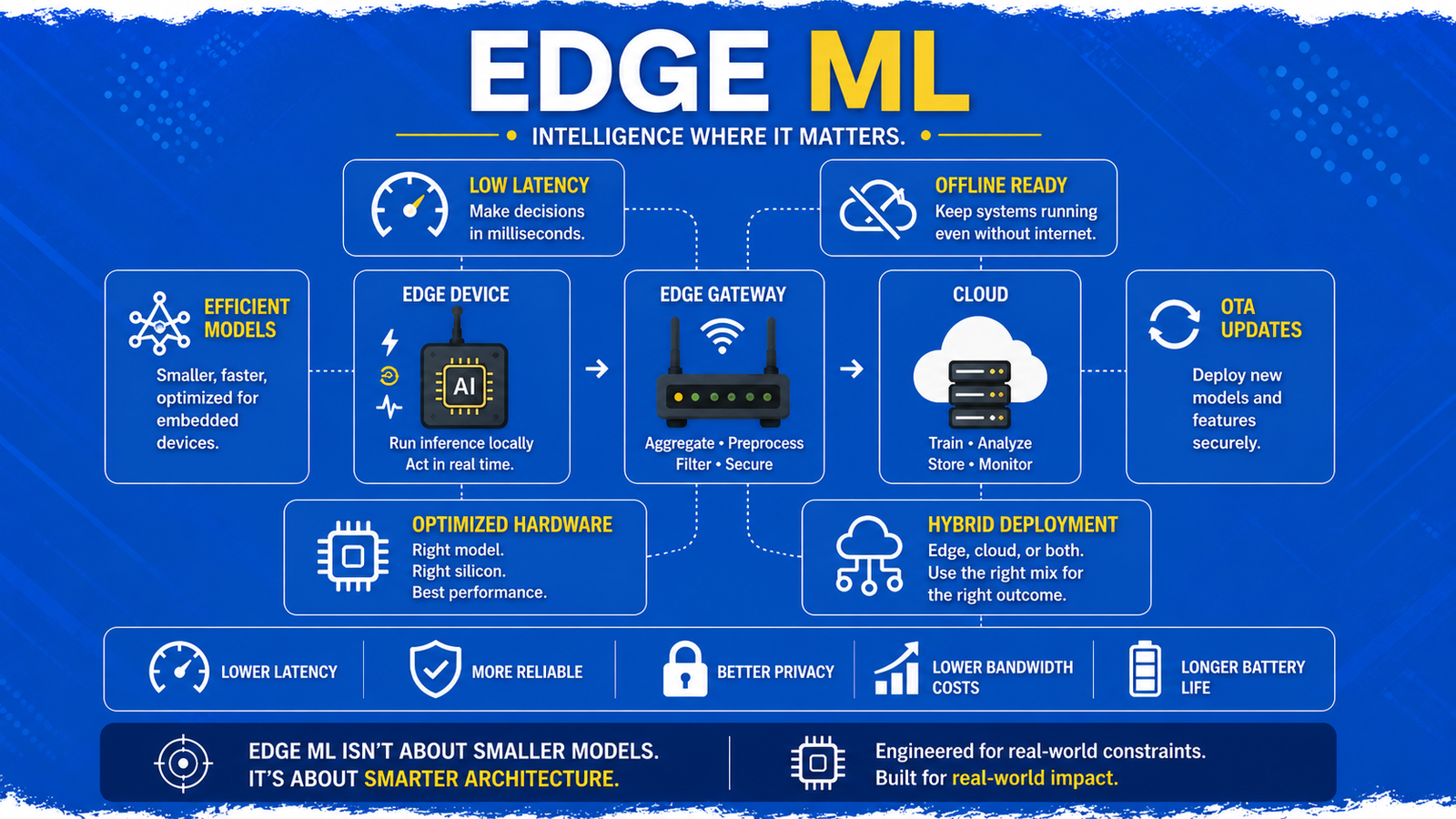
Instead of continuously transmitting raw sensor data to the cloud, Edge ML processes information locally and sends only meaningful events, summaries, or predictions. This approach enables faster decisions while reducing bandwidth usage and cloud infrastructure costs.
Why Edge Machine Learning Is Growing
Traditional cloud-based AI works well for many applications, but it introduces several limitations. Every cloud request adds latency, consumes bandwidth, and depends on reliable internet connectivity. Edge ML solves these challenges by bringing intelligence closer to the source of data.
Key benefits include:
- Real-time decision making
- Reduced network latency
- Lower cloud operating costs
- Better data privacy
- Offline operation
- Improved scalability
- Reduced bandwidth consumption
- Faster response to critical events
These advantages make Edge ML particularly valuable in industrial automation, healthcare, smart cities, transportation, agriculture, and energy management.
Common Edge Machine Learning Applications
Edge ML is powering the next generation of intelligent connected products. A few of the most common deployments include:
Industrial Predictive Maintenance
Machines continuously monitor vibration, temperature, pressure, and current consumption to detect failures before they occur.
Smart Manufacturing
Vision systems inspect products directly on production lines without requiring cloud processing.
Smart Retail
Edge cameras perform occupancy analysis, customer counting, and inventory monitoring while protecting customer privacy.
Healthcare Devices
Medical equipment analyzes patient data locally for faster alerts and improved reliability.
Smart Agriculture
Sensors detect irrigation requirements, crop health, and environmental conditions even in remote locations with limited connectivity.
Autonomous Vehicles and Robotics
Robots and vehicles require instant decisions where cloud latency is unacceptable.
The Engineering Challenges of Edge ML
Deploying machine learning on embedded systems introduces unique engineering constraints that rarely appear in cloud-only projects:
Model Optimization Techniques
Efficient models are essential for successful Edge ML deployments. The most common optimization methods include:
Quantization
Convert floating-point weights into lower precision formats such as INT8.
- Smaller model size
- Faster inference
- Lower memory usage
- Reduced power consumption
Model Pruning
Remove redundant neural network connections that contribute little to prediction accuracy. Pruning improves efficiency while maintaining performance.
Knowledge Distillation
Train a compact “student” model using predictions from a larger “teacher” model. This approach preserves much of the original model’s intelligence while reducing computational requirements.
Hardware-Aware Training
Optimize models specifically for the target processor, accelerator, or neural processing unit (NPU).
- ARM Cortex-M processors
- ESP32 AI accelerators
- NVIDIA Jetson
- Google Coral TPU
- NXP i.MX processors
Edge ML Deployment Architectures
Choosing the right deployment strategy is just as important as selecting the model itself. Three architectures cover most real-world systems:
Fully On-Device Inference
The entire AI model executes locally on the device.
- Real-time control
- Privacy-sensitive applications
- Battery-powered devices
- Remote deployments
Gateway-Based Inference
Multiple sensors transmit data to a nearby edge gateway that performs the AI processing.
- Industrial automation
- Smart buildings
- Factory monitoring
Hybrid Edge-Cloud Architecture
The most common architecture for enterprise AIoT systems, combining low latency with centralized intelligence. Edge devices handle local inference, event detection, and immediate automation, while the cloud handles:
- Model training
- Fleet management
- Historical analytics
- Dashboard visualization
- Long-term optimization
Building Production-Ready Edge ML Systems
Running a model successfully is only one part of a production deployment. Reliable systems also require:
Secure OTA Updates
Machine learning models evolve over time. Organizations need secure mechanisms to update models remotely without risking device stability.
Model Version Management
Every deployed device should report its model version, firmware version, performance metrics, and deployment status. Version visibility simplifies troubleshooting across large fleets.
Drift Monitoring
Operating conditions change, sensor behavior shifts, and equipment ages. Edge ML systems should continuously monitor prediction quality and detect model drift before accuracy declines significantly.
Efficient Data Collection
Rather than sending raw telemetry continuously, devices should transmit detected anomalies, prediction confidence, aggregated summaries, and operational statistics. This reduces bandwidth while preserving valuable insights.
Best Practices for Successful Edge ML Projects
Organizations planning Edge ML deployments should consider these recommendations:
The Future of Edge Machine Learning
Edge ML continues to evolve rapidly. As embedded hardware becomes more capable, more intelligence will move from centralized cloud platforms directly onto connected devices. Emerging technologies include:
As these capabilities mature, decision-making will continue moving to exactly where it matters most—at the edge.
Conclusion
Edge Machine Learning is changing how intelligent connected products are designed. Success is no longer determined solely by model accuracy—it depends on designing AI systems that operate reliably within real-world constraints such as limited compute, memory, power, bandwidth, and connectivity.
Organizations that combine optimized machine learning models with robust embedded firmware, secure device management, scalable cloud infrastructure, and intelligent deployment strategies will be better positioned to deliver high-performance AIoT solutions.
The future of connected products belongs to systems that make decisions where they matter most—at the edge.