



Building a connected product often starts with a simple question: how should the device communicate with the cloud?
For a small proof of concept, the answer may seem obvious — connect the microcontroller or embedded device directly to an IoT platform and start sending telemetry. But architecture decisions that appear simple during a prototype can have significant consequences when the product moves into production.
Why IoT Architecture Matters More Than You Think
The communication model you choose sits underneath everything else in the system. It quietly shapes:
- Network bandwidth
- System latency
- Device complexity
- Cloud infrastructure costs
- Reliability
- Security
- Fleet management
- Offline operation
- Scalability
This is why IoT architecture should be designed around the requirements of the complete product — not just the first prototype.
What Is a Device-to-Cloud IoT Architecture?
In a device-to-cloud architecture, each connected device communicates directly with a cloud platform. A typical flow looks like:
Sensor → Embedded Device → Internet → Cloud Platform → Application
The device may connect using Wi-Fi, Ethernet, cellular, or another IP-based connection. Cloud platforms such as AWS IoT, Azure IoT, and other IoT backends can then handle telemetry ingestion, device management, analytics, storage, and application services.
The biggest advantage is simplicity. There are fewer components between the device and cloud, which can make the system:
- Faster to prototype
- Easier to understand
- Easier to deploy initially
- Less expensive in small deployments
- Straightforward to integrate with cloud services
For example, a relatively simple environmental monitoring device may only need to periodically send temperature and humidity data. Introducing a gateway into such a system could add unnecessary complexity.
Where Device-to-Cloud Architecture Starts to Struggle
The problem usually appears when the fleet grows. A system that works perfectly with 20 or 50 devices may behave very differently with thousands of devices generating continuous telemetry.
More devices can mean:
- More network connections
- Higher bandwidth consumption
- Increased cloud ingestion
- More authentication endpoints
- Greater dependency on connectivity
- Higher communication costs
There is also another issue: the device becomes responsible for more of the communication stack. A constrained embedded device may need to handle connectivity management, authentication, encryption, protocol handling, retries, buffering, and cloud communication while also performing its actual application tasks. That isn’t always a problem — but it should be an intentional design decision.
What Is a Gateway-Based IoT Architecture?
A gateway-based IoT architecture introduces an intermediate computing layer between devices and the cloud. The architecture typically looks like:
Sensors → Edge Devices → IoT Gateway → Cloud → Applications
The gateway can communicate with multiple local devices and then communicate upstream with the cloud. It may be a dedicated industrial computer, a Raspberry Pi-class device, an embedded Linux system, an industrial controller, or another edge-computing platform.
What Does an IoT Gateway Actually Do?
A gateway isn’t simply a networking box — it can become an important processing and control layer within the system.
Data Aggregation
Instead of every sensor independently sending every measurement to the cloud, the gateway can collect data from multiple devices and package it efficiently.
Data Filtering
Not every sensor reading needs to reach the cloud. The gateway can remove redundant or irrelevant information before transmission.
Protocol Translation
Industrial and embedded systems often use different communication protocols. A gateway can bridge technologies such as:
- BLE
- Modbus
- CAN
- RS-485
- Zigbee
- Ethernet
- MQTT
This allows legacy equipment and modern cloud systems to coexist.
Local Processing
The gateway can perform analytics or business logic locally. For example, instead of sending thousands of vibration measurements to the cloud, it could calculate features locally and transmit only relevant anomalies.
Offline Operation
One of the biggest benefits is resilience. If the internet connection disappears, the gateway can continue collecting data, buffering events, and potentially making local decisions until connectivity returns.
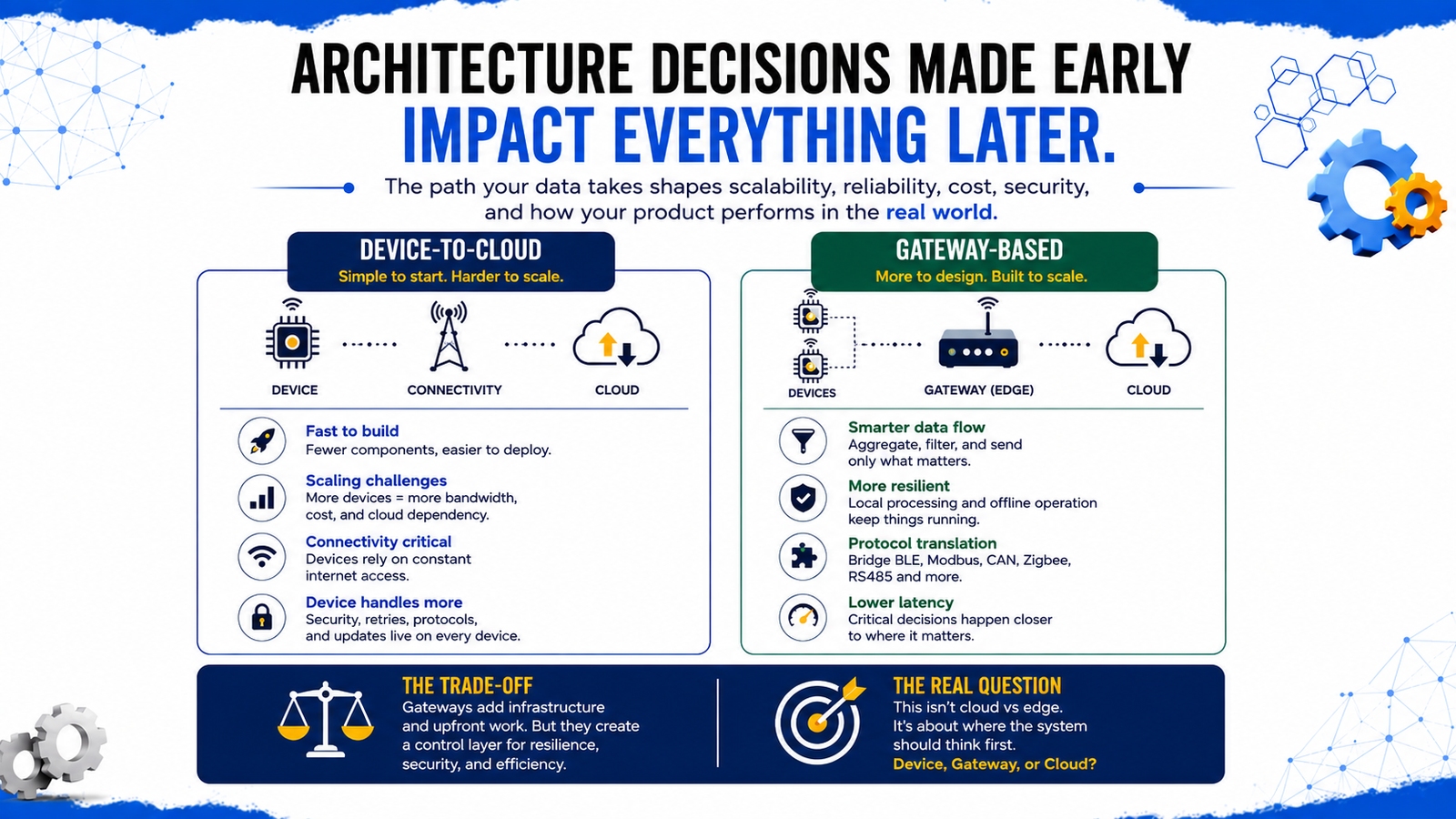
Device-to-Cloud vs Gateway-Based IoT
The right architecture depends heavily on the application. Neither model is universally better — the correct choice depends on where computation, communication, and decision-making need to happen.
| Factor | Device-to-Cloud | Gateway-Based |
|---|---|---|
| Initial complexity | Lower | Higher |
| Prototype development | Easier | More involved |
| Local processing | Limited | Strong |
| Protocol translation | Limited | Excellent |
| Offline capability | Usually limited | Strong |
| Bandwidth optimization | Limited | Strong |
| Fleet scalability | Application dependent | Often better for dense deployments |
| Infrastructure | Minimal | Additional gateway layer |
| Edge intelligence | Limited | Strong |
| Gateway maintenance | None | Required |
IoT Gateway vs Edge Computing
The terms IoT gateway and edge computing are sometimes used interchangeably, but they aren’t exactly the same. A gateway traditionally focuses on communication, aggregation, and protocol translation. An edge-computing node can go further by running:
- Machine learning inference
- Local analytics
- Rules engines
- Databases
- Event processing
- Computer vision
- Control logic
In modern IoT systems, one device can perform both roles:
Sensors → Gateway + Edge AI → Cloud
The gateway collects sensor data, performs local inference, and sends only important events to the cloud.
When Should You Choose Device-to-Cloud?
Direct connectivity is often a good choice when:
- Devices already have reliable internet access
- Data volumes are relatively small
- Local processing requirements are minimal
- No complex protocol translation is needed
- Offline operation isn’t critical
- The fleet is relatively simple
- Minimizing infrastructure is a priority
For simple consumer devices, environmental sensors, and straightforward telemetry, direct cloud connectivity can be an excellent architecture.
When Should You Use an IoT Gateway?
A gateway becomes more attractive when the product requires:
- Local decision-making
- Multiple communication protocols
- Offline operation
- High device density
- Bandwidth reduction
- Industrial equipment integration
- Edge AI and local security boundaries
- Real-time or low-latency processing
A factory may have hundreds of sensors using different protocols. A local gateway can normalize and process that data before forwarding only what cloud applications need.
Security Considerations
Architecture also changes the security model. With direct device-to-cloud communication, every device becomes an internet-connected endpoint that needs appropriate:
- Authentication
- Encryption
- Credential management
- Certificate management
- Secure firmware
- OTA update mechanisms
A gateway can introduce an additional security boundary. Devices may communicate within a controlled local network while the gateway manages upstream cloud communication. However, gateways also introduce another device that must be secured, monitored, updated, and maintained.
Adding a gateway doesn’t automatically make an IoT system more secure. It creates another architectural layer that must be designed correctly.
Designing for IoT Scalability
One of the most common mistakes in IoT development is optimizing the architecture for the pilot rather than the final fleet. A pilot with 25 devices can tolerate processes that become impossible at 25,000 devices. Before choosing an architecture, work through these questions:
Device Count
How many devices will eventually exist across the full deployment?
Data Frequency
Will each device send one message every hour — or thousands of measurements every second?
Connectivity
What happens when devices lose internet access?
Latency
Does the system need millisecond-level local responses, or can decisions wait for cloud processing?
Power
Can the device afford continuous wireless communication?
Processing
Does data need to be analyzed before it leaves the physical environment?
Maintenance
How will firmware, certificates, configuration, and software updates be managed across the fleet?
These questions should influence the architecture before hardware and firmware development become difficult to change.
The Best IoT Architecture Is Often Hybrid
Modern connected products don’t necessarily have to choose one architecture exclusively. A stronger approach is often to divide responsibilities across multiple layers:
Device → Gateway → Cloud
Device
Handles immediate sensing and control.
Gateway
Handles local aggregation, filtering, protocol conversion, and time-sensitive processing.
Cloud
Handles large-scale storage, fleet management, analytics, dashboards, and long-term intelligence.
This creates an edge-to-cloud IoT architecture where each layer performs the work it is best suited for.
Designing the Right Architecture From the Start
There is no universal rule that says every IoT product needs a gateway — or that every device should connect directly to the cloud. The right architecture comes from answering a more fundamental question: where should each decision happen?
- If a decision requires immediate response, keep it close to the device.
- If multiple local devices need to coordinate, the gateway may be the right place.
- If the problem requires large-scale analytics or fleet-wide intelligence, the cloud may be the better environment.
The goal isn’t to push everything toward the edge or everything toward the cloud. It’s to place each responsibility where it makes the most technical and economic sense.
Final Thoughts
IoT architecture decisions made during the prototype stage can remain embedded in a product for years. Choosing between device-to-cloud and gateway-based IoT architecture therefore isn’t simply a networking decision — it affects scalability, reliability, security, latency, operating costs, and the ability of the product to function in the real world.
For simple connected products, direct cloud connectivity may be the cleanest solution. For complex industrial and edge environments, a gateway can provide the processing, protocol translation, and resilience needed for scale. And for many modern products, the answer is neither one nor the other — it’s a carefully designed device-to-edge-to-cloud architecture.
Design the architecture for the fleet you want — not just the prototype you have today.