Many organizations invest heavily in AI and IoT expecting autonomous operations to emerge automatically.
In reality, most AIoT initiatives struggle not because artificial intelligence is insufficient, but because the foundational system layers required for autonomy were never engineered correctly.
True autonomous IoT systems — capable of self-healing, self-optimizing, and adaptive operation — require intentional architecture built on reliable data, observability, and governed automation.
At MetaDesk Global, we’ve observed that AIoT solutions that successfully reach production maturity consistently share the same structural pillars.
This article outlines the ten essential foundations enterprises need to build trusted autonomous operations.
Why Most AIoT Automation Initiatives Fail to Scale
Organizations often pursue automation in reverse order:
- Deploy AI models first
- Add automation logic later
- Fix data and infrastructure afterward
This approach creates fragile systems that cannot safely operate without human supervision.
Autonomy does not emerge from algorithms alone.
It emerges from trustworthy system design.
Enterprises that succeed in AI-driven operations invest first in visibility, data integrity, and decision governance.
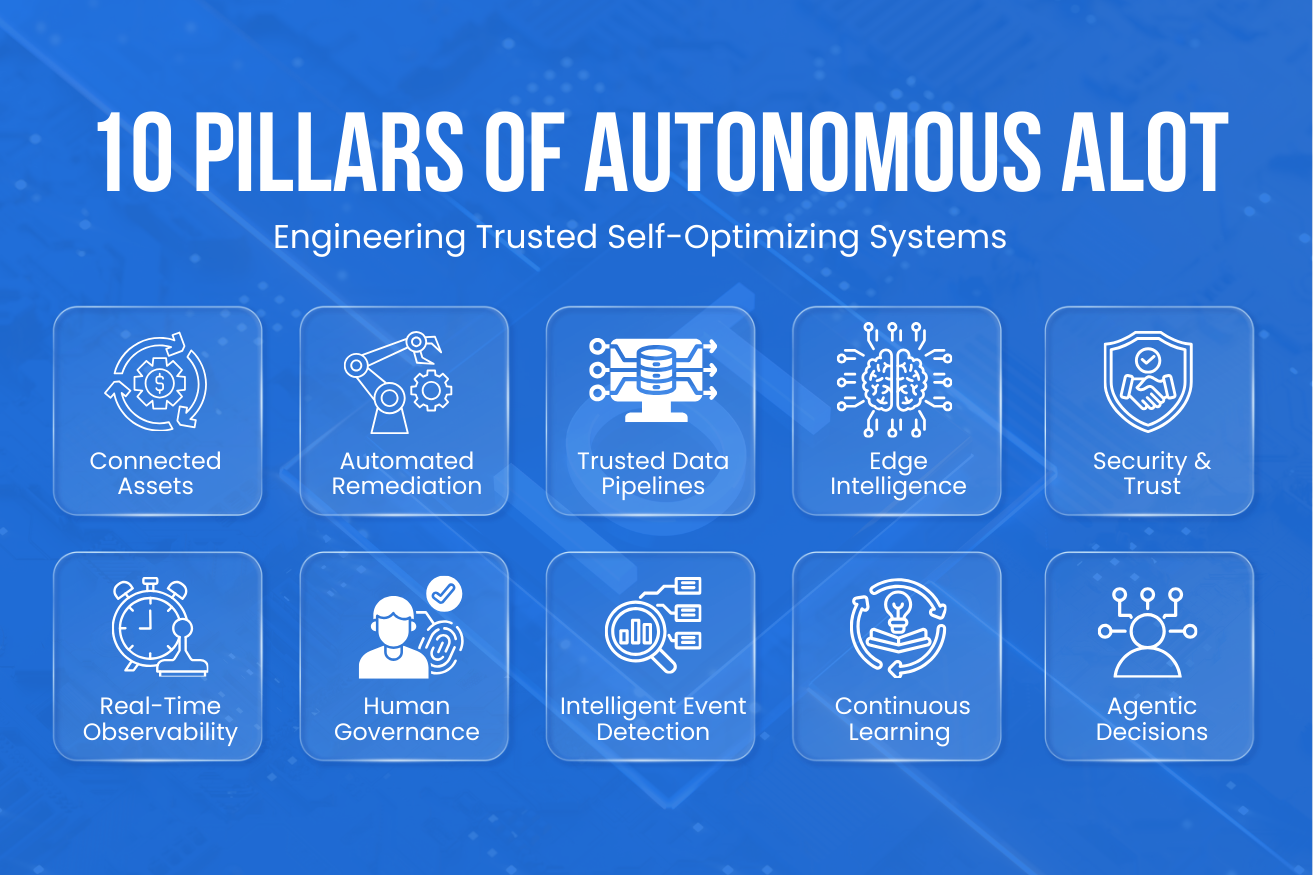
The 10 Pillars of Autonomous AIoT Architecture
Autonomous IoT systems evolve from connected monitoring toward self-optimizing control through ten foundational capabilities.
1. Connected Assets and Telemetry Foundations
Autonomy begins with visibility.
Machines, sensors, and edge devices must continuously stream reliable operational data across networks and environments.
Without consistent telemetry, AI cannot perceive system state.
Reliable asset connectivity ensures:
- Real-time situational awareness
- Accurate state representation
- Continuous operational feedback
2. High-Quality Data Pipelines
Automation depends on trustworthy data.
IoT signals must be validated, structured, timestamped, and enriched with context before AI can interpret them correctly.
Robust pipelines enable:
- Accurate model input
- Consistent event interpretation
- Reduced false automation triggers
3. Real-Time Observability
Autonomous systems require continuous awareness of their own behavior.
Observability enables systems to detect performance drift, anomalies, and failures before they escalate.
Key observability layers include:
- Device health metrics
- Network performance monitoring
- Decision execution tracking
- Latency and synchronization analysis
4. Intelligent Event Detection
AIoT environments generate massive telemetry streams.
Intelligent filtering and classification identify meaningful events — distinguishing normal operation from faults, anomalies, or behavioral changes.
Effective event detection enables:
- Early fault identification
- Predictive maintenance triggers
- Context-aware automation
5. Agentic Decision Engines
Autonomous operations require systems capable of interpreting context and determining actions without human intervention.
Decision engines evaluate:
- Current system state
- Historical patterns
- Risk thresholds
- Operational constraints
They transform insight into coordinated actions across devices and services.
6. Automated Remediation Capabilities
True autonomy includes response, not just detection.
When deviations occur, systems must automatically correct conditions through predefined or learned actions.
Examples include:
- Restarting processes
- Recalibrating devices
- Rerouting workloads
- Adjusting operating parameters
Automated remediation converts intelligence into operational resilience.
7. Edge Intelligence and Local Autonomy
Not all decisions can depend on cloud connectivity.
Edge AI enables immediate, low-latency decision-making close to physical processes, ensuring continuity during network disruption.
Edge autonomy supports:
- Safety-critical response
- Offline operation
- Real-time control loops
- Reduced latency dependency
8. Human-in-the-Loop Governance
Autonomous systems must operate within defined safety and compliance boundaries.
Human oversight provides:
- Policy definition
- Risk approval thresholds
- Exception handling
- Accountability assurance
Governed autonomy ensures systems remain aligned with operational intent.
9. Continuous Learning and Optimization
AIoT systems improve through experience.
Autonomous platforms must retrain and refine decision logic using real operational outcomes.
Continuous learning enables:
- Adaptive performance improvement
- Reduced future errors
- System optimization over time
10. Trust, Security, and Compliance Architecture
Enterprise autonomy depends on trust.
Autonomous systems must be secure, explainable, and auditable to scale safely across industries.
Trust foundations include:
- Secure device identity
- Encrypted communication
- Decision traceability
- Compliance alignment
- Model explainability
Without trust, autonomy cannot scale.
From Connected Systems to Autonomous Operations
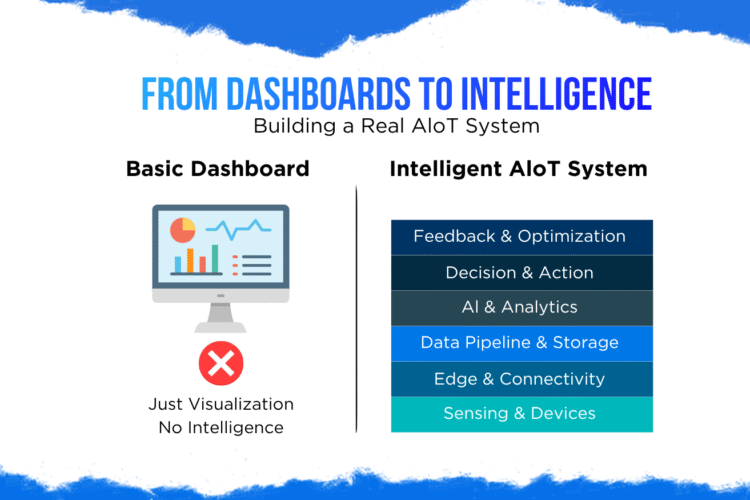
AIoT maturity evolves through stages:
- Connected monitoring
- Data analytics
- Predictive insight
- Assisted automation
- Autonomous optimization
Organizations often stall between stages 3 and 4 due to missing architectural pillars.
Building autonomy requires progressing intentionally through these layers.
Engineering Autonomous IoT with Trust
At MetaDesk Global, we design AIoT systems that evolve safely toward autonomy by strengthening each architectural pillar:
- Reliable telemetry architectures
- Robust data engineering pipelines
- Edge-cloud coordinated intelligence
- Secure OTA and lifecycle management
- Observability-driven automation
Autonomy is not a feature.
It is an engineered capability built across the entire system stack.
The Future of Enterprise AIoT Autonomy
As enterprises adopt AI-driven operations, autonomous IoT will define competitive advantage across:
- Industrial automation
- Energy infrastructure
- Smart cities
- Logistics and mobility
- Connected manufacturing
Organizations that build trust-centered autonomy architectures today will lead tomorrow’s intelligent operations.
Final Thoughts
Autonomous IoT systems do not emerge from AI models alone.
They are built through visibility, intelligence, governance, and trust across connected infrastructure.
Enterprises that invest in these foundations create systems that:
- Detect
- Decide
- Act
- Learn
- Optimize
At MetaDesk Global, we help organizations architect AIoT platforms that move beyond automation toward safe, trusted autonomy.