The Internet of Things has moved far beyond simple device connectivity. Today, organizations are no longer asking how to connect assets — they are asking how to make them intelligent, predictive, and autonomous.
Yet many IoT initiatives stall after deployment. Sensors are installed, dashboards are live, data is flowing — but measurable automation and ROI remain limited.
The reason is that IoT transformation is not a single step — it is a maturity journey.
True AI-powered IoT systems evolve through progressive layers of intelligence.
Understanding this evolution is critical for any business planning scalable IoT or AIoT solutions.
Why Most IoT Projects Stop at Connectivity
Many connected systems never progress beyond monitoring. Companies invest in devices and cloud dashboards expecting automation to emerge automatically.
In reality, intelligence must be engineered.
Common symptoms of stalled IoT maturity include:
- Data visibility without actionable insight
- Manual decision-making despite real-time telemetry
- Alerts without automated response
- Disconnected devices and platforms
- Limited operational impact from IoT investments
These challenges occur because organizations remain in early maturity stages while expecting advanced outcomes.
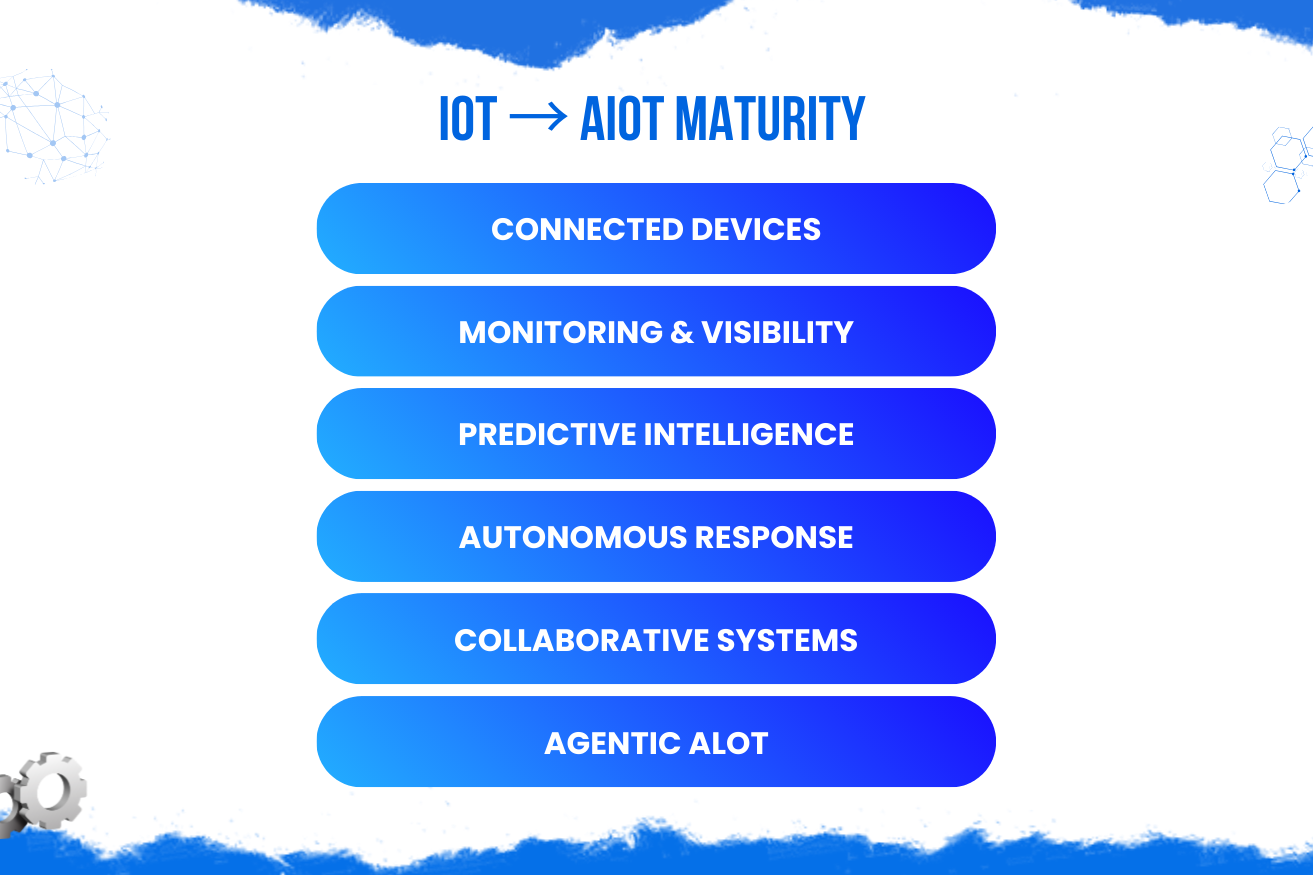
The IoT to AIoT Maturity Model
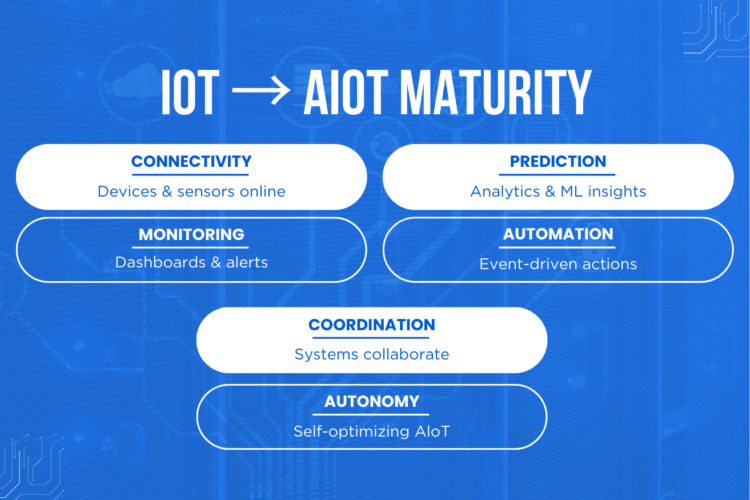
Based on real-world deployments across industries, IoT intelligence typically progresses through six distinct stages.
Stage 1 — Connected Assets (Reactive IoT)
At the foundation, devices and sensors transmit operational data to cloud or edge platforms.
Characteristics
- Sensor telemetry collection
- Device connectivity and communication
- Basic remote monitoring
- Manual interpretation
Business Value
Visibility into assets and environments.
Limitation
No automated intelligence or prediction.
Stage 2 — Operational Monitoring (Descriptive IoT)
Data becomes structured and visualized through dashboards, alerts, and reporting tools.
Characteristics
- Real-time dashboards
- Threshold-based alerts
- Status monitoring
- Historical logs
Business Value
Teams understand what is happening in operations.
Limitation
Still reactive — humans interpret and act.
Stage 3 — Predictive Intelligence (Analytical IoT)
Analytics and machine learning extract patterns from historical and live data.
Characteristics
- Predictive maintenance models
- Trend analysis
- Anomaly detection
- Performance forecasting
Business Value
Systems anticipate failures and inefficiencies.
Limitation
Insights exist, but action remains manual.
Stage 4 — Intelligent Automation (Adaptive IoT)
Event-driven automation enables systems to respond automatically to conditions.
Characteristics
- Rule-based automation
- AI-triggered actions
- Closed-loop control
- Workflow orchestration
Business Value
Reduced manual intervention and faster response.
Limitation
Automation often remains isolated per system.
Stage 5 — Ecosystem Coordination (Collaborative AIoT)
Multiple devices, platforms, and processes share context and coordinate decisions.
Characteristics
- Cross-system integration
- Shared operational context
- Device-to-device coordination
- Platform interoperability
Business Value
End-to-end operational optimization.
Limitation
Systems coordinate but don’t self-optimize continuously.
Stage 6 — Autonomous Operations (Agentic AIoT)
AI-driven systems independently plan, optimize, and adapt processes.
Characteristics
- Goal-driven AI agents
- Continuous learning
- Self-healing systems
- Adaptive optimization
Business Value
Autonomous, scalable operations with minimal human oversight.
Outcome
True AIoT maturity.
The Real Shift: From Visibility to Autonomy
IoT maturity is not defined by how many devices are connected.
It is defined by how independently systems can operate.
The transformation path typically follows:
Connectivity → Visibility → Prediction → Automation → Coordination → Autonomy
Organizations often attempt to jump directly from connectivity to AI automation.
Without strong data pipelines, observability, and integration layers, this leap fails.
Autonomy is not installed — it is built progressively.
Why AI Alone Does Not Create AIoT
A common misconception is that adding AI models to IoT systems automatically creates intelligence.
In practice, successful AIoT requires:
- Reliable telemetry integrity
- Context-rich data pipelines
- Real-time observability
- Edge-cloud coordination
- Automation frameworks
- Governance and safety controls
Without these foundations, AI becomes isolated analytics rather than operational intelligence.
How Organizations Can Advance IoT Maturity
Strengthening Data Foundations
Ensure accurate, synchronized, and contextualized telemetry across devices.
Enabling Real-Time Observability
Monitor performance, drift, latency, and failures continuously.
Introducing Predictive Analytics
Apply targeted ML models with clear operational outcomes.
Automating High-Value Actions
Convert insights into automated workflows.
Integrating Systems and Platforms
Unify devices, applications, and operational processes.
Scaling Toward Autonomous Operations
Deploy adaptive AI agents where stability and trust are established.
How MetaDesk Global Helps Organizations Evolve from IoT to AIoT
At MetaDesk Global, we work with companies across industries to design and scale connected systems that progress beyond monitoring into intelligence and automation.
Our expertise spans:
- Embedded IoT hardware design
- Edge AI and on-device intelligence
- Telemetry and data pipeline architecture
- Predictive analytics integration
- Automation frameworks
- Scalable IoT product engineering
We help organizations move from connected devices to autonomous systems — reliably and incrementally.
Conclusion: IoT Success Depends on Intelligence Maturity
Connecting devices is only the beginning of IoT transformation.
The real value emerges when systems evolve from visibility to prediction, from automation to autonomy.
For any organization investing in IoT, the key question is not:
How many devices are connected?
It is:
How intelligent and independent are your systems today?
Ready to advance your IoT systems toward AIoT maturity?
MetaDesk Global helps design scalable, intelligent, and autonomous connected solutions.