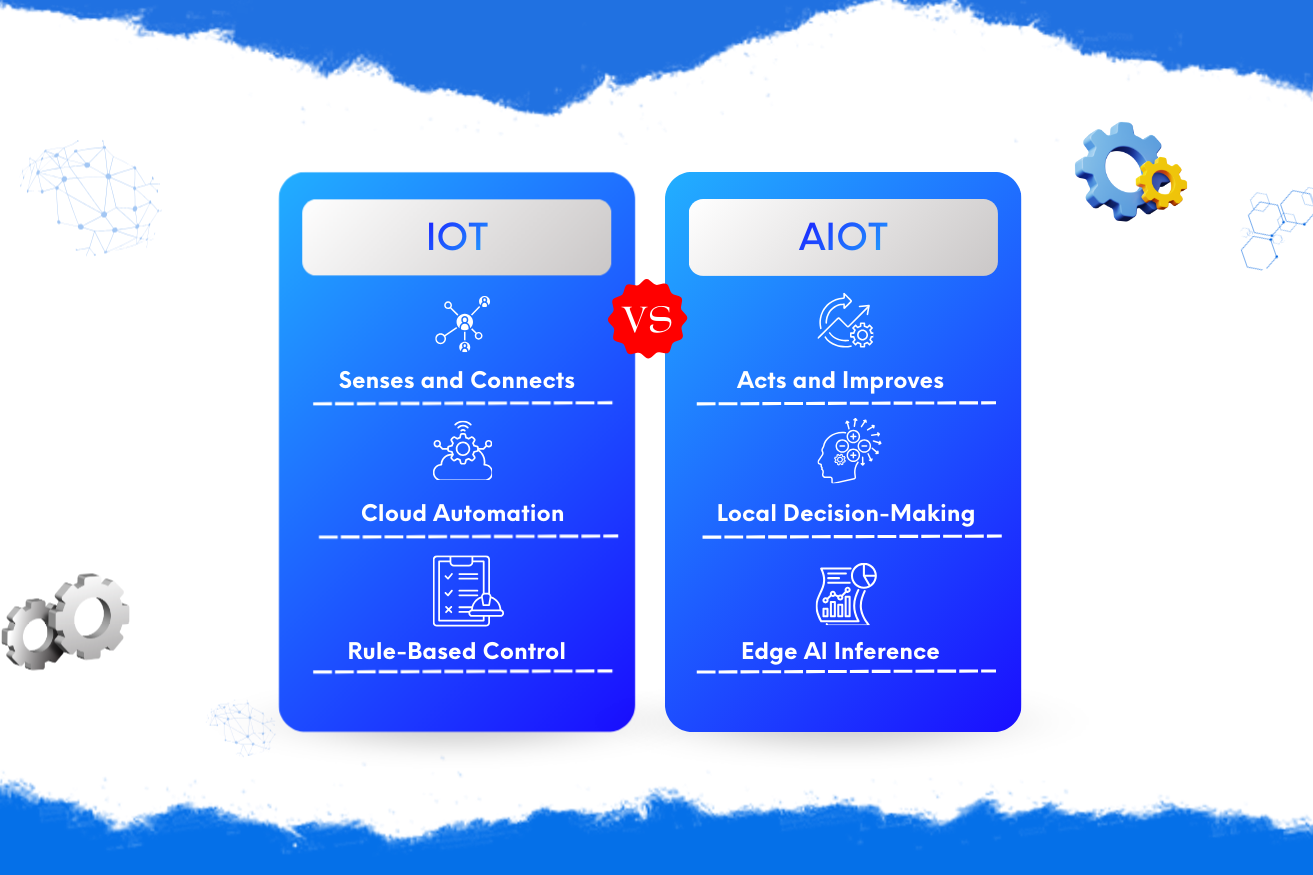
The terms IoT and AIoT are often used interchangeably, but in real product development they represent two very different engineering challenges.
While IoT focuses on connectivity and visibility, AIoT introduces autonomy, learning, and decision-making — requiring a fundamentally different approach to system design.
Understanding this distinction early can determine whether a product scales successfully or stalls in production.
What Traditional IoT Architecture Is Designed For
Traditional IoT systems are built around data collection and centralized processing.
Their goal is to reliably move information from the physical world into software platforms.
A typical IoT architecture includes:
- Sensors capturing telemetry
- Gateways aggregating and forwarding data
- Cloud services for storage and analytics
- Dashboards and rule engines for alerts and automation
This model works well for:
- Monitoring and reporting
- Asset tracking
- Condition-based alerts
- Cloud-driven workflows
IoT excels at visibility and control, but decision-making usually happens outside the device — in the cloud or by human operators.
The Shared Foundations of IoT and AIoT Systems
Both IoT and AIoT systems must be built on strong fundamentals:
- Secure device identity and authentication
- Encrypted, reliable data transport
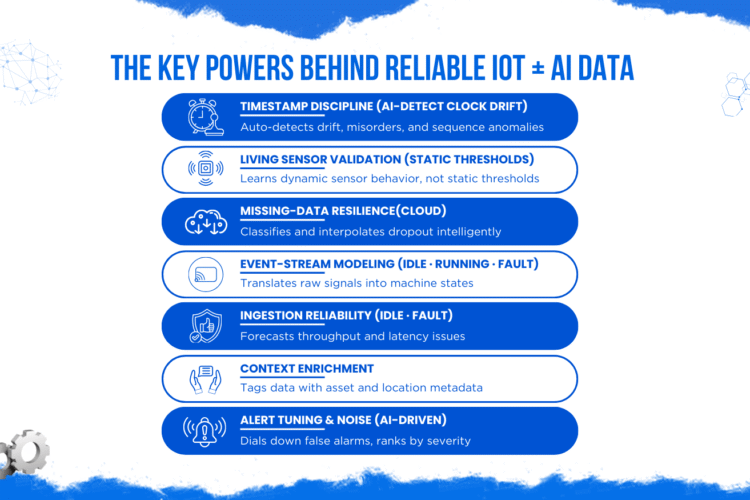
- Scalable and observable data pipelines
- Consistent schemas and interoperability
- Robust monitoring and logging
These are baseline requirements. They keep systems operational — but they do not make them intelligent.
What Makes AIoT Architecture Fundamentally Different
AIoT goes beyond connectivity by embedding decision-making into the system itself.
Instead of pushing all intelligence to the cloud, AIoT distributes it across the stack — often closer to where data is generated.
Key characteristics of AIoT systems include:
- Edge inference using optimized, lightweight models
- Local decision-making with low latency
- Reduced reliance on constant cloud connectivity
- Feedback loops that enable continuous improvement
The result is devices that don’t just report data — they interpret, decide, and act.
Edge Intelligence and Local Decision-Making
In AIoT systems, the edge is no longer a passive data forwarder.
By running small, quantized models locally, devices can:
- Respond in milliseconds
- Operate during network outages
- Preserve privacy by processing data locally
- Reduce cloud costs and bandwidth usage
This is essential for use cases where latency, safety, or availability matter.
Feedback Loops and Learning in the Field
One of the most overlooked aspects of AIoT is learning after deployment.
Production systems must be designed to:
- Capture outcomes of decisions
- Add structured context such as time, state, and environment
- Feed validated results back into training pipelines
Logs alone are not enough. Without feedback and labeling, models stagnate and system performance degrades over time.
Practical Design Principles for Real-World AIoT
- Start With the Decision, Not the Sensor
Define the action the system must take before selecting sensors or models. - Add Context Early
Time, location, device state, and user identity turn predictions into actionable outcomes. - Be Edge-First Where It Matters
If latency, privacy, or offline capability is required, cloud-only intelligence will fail. - Separate AI Recommendations From Actuation
Human-in-the-loop or rule-based gating improves safety and trust. - Treat OTA and Model Updates as Release Engineering
Versioning, rollback, validation, and governance must be planned from day one. - Design Observability for Decisions
Telemetry shows what happened. Decision observability explains why. - Build Security as a Foundation
Secure boot, certificates, encryption, and key rotation are essential as autonomy increases.
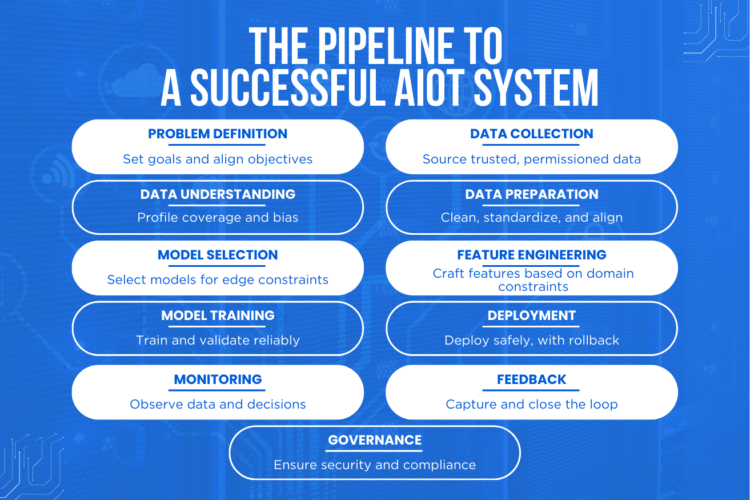
AIoT Is a Product Lifecycle Challenge, Not a Feature
AIoT is not about adding a neural network to an existing IoT product.
It requires rethinking:
- System architecture
- Data pipelines
- Update and rollback mechanisms
- Security and governance
- Operational workflows
Only when intelligence is treated as system design — not an add-on — do AIoT products scale reliably in the real world.
Building AIoT Systems That Ship
The most successful intelligent products are not defined by the complexity of their models,
but by the strength of their architecture.
Clear decisions, strong data foundations, disciplined deployment processes,
and secure operations matter more than algorithms alone.
At MetaDesk Global, we help teams design and build IoT and AIoT systems
that move beyond connected demos — and work reliably in production.