



Sound Frequency Analyzer
- Home
- portfolio
- Embedded IoT Solutions
- Sound Frequency Analyzer
Platform
ESP32
Type
Embedded / IoT
Analysis
FFT + Cloud
Status
Completed
Background
Real-Time Sound Monitoring and Frequency Analysis with Cloud-Connected Embedded Intelligence
The Sound Frequency Analyzer project was developed to enable real-time monitoring and analysis of sound environments using embedded systems and cloud connectivity. Traditional audio analysis tools are often complex and not suitable for continuous, remote monitoring. This project aimed to create a compact, scalable solution capable of capturing, processing, and transmitting audio data for intelligent insights across various applications such as environmental monitoring and diagnostics.
Challenges
Key Project Challenges
1
Real-Time Audio Processing
Capturing and analyzing live sound data efficiently on embedded hardware without introducing processing delays or data loss.
2
Accurate Frequency Analysis
Converting raw audio signals into reliable frequency-domain insights covering pitch and intensity across distinct frequency bands.
3
Data Storage & Traceability
Managing timestamped audio recordings on local storage to ensure full traceability and availability for later analysis and diagnostics.
4
Cloud Integration
Ensuring reliable Wi-Fi-based data transmission to cloud endpoints for real-time monitoring, categorization, and remote visualization.
5
Resource Constraints
Handling FFT-based signal processing within the limited memory and computational capacity of the embedded ESP32 platform.
Project Details
CategoryEmbedded / IoT
Client TypeIndustrial / Environmental
ControllerESP32
MicrophoneINMP441 (I2S)
AnalysisFFT + Cloud
StatusCompleted
Have a Similar Project?
We build custom embedded hardware and software solutions tailored to your needs. Let's talk.
Request a Free Quote →Solutions
How We Built It
Our Approach
ESP32 + FFT Audio Pipeline with SD Logging and Cloud Transmission
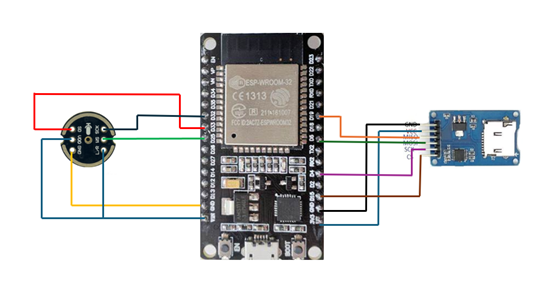
A sound analysis system was developed using the ESP32 paired with an INMP441 microphone for high-quality audio capture. The system records audio as timestamped WAV files stored on an SD card for traceability. A Fast Fourier Transform (FFT) algorithm is applied to convert audio signals into the frequency domain, enabling analysis of pitch and intensity across different frequency bands. Processed data is transmitted via Wi-Fi to cloud endpoints, where it is categorized and monitored in real time. The architecture ensures efficient performance while maintaining scalability for extended applications.
ESP32
INMP441 Microphone
FFT Algorithm
WAV Recording
SD Card Logging
Wi-Fi Transmission
Cloud Monitoring
Benefits
Value Delivered
Real-Time Sound Monitoring
Provides continuous, live insights into audio environments without requiring manual intervention or post-processing delays.
Accurate Frequency Analysis
Enables detailed understanding of sound characteristics including pitch, intensity, and frequency band distribution through FFT processing.
Cloud-Connected Intelligence
Allows remote monitoring, real-time data visualization, and intelligent categorization through cloud-connected endpoints.
Reliable Data Logging
Stores timestamped WAV recordings locally on SD card, ensuring full traceability and availability for offline diagnostics.
Versatile Application
Suitable for environmental monitoring, smart sensing, acoustic diagnostics, and a broad range of industrial audio analysis use cases.
Client Feedback
What the Client Said
"
We needed something that could listen to our environment continuously and flag anomalies without a person having to be there. The frequency breakdown from the FFT is exactly the level of detail we were after — we can see precisely what's happening in each band. The timestamped local logs have already helped us trace back two incidents we couldn't explain at the time. Compact, accurate, and genuinely useful in the field.
Have a Similar Project?
We build custom embedded hardware and software solutions tailored to your needs.
Request a Free Quote →