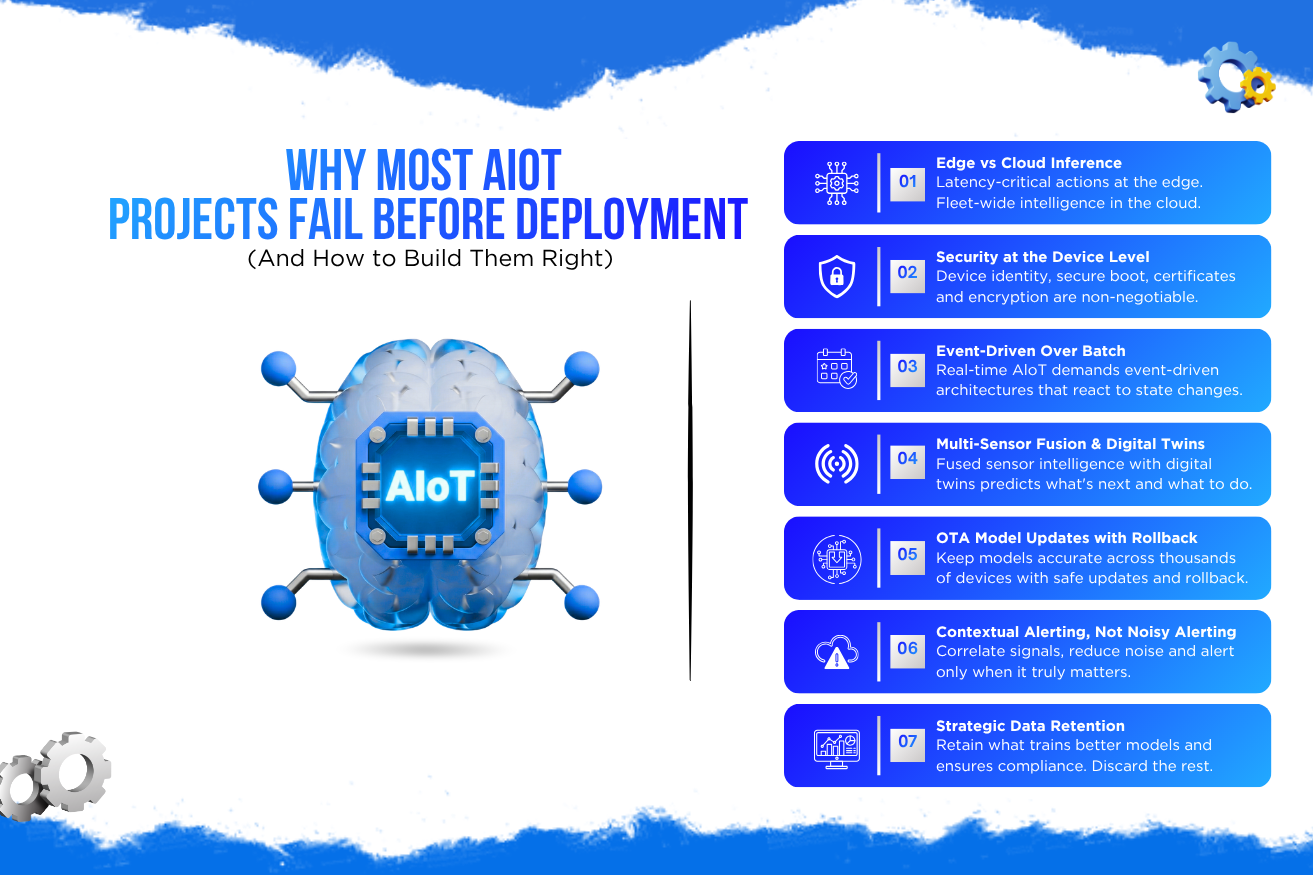
AIoT (Artificial Intelligence of Things) is often positioned as the next evolution of IoT — combining connected devices with intelligent decision-making.
But in reality, many AIoT initiatives never make it past the pilot stage.
Surprisingly, the failure is rarely due to poor machine learning models.
Instead, it comes down to one critical issue:
👉 Weak architectural decisions made early in the project lifecycle.
This article explores why AIoT systems fail — and the key architectural principles required to build scalable, production-ready platforms.
What Makes AIoT Different from Traditional IoT?
Traditional IoT systems focus on:
- Device connectivity
- Data collection
- Monitoring and dashboards
AIoT systems go further by:
- Processing data intelligently
- Making autonomous decisions
- Triggering real-world actions
- Continuously learning and improving
This shift requires a fundamentally different approach to system design.
The Real Reason AIoT Projects Fail
Most teams focus heavily on:
- Model accuracy
- Data science pipelines
- Algorithm optimization
While these are important, they overlook the foundation:
👉 System architecture determines whether AI can actually run in production.
Without the right architecture:
- Models cannot scale across devices
- Systems fail under real-world conditions
- Updates become risky and unmanageable
- Data pipelines break or become inefficient
7 Critical Architectural Decisions in AIoT Systems
To build successful AIoT platforms, teams must address these core design areas early.
1. Edge vs Cloud Inference Strategy
AIoT systems must decide where intelligence lives.
- Edge Computing: Handles real-time, low-latency decisions
- Cloud Computing: Performs large-scale analytics and model training
The most effective systems use a hybrid approach.
2. Device-Level Security as the Foundation
Security cannot be added later — it must be built from the ground up.
- Device identity management
- Secure boot mechanisms
- Certificate-based authentication
- Encrypted communication
If security starts at the cloud layer, the system is already vulnerable.
3. Event-Driven Architecture for Real-Time Systems
- Event-driven pipelines
- Real-time data processing
- Immediate response to state changes
4. Multi-Sensor Fusion and Context Awareness
- Better anomaly detection
- Predictive intelligence
- Context-aware decision-making
5. OTA Model Updates with Version Control
- Over-the-air (OTA) model updates
- Version control for firmware and models
- Safe rollback mechanisms
6. Contextual Alerting vs Alert Overload
- Correlate multiple signals
- Prioritize alerts
- Reduce noise
7. Strategic Data Retention and Management
- Retain high-value data
- Discard low-impact data
- Ensure compliance
Why Architecture Matters More Than Models
- Data pipelines must be reliable
- Devices must handle inference
- Updates must be safe
- Systems must scale
Best Practices for Building Scalable AIoT Systems
1. Hybrid Edge-Cloud Architectures
2. Security at Every Layer
3. Real-Time Processing
4. Continuous Model Management
5. Feedback Loops
Conclusion: Build for Reality
- Real-world environments
- Scalability
- Continuous operation
- ✔ Make architectural decisions early
- ✔ Design for real-world constraints
- ✔ Focus on system-level intelligence
About MetaDesk Global
MetaDesk Global specializes in designing and building end-to-end AIoT systems — from embedded firmware and hardware to scalable cloud platforms and intelligent automation.
We help organizations move beyond prototypes and deliver production-ready intelligent systems that perform reliably at scale.