




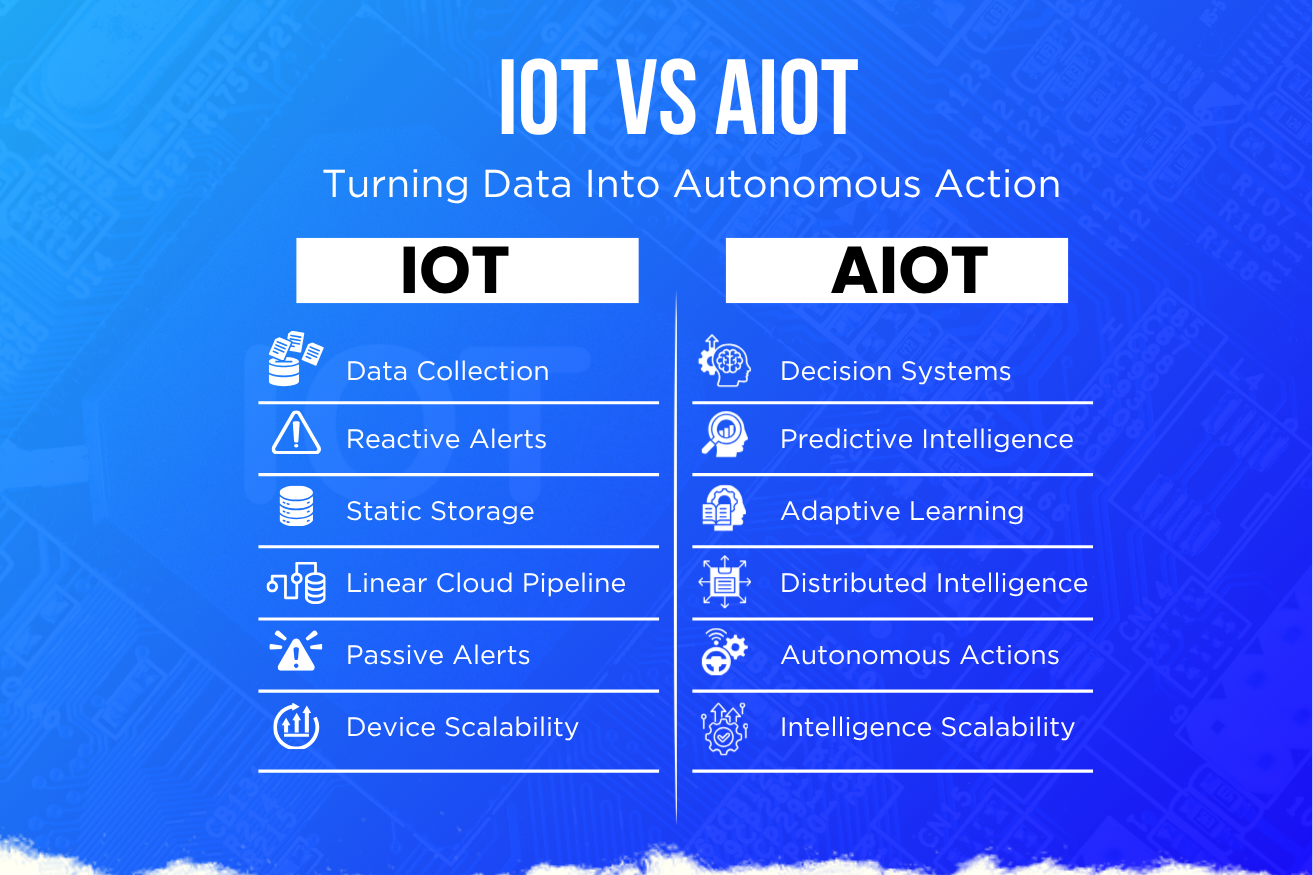
Most comparisons of IoT and AIoT stop at the definition: IoT connects things, AIoT adds artificial intelligence to them. That is accurate and almost useless, because it frames intelligence as an optional upgrade — something you bolt on when budget allows.
The more useful framing is economic. Plain IoT works beautifully at small scale and then hits a wall that has nothing to do with technology. Every connected device generates data that a human must eventually interpret, and human attention does not scale with device count. That mismatch is the real reason organisations reach for AIoT.
This article looks at IoT and AIoT through that lens: what specifically breaks as fleets grow, why adding people cannot fix it, and where intelligence has to sit for the economics to work.
IoT and AIoT, Defined by What They Produce
The clearest distinction is not the technology in each system but the output each one delivers to the organisation.
| Traditional IoT | AIoT | |
|---|---|---|
| Primary output | Measurements and visibility | Conclusions and recommended actions |
| Who interprets the data | A person, via a dashboard | The system, with a person supervising |
| Alerting model | Fixed thresholds | Learned patterns and per-asset baselines |
| Cost driver as fleet grows | Human attention | Compute and model maintenance |
| Value per added device | Diminishing — more to watch | Increasing — more to learn from |
| Typical failure at scale | Alert fatigue, ignored dashboards | Model drift, unexplained decisions |
Read the last two rows carefully, because they contain the whole argument. In traditional IoT, each additional device makes the system slightly harder to operate. In AIoT, each additional device makes it slightly better informed. The two curves point in opposite directions, and that is why the difference becomes decisive with scale rather than at launch.
What Actually Breaks as an IoT Fleet Grows
Scaling problems in connected systems are rarely about servers. Four specific things break, in a fairly predictable order.
Alert volume outruns human capacity
Threshold alerting has a fixed false-positive rate per device. Multiply that rate by ten devices and you get a manageable trickle. Multiply it by ten thousand and you get a stream nobody reads.
The failure is not that alerts stop arriving — it is that they keep arriving and stop being acted on. The system appears healthy while it has quietly become decorative.
Thresholds cannot express real conditions
A single limit must be loose enough to avoid nuisance alarms on the most variable asset and tight enough to catch problems on the most stable one. Those requirements conflict, so the threshold is set loose, and genuine early warnings fall below it.
Real failures rarely announce themselves in one variable. They appear as a change in the relationship between variables — vibration rising while load stays flat, temperature climbing slightly earlier in each cycle. No fixed limit captures that.
Bandwidth and storage costs grow linearly with no matching value
A fleet reporting everything, continuously, to the cloud pays for every byte twice — once in transmission and once in storage — while the overwhelming majority of that data is unremarkable. At small scale this is a rounding error. At large scale it becomes the dominant operating expense, and it buys almost nothing.
Response time cannot keep up with the process
Any workflow that ends in a person deciding inherits that person’s availability. Overnight, at a weekend, or during a shift change, the loop is open. For processes that move faster than a human response cycle, visibility arrives too late to change the outcome — the event is documented rather than prevented.
A connected system that produces more information than its operators can absorb has not scaled. It has simply grown.
The Attention Economics of Connected Fleets
The obvious response to alert overload is to hire more analysts. It rarely works, for three structural reasons.
- Cost scales with the fleet. If monitoring headcount grows in proportion to devices, the marginal device never becomes profitable — which defeats the point of connecting things in the first place.
- Judgement is inconsistent. Two operators reach different conclusions from the same data, and the same operator reaches different conclusions at hour one and hour seven of a shift.
- Experience does not accumulate. A skilled operator learns which alerts matter, and that knowledge leaves with them. Nothing is captured in a form the system can reuse.
Intelligence in the system solves all three at once. It applies the same criteria to every asset, it costs compute rather than salary as the fleet grows, and it encodes learned behaviour in a way that persists.
None of that means removing people. It means changing what they are asked to do — from watching for problems to deciding on candidates the system has already identified and explained.
Where the Intelligence Has to Live
Deciding to add intelligence is easy. Deciding where to run it is the architectural choice that determines whether the economics improve.
Systems that scale well almost always use all three, with a clear division of labour: the device decides what happened, the edge decides what it means here and now, and the cloud decides what it means across the fleet over time. Pushing everything to one tier is the most common architectural mistake, and it is worth resolving early — the trade-offs are covered in more detail in our guide to choosing an IoT deployment architecture.
What Has to Be True Before AIoT Works
Adding intelligence to a system with weak foundations produces confident nonsense faster than it produces value. Three things must be in place first.
These are the same foundations that determine whether any connected system earns trust, and they are explored in depth in the data properties behind reliable AIoT systems.
When Plain IoT Is Genuinely the Right Answer
Intelligence is not always warranted, and pretending otherwise wastes money. Traditional IoT remains the correct choice when:
- The fleet is small enough that a person can meaningfully review it
- The decision rule is genuinely simple and stable — a tank is full or it is not
- Regulation requires deterministic, explainable behaviour with no learned component
- The data foundation is not yet reliable enough to support inference
- Nobody has identified an action that a prediction would actually change
The honest test is a question about consequence: if this system told you something a day earlier, what would you do differently, and what is that worth? If there is no clear answer, better visibility is the right investment and intelligence can wait.
Frequently Asked Questions
Conclusion
IoT and AIoT are not competing technologies, and AIoT is not a more advanced product category. They are two answers to the same question — who turns measurements into decisions — and only one of those answers survives contact with a large fleet.
Connected systems need intelligence to scale because human attention is the resource that runs out first. The organisations that get real value from this are not the ones with the most sophisticated models. They are the ones that fixed their data foundation, named a decision worth automating, and put the intelligence at the tier where it changed the economics.