




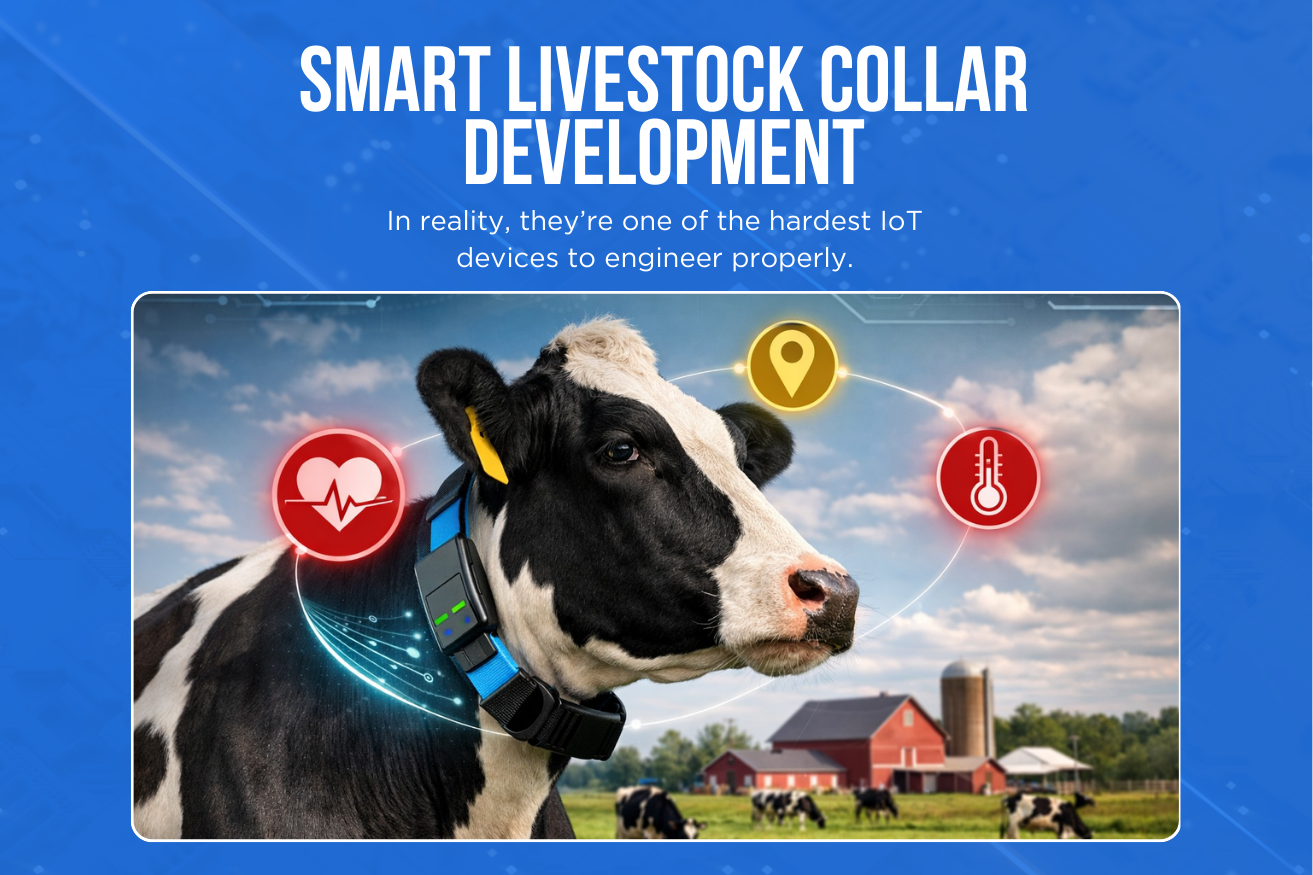
A cow collar looks like one of the simplest IoT products imaginable: an accelerometer, a radio, a battery, and a plastic housing. In practice it is one of the most demanding embedded products a team can attempt.
The device must survive years strapped to a large animal that rubs against steel gates, stands in the rain, lives in ammonia-rich air, and never stops moving. It must run for the whole of that time on a battery that cannot be recharged. It must reach a gateway from a field with no mains power. And the behaviour it is trying to detect — rumination, heat, lameness, calving — is subtle, individual, and easily masked by noise.
This article walks through the engineering constraints that actually decide whether a livestock monitoring product works, based on the physics and economics of the problem rather than the marketing.
What Smart Livestock Monitoring Is Trying to Detect
Before the engineering makes sense, it helps to be precise about the biological signals a collar is expected to infer. Each one has a different detection difficulty and a different commercial value.
| Signal | What it indicates | Detection difficulty |
|---|---|---|
| Rumination time | Digestive health, feed quality, early illness | Moderate — distinctive jaw motion pattern |
| Oestrus (heat) | Optimal insemination window | Moderate — activity spike above individual baseline |
| Feeding and drinking time | Intake, competition at the trough, illness | Moderate — head-down posture plus motion |
| Lameness | Hoof disease, injury | Hard — gait change is subtle from the neck |
| Calving onset | Intervention timing | Hard — restlessness overlaps with normal behaviour |
| Location and grazing pattern | Pasture use, theft, straying | Easy to sense, expensive in power |
Oestrus detection is usually what pays for the system: a missed heat costs a farm a full oestrus cycle of lost production. That commercial reality shapes every engineering trade-off that follows, because it sets the minimum acceptable detection latency at hours, not days.
The Power Budget Governs Everything Else
A collar is expected to last for years without a charge, and nobody is going to catch two hundred cows to swap batteries. That single requirement cascades into every other decision in the design.
The energy budget has to cover four consumers, and they are not equal:
The consequence is a design rule that holds across almost every successful collar: transmit conclusions, not signals. Raw accelerometer streams must never leave the device. The collar samples continuously, classifies locally, and sends compact summaries — minutes of rumination, activity index, event flags — on a schedule.
The design question is not “how much data can we collect?” It is “what is the smallest message that still supports the decision?”
This is the same data reduction principle that governs any bandwidth-constrained deployment, applied under an unusually strict energy ceiling.
Connectivity Across a Farm Is Harder Than It Looks
Farms are among the least forgiving RF environments in commercial IoT. Coverage must reach across pasture, into steel-framed barns, and through a herd of animals that are themselves largely water — an effective absorber at 2.4 GHz.
Each realistic option comes with a distinct compromise:
LoRaWAN
The most common choice for pasture-based systems. Kilometre-scale range at very low power, and the farm owns the gateway. The cost is bandwidth: duty-cycle limits and small payloads mean you are committed to sending summaries, and firmware updates over the same link are slow enough to need careful planning.
NB-IoT or LTE-M
No gateway infrastructure to install and maintain, which is attractive for scattered smallholdings. The trade-offs are a recurring per-device subscription, higher transmit energy, and complete dependence on operator coverage — which in rural areas is exactly where it is weakest.
Sub-GHz proprietary
Maximum control over duty cycle and protocol efficiency, and good propagation. It requires you to build and maintain the entire stack yourself, including the gateway, provisioning, and update path.
BLE with barn gateways
Very low energy and cheap silicon, but short range and poor penetration through animal bodies. It works as an opportunistic bulk-offload channel when the herd passes a milking parlour or feed station, and pairs well with a long-range link for time-critical alerts.
Whichever link is chosen, the collar must assume it is disconnected most of the time. Herds move out of range, gateways lose power, and animals lie down on their radios. A store-and-forward buffer with prioritised, deduplicated delivery is mandatory — the standard offline-first design pattern, applied with a very small memory budget.
Mechanical Survival on a Living Animal
The enclosure is not a packaging detail. It is a primary reliability component, and it fails in ways bench testing rarely predicts.
- Abrasion — cattle rub deliberately and persistently against gates, posts, and each other. Housings wear through at the contact face long before the electronics fail.
- Impact — head-butting and crush loads in a race or crush apply forces far beyond a normal drop test.
- Chemical exposure — ammonia, urine, disinfectant, and slurry attack seals, adhesives, and plastics continuously.
- UV and thermal cycling — years of sunlight embrittle polymers; daily temperature swings pump moisture past marginal seals.
- Water ingress — IP67 is not enough. Sustained rain, wash-down, and immersion at a water trough demand IP68-class sealing with no serviceable openings.
- Weight and balance — welfare requirements and simple practicality cap the mass, which caps the battery, which caps everything.
There is also a subtler mechanical problem that quietly ruins data quality: orientation drift. A collar rotates around the neck over days. An algorithm that assumes a fixed axis alignment will degrade as the device turns. Robust products either estimate the gravity vector continuously and rotate readings into an animal-relative frame, or use orientation-invariant features. Weighting the collar so it self-rights helps, but should never be the only defence.
Why the Algorithm Is Harder Than the Hardware
Even with perfect data capture, turning motion into behaviour is genuinely difficult, and for reasons that are structural rather than solvable by a better model.
The practical architecture that emerges is a split: cheap, robust feature extraction on the collar, and per-animal baselining plus anomaly scoring on the server, where history and herd context are available. The collar decides what the animal is doing; the platform decides whether that is unusual for this animal.
Fleet Operations at Herd Scale
A dairy operation running a thousand collars is running a device fleet, whether or not anyone calls it that. The operational requirements are real and frequently underestimated.
Cost per Collar Decides the Product
A collar has to be cheap enough that a farmer will fit one to every animal, and the value it returns must exceed its full lifetime cost. That constraint eliminates a great many technically attractive options.
Full cost includes the device, the battery, the gateway amortised across the herd, connectivity, cloud, support, and replacement rate. A collar that fails at eighteen months against a five-year business case does not have a reliability problem — it has a commercial one.
This is why the strongest products in this category tend to look conservative: modest sensing, aggressive on-device summarisation, a long-range low-power radio, and a rugged sealed housing. The exotic build with GNSS, cellular, and a rich sensor suite usually demonstrates well and then fails on battery life, weight, or price.
Frequently Asked Questions
Conclusion
Smart livestock monitoring is a genuinely hard embedded problem wearing a simple disguise. The energy budget dictates that intelligence lives on the device. The RF environment dictates that the device must work while disconnected. The animal dictates the mechanical design, the weight limit, and the orientation problem. And the biology dictates that detection is relative, individual, and dependent on hard-won labelled data.
Products that respect those constraints tend to look unglamorous and last for years in the field. Products that treat the collar as a small computer with a radio attached tend to demo beautifully and then meet the farm.