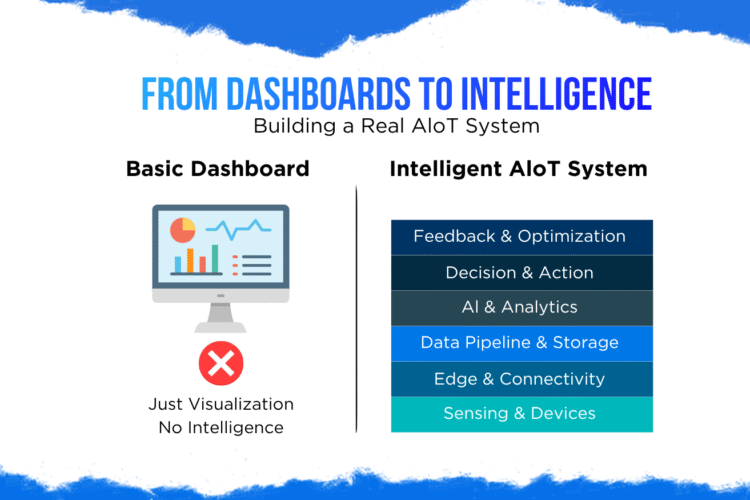
Real-Time IoT AI is transforming how connected systems operate — shifting from passive monitoring to continuous sensing, decision-making, and automated action.
Instead of analyzing data after events occur, modern IoT AI systems interpret streaming data instantly across edge and cloud environments. This enables predictive maintenance, autonomous control, and real-time optimization at scale.
In production deployments, successful Real-Time IoT AI platforms share a common architectural foundation. Below are the 10 essential concepts that enable systems to sense faster, decide smarter, and act autonomously.
What Is Real-Time IoT AI?
Real-Time IoT AI refers to connected systems that process streaming sensor data and execute AI inference instantly — enabling immediate decisions and automated responses.
Unlike traditional IoT analytics (which often relies on delayed cloud processing), real-time architectures integrate edge computing, event streaming, and AI inference into a continuous operational loop.
Key characteristics of Real-Time IoT AI:
- Continuous telemetry ingestion
- Streaming analytics and inference
- Event-driven automation
- Edge–cloud coordination
- Closed-loop feedback and learning
These capabilities allow systems to respond to physical conditions as they happen, not minutes or hours later.
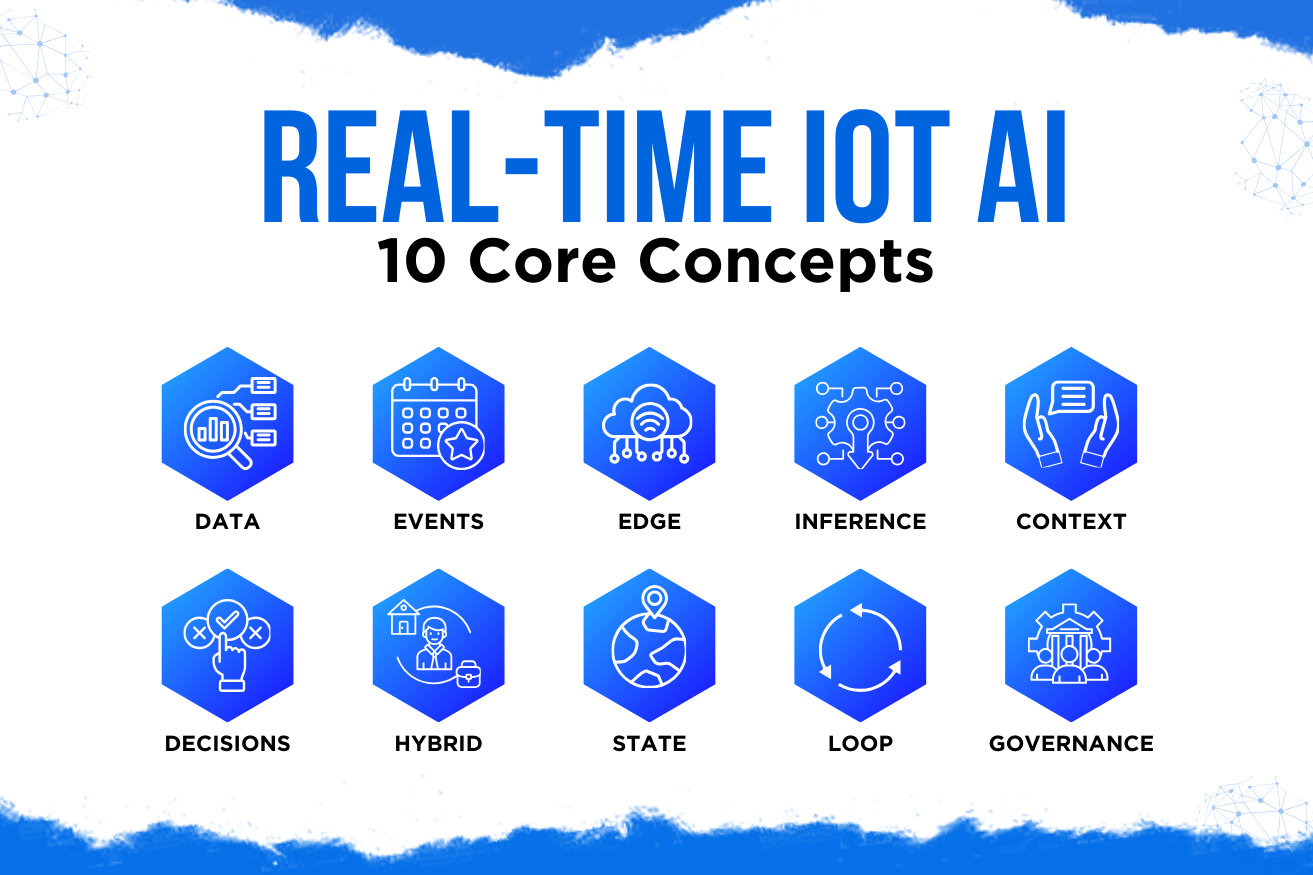
The 10 Core Concepts of Real-Time IoT AI Systems
1. Reliable Sensor Telemetry
All real-time intelligence begins with trustworthy data capture. Sensors must deliver consistent, calibrated signals across environments and operating conditions.
Inconsistent telemetry leads to inaccurate inference, false alerts, and unstable automation.
Best practices:
- Calibration and environmental compensation
- Signal integrity validation
- Redundant sensing where critical
2. Structured Event Streaming
Raw sensor signals must be transformed into structured, time-ordered events.
Without consistent event schemas and sequencing, real-time analytics cannot detect trends or causality.
Key elements:
- Timestamp normalization
- Event schemas and metadata
- Ordered streaming pipelines
3. Edge Data Conditioning
Processing data at the edge before transmission reduces latency, bandwidth, and noise.
Filtering and enrichment near the source improves downstream AI accuracy and responsiveness.
Typical edge preprocessing tasks:
- Noise filtering
- Compression and aggregation
- Local anomaly flags
- Context tagging
4. Instantaneous AI Inference
Real-Time IoT AI systems execute models immediately when data arrives.
Batch processing or delayed inference breaks real-time responsiveness, especially in industrial or safety-critical systems.
Use cases:
- Fault detection
- Object or sound recognition
- Equipment state classification
5. Dynamic Feature Context
Real-world systems evolve continuously. Features must be generated from recent and historical state — not static datasets.
Streaming feature engineering enables models to interpret current conditions accurately.
Examples:
- Rolling averages
- Time-window statistics
- State transitions
- Temporal correlations
6. Event-Driven Decision Logic
Automation should be triggered by conditions and events, not fixed schedules.
Real-time IoT AI systems react to environmental changes the moment they occur.
Examples:
- Threshold-based triggers
- State-change events
- Pattern detection
- Predictive alerts
7. Edge–Cloud Intelligence Balance
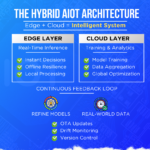
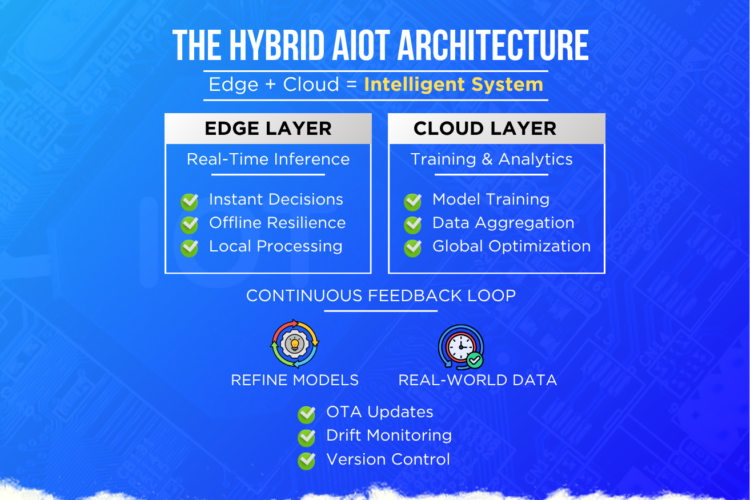
Effective Real-Time IoT AI distributes workloads between edge and cloud depending on latency, compute capacity, and reliability requirements.
Edge AI handles:
- Immediate control actions
- Low-latency inference
- Offline resilience
Cloud AI handles:
- Model training
- Fleet analytics
- Long-term optimization
8. Continuous State Synchronization
Edge and cloud components must share consistent system state.
State divergence causes incorrect decisions, delayed actions, and hidden failures.
Synchronization includes:
- Device status
- Model versions
- Configuration
- Context history
9. Closed-Loop Automation
Real-Time IoT AI systems form a continuous loop:
Sense → Analyze → Decide → Act → Learn
This closed loop enables autonomous optimization and predictive control rather than passive monitoring.
Examples:
- Predictive maintenance cycles
- Adaptive process control
- Self-healing infrastructure
10. Observability and Governance
Real-time autonomous systems must remain transparent, secure, and controllable.
Observability ensures engineers can understand decisions and detect drift or failure early.
Critical governance components:
- Latency and performance monitoring
- Model drift detection
- Explainable AI outputs
- Safety policies and guardrails
- Compliance and security controls
Why Real-Time IoT AI Matters for Modern Systems
Organizations adopting Real-Time IoT AI achieve:
- Faster operational decisions
- Reduced downtime
- Improved automation reliability
- Lower latency control loops
- Scalable intelligent infrastructure
Industries benefiting most include:
- Industrial automation
- Smart manufacturing
- Energy and utilities
- Healthcare monitoring
- Smart cities and infrastructure
- Autonomous robotics and vehicles
Real-Time IoT AI vs Traditional IoT Analytics
| Traditional IoT |
Real-Time IoT AI |
| Delayed cloud analysis |
Instant inference |
| Periodic dashboards |
Continuous decisions |
| Manual response |
Automated action |
| Batch data |
Streaming events |
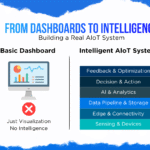
| Monitoring systems |
Autonomous systems |
Building Real-Time IoT AI Systems
Engineering real-time intelligent systems requires expertise across:
- Embedded systems and sensors
- Edge AI deployment
- Streaming architectures
- Cloud orchestration
- Automation logic
- AI governance and safety
At MetaDesk Global, we design Real-Time IoT AI architectures that move beyond monitoring — enabling systems that sense, decide, and act continuously across edge and cloud environments.
Conclusion
Real-Time IoT AI is not a single technology — it is a coordinated architecture spanning data capture, streaming, inference, automation, and governance.
When these 10 concepts operate together, connected systems evolve from reactive monitoring tools into autonomous, intelligent platforms capable of real-world decision-making at scale.