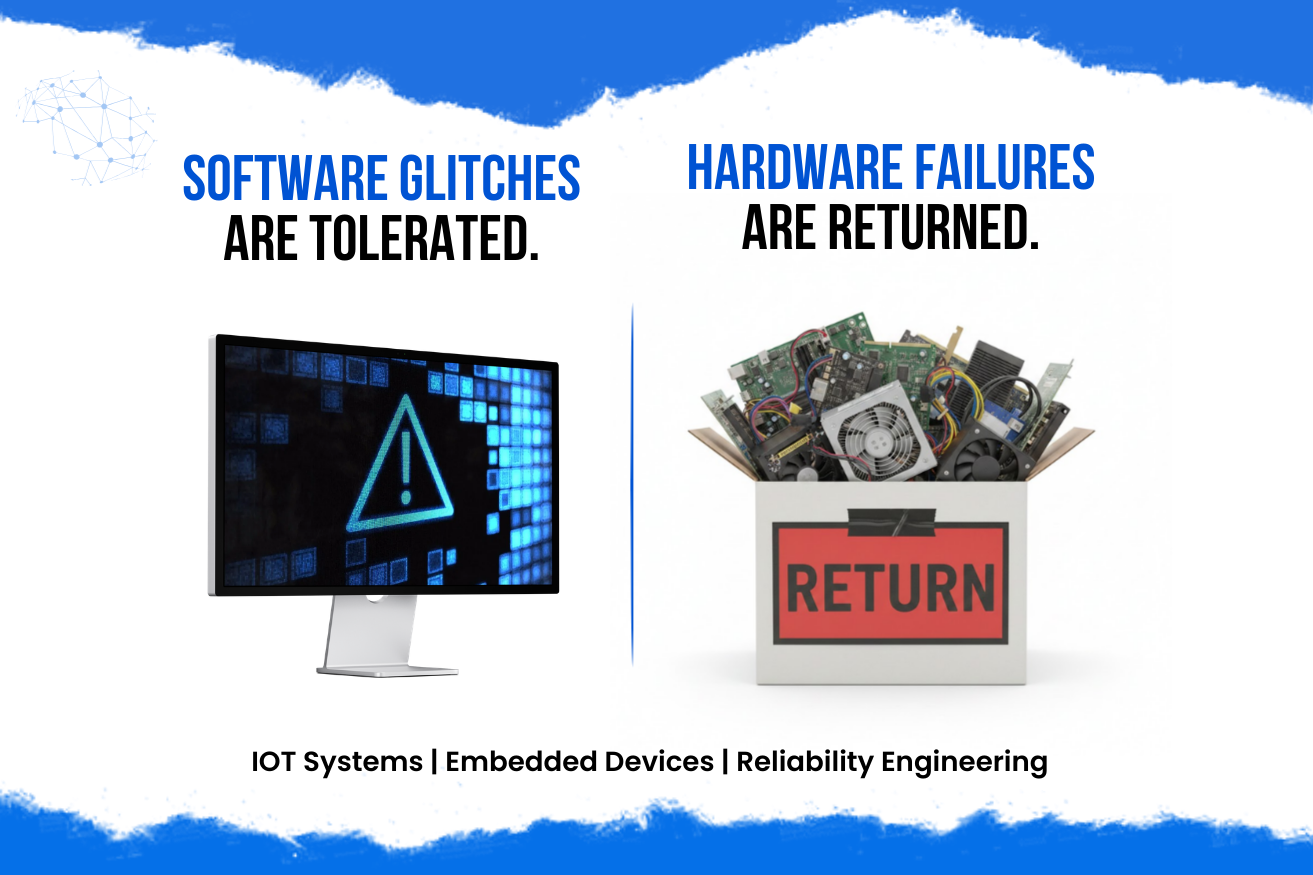
In pure software environments, users are surprisingly tolerant of failure.
An app crashes? Restart it.
A website glitches? Refresh the page.
A bug appears? Wait for the next patch.
But the moment software controls something physical, expectations change completely.
In IoT and embedded systems, reliability is not just about user experience. It determines whether a product stays in the customer’s home — or gets shipped back.
At MetaDesk Global, we’ve seen how the transition from digital software to connected hardware fundamentally changes what “acceptable performance” means.
The Expectation Gap Between Digital and Physical Products
Digital services are perceived as flexible and temporary.
Physical devices are expected to behave consistently and predictably.
A 30-second outage in a web application may go unnoticed.
The same interruption in a smart lock, medical device, or industrial controller becomes a critical failure.
The code may be identical.
The consequence of failure is not.
This is the expectation gap that defines modern IoT product development.
Why 99% Reliability Is Not Enough in Connected Hardware
In SaaS environments, 99% uptime may be acceptable.
- 1% downtime can occur at the worst possible moment
- 1% latency can break synchronization
- 1% inconsistency can destroy user trust
When software controls doors, sensors, medical systems, or vehicles, failure is not an inconvenience — it is a breach of reliability.
Users do not “retry later” when a door fails to unlock.
They do not accept instability in safety-critical systems.
In IoT, reliability must approach determinism.
The Business Cost of Reliability Failures
- Increased product returns (RMA)
- Higher support and warranty costs
- Negative customer reviews
- Reduced brand credibility
- Loss of long-term customer trust
Every overlooked edge case in development becomes a potential return shipment.
Reliability is not just a technical metric — it is a commercial strategy.
What Makes IoT Reliability Different from Cloud Reliability?
IoT systems operate across multiple tightly coupled layers:
- Firmware and Device Logic: Embedded firmware must handle unstable connectivity, power interruptions, and real-world noise without entering undefined states.
- Connectivity and Network Resilience: IoT devices must gracefully handle packet loss, signal degradation, and latency without disrupting user experience.
- Backend Synchronization: Cloud logic must align with device state and timing. API success does not guarantee physical execution.
- Physical Actuation and Feedback: Commands must translate into predictable, real-world actions — not just successful responses in logs.
The complexity of coordinating these layers makes reliability engineering significantly more demanding than traditional web development.
Designing IoT Systems with Reliability First
At MetaDesk Global, reliability is engineered from the beginning — not added after launch.
Our reliability-first approach includes:
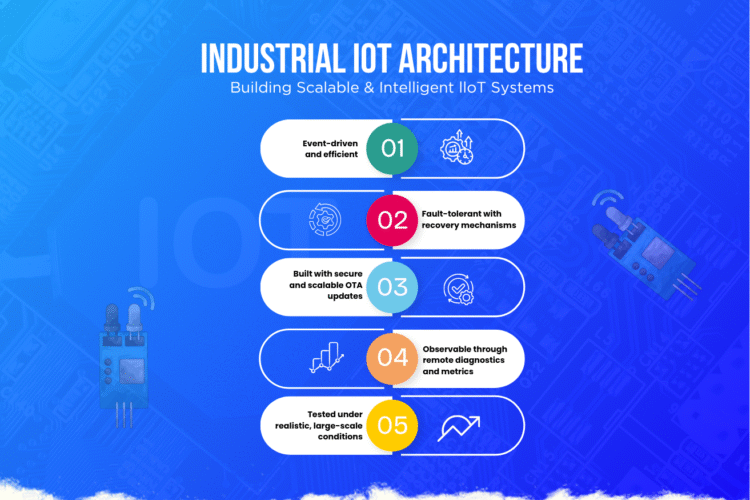
- Failure Mode and Edge Case Analysis: Simulating real-world conditions early in development to uncover hidden vulnerabilities.
- Deterministic State Management: Ensuring device state transitions remain consistent even under unstable network conditions.
- Secure OTA and Rollback Systems: Implementing firmware update mechanisms with validation and safe fallback paths.
- End-to-End Observability: Monitoring not only uptime but execution timing, synchronization accuracy, and anomaly patterns.
- Manufacturing Validation: Testing GPS, Bluetooth, WiFi, sensors, and audio in unified validation processes before shipment.
Reliability is not a single feature. It is a system-wide discipline.
The Future of Reliable Connected Hardware
As IoT products become more integrated into everyday life, tolerance for instability will continue to decrease.
- Consumers expect:
- Instant response
- Predictable behavior
- Secure operation
- Long-term stability
In connected hardware, consistency defines credibility.
Final Thoughts
When software controls pixels, users forgive.
When software controls physical systems, users expect perfection.
The real challenge in IoT development is not feature velocity — it is aligning firmware, connectivity, backend logic, and physical behavior into a cohesive, reliable system.
At MetaDesk Global, we help organizations build IoT architectures that prioritize reliability from day one — because in hardware, there is no refresh button.