Building IoT products that actually ship, operate reliably, and scale in the real world requires far more than connecting devices and visualizing data.
Successful IoT systems are the result of strong engineering fundamentals, system-level thinking, and long-term planning.
Teams that focus only on features or trends often struggle once their solutions leave the lab.
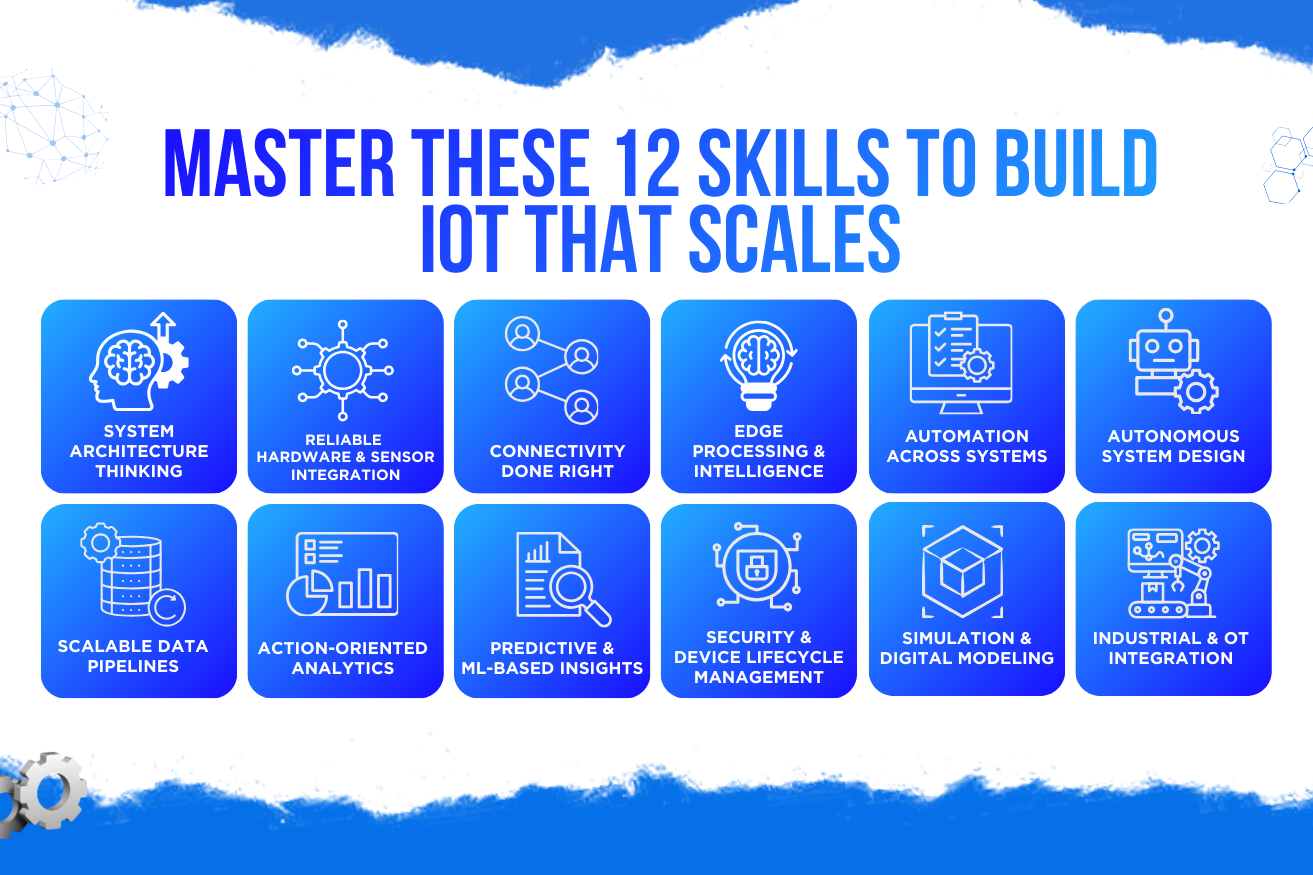
In this article, we break down the 12 core skills every modern IoT team must master to build scalable, secure, and production-ready IoT systems.
Why IoT Skills Matter More Than Tools
Tools and platforms change rapidly, but strong IoT products are built on skills that remain constant.
Organizations fail with IoT not because of lack of technology — but because:
- Architecture is unclear
- Data pipelines are fragile
- Security is added too late
- Systems don’t scale operationally
Mastering the right skills reduces risk far faster than chasing the latest frameworks.
The 12 Core Skills for Building Scalable IoT Systems
1. IoT Architecture Design
IoT teams must think end-to-end.
- Edge vs cloud responsibility separation
- Data flow design
- Latency and fault tolerance planning
Strong architecture ensures systems remain flexible as requirements evolve.
2. Sensor and Hardware Integration
Reliable data begins at the hardware layer.
- Sensor accuracy and calibration
- Environmental limits
- Power behavior and failure modes
Bad input data cannot be fixed by software or AI later.
3. Connectivity and IoT Protocols
Connectivity choices must be driven by:
- Range requirements
- Power consumption
- Reliability and latency
Selecting protocols based on trends often leads to unstable deployments.
4. Edge Computing and Edge AI
Processing data closer to the source reduces:
- Latency
- Bandwidth usage
- Cloud dependency
Edge intelligence is critical for real-time and offline-capable systems.
5. Data Ingestion and Streaming Pipelines
Production IoT generates irregular and bursty data.
Teams must design pipelines that:
- Preserve message ordering
- Handle retries and failures
- Scale with device count
Reliable ingestion is the backbone of IoT scalability.
6. Data Analytics and Visualization
Dashboards should drive action — not overwhelm users.
Effective analytics:
- Highlight anomalies
- Reduce decision time
- Provide operational clarity
Visualization is successful only when it supports real decisions.
7. Predictive Maintenance and Machine Learning
AI becomes valuable when it reduces downtime and cost.
This requires:
- Clean labeled data
- Domain understanding
- Controlled false-positive rates
Models must support operations — not create noise.
8. Security and Device Lifecycle Management
Security is not optional.
Critical components include:
- Device identity and certificates
- Secure OTA updates
- Key rotation and access control
Security must be foundational, not retrofitted.
9. Digital Twins and Simulation
Simulation allows teams to:
- Test behavior at scale
- Validate logic before deployment
- Predict failure scenarios
Digital twins reduce deployment risk significantly.
10. Industrial IoT and OT Integration
Enterprise IoT often intersects with operational technology.
This requires understanding:
- PLCs and industrial protocols
- Real-time constraints
- Safety-critical systems
Bridging IT and OT safely is a specialized skill.
11. Automation and Systems Integration
IoT insights only matter when they trigger action.
Automation connects IoT with:
- ERP systems
- Maintenance platforms
- Business workflows
Well-designed automation transforms insights into measurable outcomes.
12. Autonomous and AI-Driven Systems
Advanced IoT systems include:
- Feedback loops
- Drift monitoring
- Safe rollback mechanisms
Autonomy must be engineered carefully to maintain trust and control.
Where Teams Should Start
For organizations early in their IoT journey, three skills reduce risk the fastest:
- System architecture clarity
- Reliable data pipelines
- Security and lifecycle planning
These foundations enable everything else to scale safely.
How MetaDesk Global Supports IoT Teams
At MetaDesk Global, we help organizations design and implement IoT systems that move beyond demos into real operations.
Our approach focuses on:
- End-to-end system architecture
- Embedded and edge engineering
- Secure device lifecycle management
- Scalable data and AI pipelines
We help teams build IoT systems that ship — and continue working in the field.
Final Thoughts
IoT success is not about collecting buzzwords or stacking tools.
It’s about mastering the skills that allow systems to:
- Operate reliably
- Scale predictably
- Adapt over time
Organizations that invest in these fundamentals build connected systems that last.