




Logo home 9

Over 10 years we helping companies reach their financial and branding goals. Onum is a values-driven SEO agency dedicated.

CONTACTS
Embedded IoT Solutions

Hardware vs Firmware Engineers: Why a Dedicated Team Matters

Category
Embedded IoT Solutions
Read Time
7 min read
Published
August 21, 2025
Status
Published

Hardware and firmware are different crafts with different failure modes. They meet at a boundary where most IoT product problems actually happen.

“We need an embedded engineer” is one of the most expensive ambiguous sentences in connected product development. It can mean someone who designs circuit boards, someone who writes code for microcontrollers, or someone who does a bit of both and neither especially well.

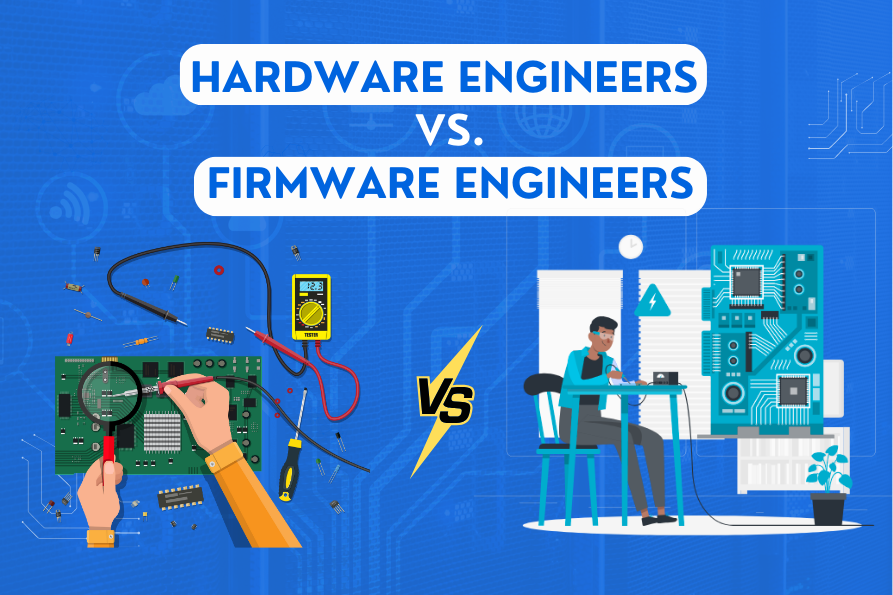
Hardware and firmware are different disciplines with different tools, different failure modes, and different hiring markets. They meet at a boundary where most IoT product problems actually occur — and teams that treat them as one role usually discover this late, in the field.

This guide explains what each role really does, where they overlap, how to tell which one your project needs, and how to structure the handoff between them.

Definitions

What Each Engineer Actually Does

1

The hardware engineer

Responsible for the physical electronics: the circuit that makes the product possible at all.

Daily work
  • Component selection and schematic design
  • PCB layout, including routing, grounding, and impedance control
  • Power supply design, regulation, and protection
  • Antenna placement and RF performance
  • Thermal behaviour and signal integrity
  • Bring-up, oscilloscope debugging, and design for manufacture

Their failures are permanent. A grounding mistake or an antenna placed next to a battery cannot be patched; it needs a new board revision and, often, recertification.

2

The firmware engineer

Responsible for the code that runs directly on the microcontroller, with no operating system beneath it or only a small real-time one.

Daily work
  • Device drivers and peripheral configuration (I2C, SPI, UART, ADC, timers)
  • Power management: sleep modes, wake sources, duty cycling
  • Communication stacks and protocol handling
  • Bootloaders and over-the-air update logic
  • Watchdogs, fault handling, and safe recovery
  • Working inside kilobytes of RAM and strict timing budgets

Their failures are fixable but risky. Most can be corrected with an update — unless the bug is in the bootloader, in which case devices can be bricked beyond recovery.

Comparison

Hardware vs Firmware at a Glance

Hardware engineerFirmware engineer
Primary outputSchematics, PCB layout, BOMEmbedded C/C++ or Rust on the MCU
Main toolsCAD, oscilloscope, spectrum analyser, solderingIDE, debugger, logic analyser, version control
Iteration speedWeeks, limited by fabricationMinutes, limited by flashing
Cost of a mistakeVery high — board respin, possible recertificationUsually recoverable by update
Thinks inVolts, amps, impedance, heat, physicsRegisters, interrupts, timing, memory
Typical questionWill this circuit be stable at −20°C?What happens if this interrupt fires mid-write?

Hardware decides what the product can ever do. Firmware decides what it actually does.

The Boundary

Where the Two Roles Meet — and Where Products Break

The expensive problems in embedded products rarely sit cleanly in one discipline. They live on the boundary, and they are the reason this distinction matters commercially.

Battery life misses the target
Hardware blames firmware for not sleeping properly; firmware blames hardware for leakage paths or a sensor that cannot be powered down. Usually both contribute, and only measurement settles it.
The radio underperforms
Antenna layout, ground plane, and enclosure are hardware. Transmit power, retries, and timing are firmware. Range problems need both looking at the same measurement together.
Readings drift or look noisy
Could be analogue noise, a shared ground, or an ADC sampled at the wrong moment relative to a switching regulator. The symptom is identical in all three cases.
Devices reset unpredictably
Brownout from a power rail that sags during transmission, or a firmware stall triggering the watchdog. Without reset-cause logging, nobody can tell which.
Units fail at manufacture
Test fixtures, calibration routines, and provisioning need both: hardware provides test points, firmware provides the test mode.

This is the same class of boundary problem behind most devices that pass the bench and fail in the field. A team where neither role owns the boundary tends to find these issues after production.

Hiring

Which One Does Your Project Need?

Your situationWho you need
Custom board from scratch, new sensors, tight power budgetHardware first, firmware joining early
Off-the-shelf module or dev kit, custom behaviourFirmware only
Existing product, new features or bug fixesFirmware
Product works on the bench, fails in the fieldBoth, together, with measurement
Moving from prototype to manufacturingHardware, plus firmware for test and provisioning
Cost reduction on a shipping productHardware, with firmware validating the changes

A genuine point worth stating plainly: engineers who are strong at both exist, but they are rare, and most people who claim both are considerably stronger at one. For a product that matters, it is usually better to hire one specialist in each than one generalist in the middle.

Practice

Making the Handoff Work

1Involve firmware before the schematic is frozen
Pin assignment, peripheral choice, debug access, and test points are far cheaper to get right in CAD than after fabrication.
2Agree the power budget as one document
Hardware states what each rail costs; firmware states how long each state lasts. Battery life is the product of both, and neither can own it alone.
3Keep debug access on production boards
Test points, a serial console, and a reset-cause register cost almost nothing and are the difference between diagnosing a field failure and guessing.
4Measure instead of arguing
A current probe and a logic analyser settle most hardware-versus-firmware disputes in an afternoon. Opinions about them can last weeks.
5Write a hardware abstraction layer
A clean driver boundary lets firmware survive a sensor substitution or board revision, which matters when a component goes out of stock.
6Give one person the system
Someone must own behaviour end to end, including the boundary. Without that, boundary defects belong to nobody until a customer finds them.

These practices also set the pace of the project, since hardware and firmware simply cannot iterate at the same speed.

FAQ

Frequently Asked Questions

What is the difference between a hardware and a firmware engineer?
A hardware engineer designs the physical electronics: schematics, PCB layout, power, and RF. A firmware engineer writes the code running directly on the microcontroller: drivers, power management, communication stacks, and update logic. Hardware sets what the product can do; firmware determines what it does.
Can one engineer do both hardware and firmware?
Some can, but genuinely strong dual-discipline engineers are rare and most people who claim both are much stronger at one. For a product that has to ship and scale, one specialist in each usually beats one generalist covering the middle.
Is firmware the same as embedded software?
Closely related but not identical. Firmware runs directly on a microcontroller with no operating system or a small RTOS, in kilobytes of memory. Embedded software often means applications on a Linux-capable processor, where normal software tooling and abstractions are available.
Which role should you hire first for an IoT product?
It depends on the starting point. A custom board with new sensors and a tight power budget needs hardware first, with firmware joining before the schematic is frozen. A product built on an off-the-shelf module or dev kit usually needs only firmware.
Why do battery life problems cause so much disagreement?
Because battery life is the product of both disciplines: hardware determines leakage and what each rail costs, firmware determines how long the device spends in each state. It is settled by measuring current with a probe, not by debate.
What happens if nobody owns the hardware-firmware boundary?
Boundary defects such as brownout resets, radio range shortfalls, and noisy sensor readings go unassigned until a customer reports them. Appointing one person accountable for end-to-end behaviour is the cheapest fix available.
Wrapping Up

Conclusion

Hardware and firmware engineering are two distinct crafts that share one product. One thinks in volts, heat, and physics with iteration measured in weeks; the other thinks in registers, interrupts, and memory with iteration measured in minutes.

Most embedded product failures happen where they meet. Bring firmware in before the schematic is frozen, own the power budget jointly, keep debug access on production boards, settle disputes with measurement, and make one person accountable for the whole system. That is what a dedicated team buys you.

About MetaDesk Global

Engineering the Next Generation of Connected Products

MetaDesk Global helps startups and enterprises develop intelligent connected products that combine embedded systems, Industrial IoT, Edge AI, and cloud technologies. Our expertise includes:

Industrial IoT (IIoT) Solutions Embedded Firmware Development Edge AI Development Predictive Maintenance Systems PCB Design IoT Gateway Development Cloud Integration OTA Firmware Updates AIoT Product Development End-to-End Product Engineering

From hardware design to AI-powered industrial platforms, we build scalable solutions for the next generation of connected products.

Start Your Project

Building a Connected Product?

We design IIoT sensor networks, Edge AI pipelines, and secure cloud platforms — from prototype to production.

Request a Free Quote →