



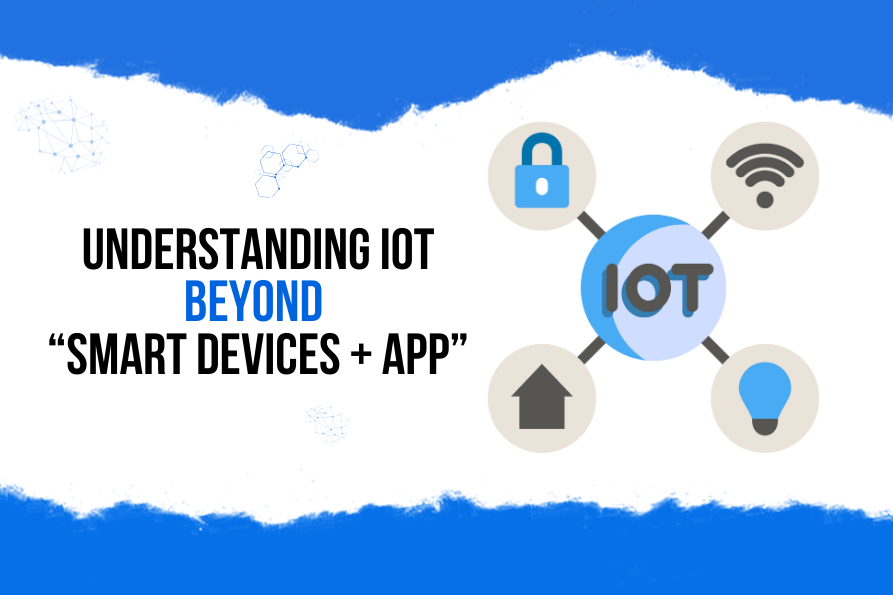
Ask most people to describe an IoT product and you will hear the same answer: a smart device and a mobile app. It is a reasonable first picture. It is also why so many IoT budgets and timelines turn out to be wrong by a factor of two or three.
The device and the app are the visible 30 percent. Underneath sits a set of workstreams nobody sees in a demo — provisioning, security, over-the-air updates, certification, fleet monitoring, manufacturing test, support — and every one of them is required before a connected product can be sold, deployed, and kept working.
This guide is for founders, product managers, and business owners planning an IoT product. It maps what a real connected product includes beyond the device and the app, why each part matters, and how to scope it before it surprises you. For the technical architecture itself, see our guides to the 4 main components of IoT and the 4 layers of IoT architecture.
Why “Device + App” Underestimates IoT
The device-plus-app picture comes from the demo. In a demo, one engineer flashes one unit, pairs it with one phone on office Wi-Fi, and it works. Every hard problem has been removed.
A product has to survive conditions the demo never meets:
- Thousands of units, each needing a unique identity and credentials
- Installation by people who did not build it
- Networks that fail, change, or block traffic
- Bugs discovered after units are already in customers’ hands
- Regulators who must approve the radio before it can be sold
- Customers who call support when something stops working
The device and the app are what customers see. Everything else is what keeps them customers.
What a Real IoT Product Includes
Here is the complete scope of a connected product, grouped by where the work happens.
Hardware and firmware
The device is not only a board. It includes sensor selection and calibration, power design and battery sizing, the enclosure and its sealing, antenna placement, and firmware that has to run reliably for years.
- Measured power budget, not a datasheet estimate
- Watchdogs, safe recovery, and fault reporting
- Compute and memory headroom for future features
- Environmental testing across the real operating range
Security foundation
Every unit needs a unique identity, secure boot, encrypted communication, and a way to rotate or revoke credentials. Shared passwords or a single key across all devices are among the most common and most damaging IoT security failures.
This has to be designed into hardware and manufacturing from the start; it cannot be added through the app later. Our guide to IoT device security covers it in depth.
Connectivity plan
Choosing Wi-Fi, BLE, LoRaWAN, NB-IoT, or cellular is only the start. A connectivity plan also covers SIM contracts and data costs, onboarding to customer networks, behaviour during outages, and what happens when a network or carrier changes.
Manufacturing and provisioning
Each unit must be flashed, tested, calibrated, and given its identity on the production line. That requires test fixtures, a provisioning process, and records that link every serial number to its credentials and test results.
Cloud platform and data
Behind the app sits a platform that authenticates devices, ingests and stores data, runs rules and analytics, and exposes APIs. It needs data retention decisions, backups, scaling, and monitoring — plus a data model that survives several firmware versions in the field at once.
Over-the-air updates
Every connected product needs fixes after launch. A secure, staged, reversible OTA update system is what makes those fixes possible without visiting each unit. Without it, the version you ship is the version you are stuck with.
Fleet monitoring and operations
Someone has to know which devices are offline, which batteries are running low, which firmware versions are deployed, and which sites are having problems. That means dashboards and alerts for your own team, not only for customers.
Certification and compliance
Radio products need regulatory approval such as FCC in the United States and CE/RED in Europe before sale. Depending on the market there may be safety, battery transport, privacy, or industry-specific requirements. Certification takes weeks to months and significant hardware changes can require repeating it.
Support, returns and lifecycle
Installation guides, troubleshooting, warranty returns, replacement units, and end-of-life planning. Support costs are often the line item that decides whether an IoT business is profitable.
The Hidden Scope, at a Glance
| Workstream | Visible in a demo? | Required to sell? | What happens if skipped |
|---|---|---|---|
| Device and app | Yes | Yes | No product |
| Security and identity | No | Yes | Fleet-wide vulnerability, lost trust |
| Provisioning and manufacturing test | No | Yes | Units cannot be produced at volume |
| OTA updates | No | Effectively yes | Every bug needs a site visit |
| Certification | No | Yes | Product cannot legally be sold |
| Fleet monitoring | No | Yes, at scale | Problems found by customers first |
| Connectivity contracts | No | Yes | Unexpected recurring costs |
| Support and returns | No | Yes | Margin disappears after launch |
Most of the rows marked “No” in the second column are also where schedules slip, because they were never on the original plan.
How to Scope an IoT Product Realistically
Frequently Asked Questions
Conclusion
Understanding IoT means looking past the device and the app. A real connected product is a system of hardware, security, connectivity, manufacturing, cloud, updates, monitoring, certification, and support — and the invisible parts decide whether it can be sold, deployed, and kept running.
Scope all of it at the start, budget the whole lifecycle rather than the prototype, and ship updates and monitoring in version one. That is the difference between an impressive demo and a product customers can rely on.