



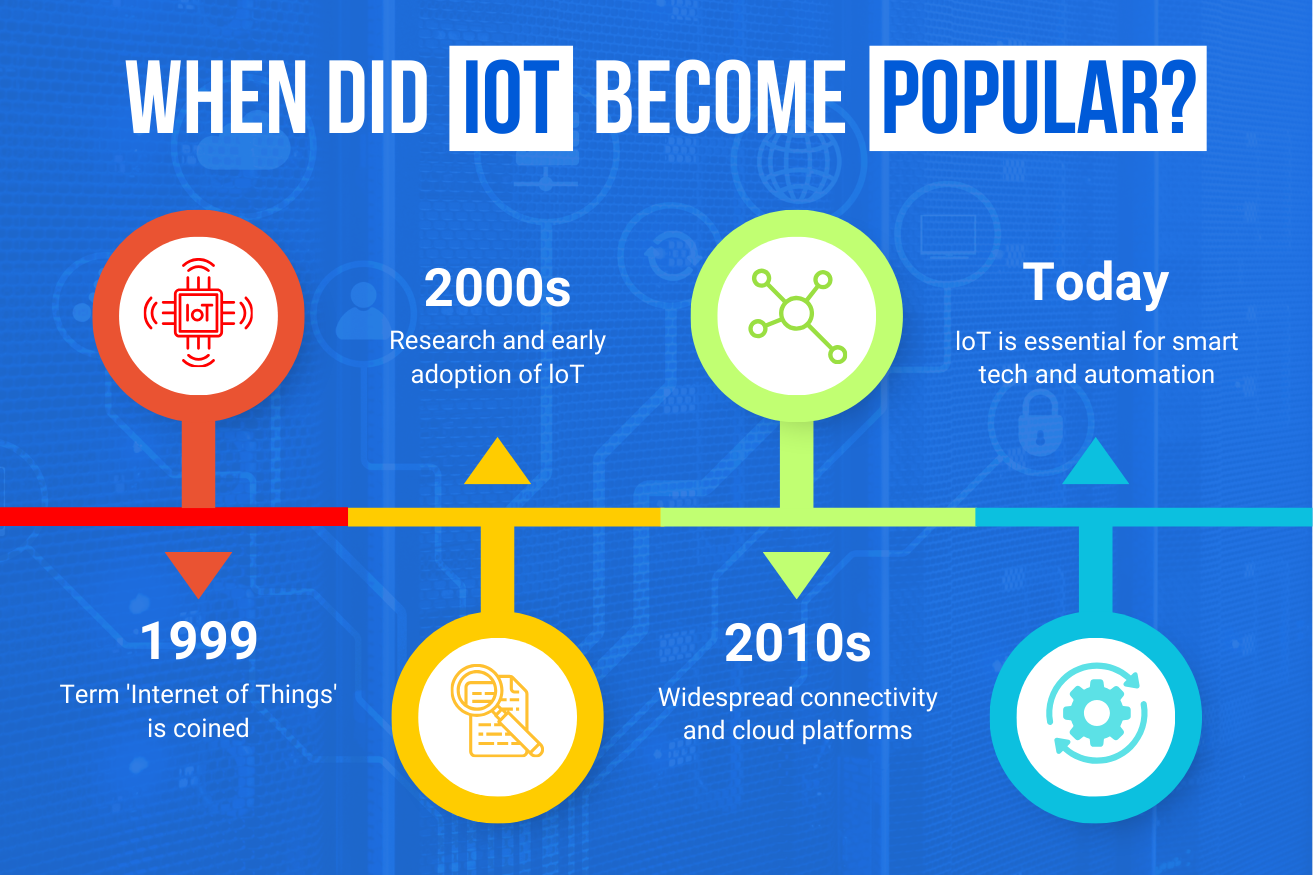
The Internet of Things has two origin stories. The phrase was coined in 1999, but the idea only became practical around 2010–2014, when four separate things became cheap at roughly the same time: wireless chips, microcontrollers, cloud infrastructure, and smartphones.
Understanding that timeline is more useful than it sounds. The constraints that shaped each era are still visible in products shipping today — and the reasons IoT took off when it did explain where it is going next.
Before the Name (1982–1999)
Connected devices predate the term by decades. A modified Coca-Cola machine at Carnegie Mellon University reported its inventory and whether drinks were cold over the ARPANET in the early 1980s — widely cited as the first internet-connected appliance.
Through the 1990s, machine-to-machine communication was real but industrial and expensive: SCADA systems, vending telemetry, and fleet tracking over proprietary links. Each deployment was bespoke, and connectivity cost enough that only high-value assets justified it.
In 1999, Kevin Ashton used the phrase “Internet of Things” while working on RFID supply chain projects at Procter & Gamble. The name arrived roughly a decade before the economics did.
Why IoT Became Popular Around 2010–2014
IoT did not take off because of a single breakthrough. Four cost curves crossed useful thresholds within a few years of each other.
Wireless chips became cheap and integrated
Bluetooth Low Energy arrived in 2010 and made battery-powered wireless sensors genuinely practical. Combined system-on-chip designs put a processor and radio in one inexpensive part, removing both cost and board complexity.
Everyone started carrying a gateway
Smartphone adoption meant most people had a powerful, connected, Bluetooth-equipped device in their pocket. Consumer IoT products no longer needed their own screen, their own internet connection, or their own user interface.
Cloud removed the server problem
Before cloud platforms, connecting a product meant buying and running servers. Pay-as-you-go infrastructure let a small company launch a connected product without capital expenditure, and managed IoT services later removed much of the remaining plumbing.
Prototyping became accessible
Arduino, Raspberry Pi, and later the ESP8266 and ESP32 put capable hardware in the hands of anyone with a modest budget. The pool of people who could build a connected prototype expanded from specialist firms to essentially anyone.
IoT became popular when building a connected product stopped requiring a factory, a server room, and a telecoms contract.
The Eras at a Glance
| Period | What defined it | Limitation |
|---|---|---|
| 1982–1999 | Isolated experiments and industrial M2M | Bespoke, expensive, no standards |
| 1999–2009 | The term exists; RFID and supply chain focus | Hardware and connectivity still costly |
| 2010–2014 | BLE, smartphones, cloud, cheap dev boards | Fragmented ecosystems, weak security |
| 2015–2019 | Consumer smart home boom, LPWAN arrives | Incompatibility; notorious security failures |
| 2020–2024 | Industrial focus, edge computing, Matter | Proving ROI beyond pilots |
| 2025 onward | On-device AI, interoperability, regulation | Attention and trust, not connectivity |
Why the Fifty Billion Devices Never Arrived
Around 2010, widely quoted forecasts predicted 50 billion connected devices by 2020. Reality came in far lower, and the reasons are instructive because they are still the main obstacles today.
- Connecting something is easy; justifying it is not. Many products were connected because it was possible, not because anyone would act differently as a result.
- Fragmentation taxed every project. Incompatible ecosystems meant integration work on every deployment and stranded customers when vendors pivoted.
- Security incidents damaged trust. Large botnets built from default-password devices made buyers and regulators cautious, correctly.
- Pilots did not become rollouts. Projects proved technical feasibility, then stalled on unit economics, installation quality, and operations — the pilot-to-production gap.
What grew instead was narrower and healthier: industrial monitoring, utility metering, logistics, and building systems, where the value per device is measurable.
What Changed, and What Did Not
The constraints that made IoT hard in 2014 have mostly shifted rather than disappeared:
- Solved: cheap radios, cloud infrastructure, prototyping access, and increasingly interoperability through Matter and industrial standards.
- Improving: security expectations are now entry requirements, and on-device intelligence is reducing the cost of operating fleets.
- Still hard: proving a connected product changes a decision someone will pay for, installing and maintaining devices at scale, and keeping data trustworthy over years.
The hard parts moved from the technology to the operation — which is why the useful question today is not whether something can be connected, but what anyone will do differently once it is.
Frequently Asked Questions
Conclusion
IoT became popular when it became affordable, not when it became possible. The gap between Kevin Ashton naming it in 1999 and products reaching the mainstream around 2012 was entirely about cost: radios, compute, servers, and prototyping all had to get cheap at the same time.
The same logic applies now. The remaining obstacles are not technical — they are proving the decision a connected product changes, and operating fleets reliably for years. Those are the costs that decide which IoT products exist a decade from now.