




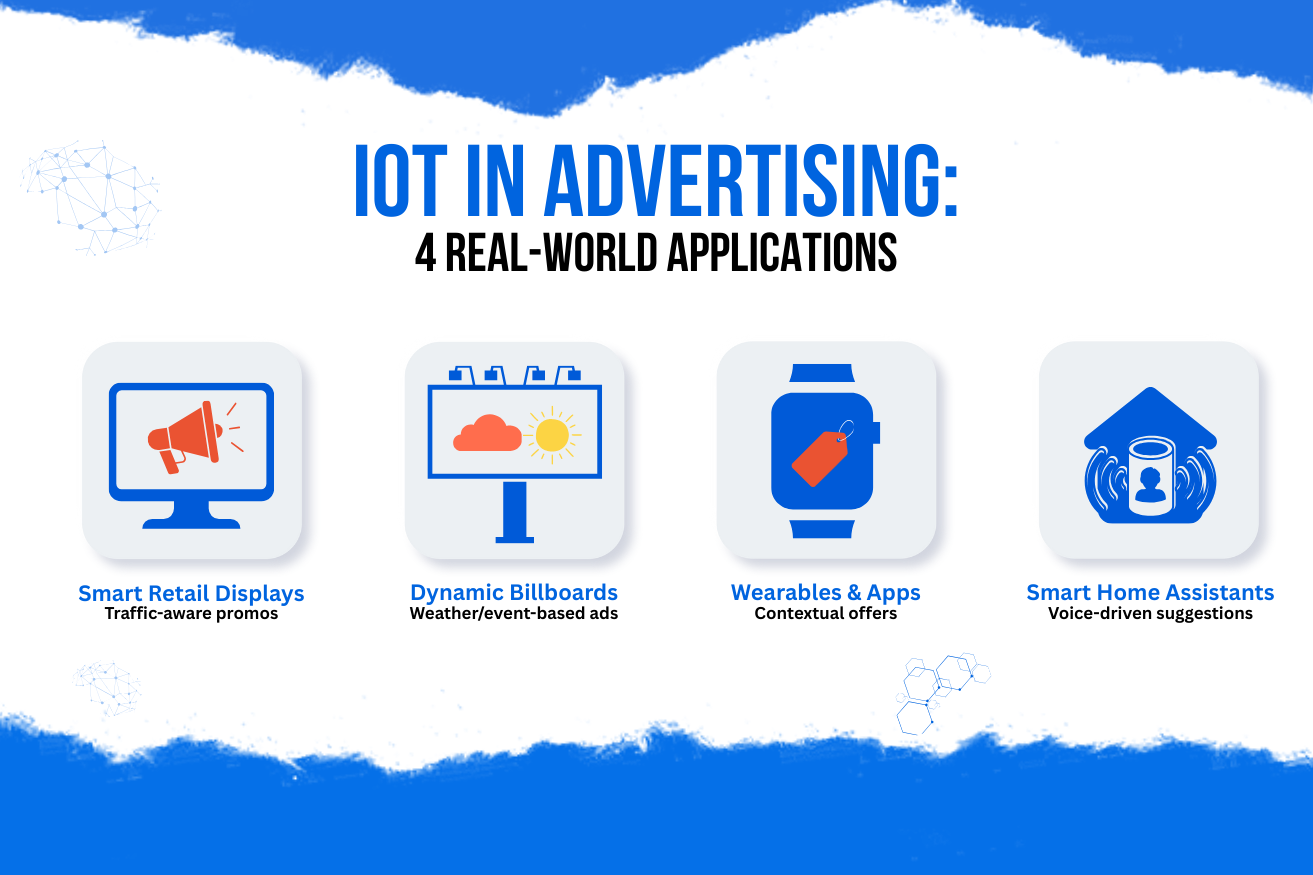
Digital advertising has spent two decades learning to measure everything online. Physical advertising has spent the same period largely unable to answer the most basic question: did anyone actually see this, and did it change what they did next?
IoT closes that gap. Connected screens, sensors, and beacons let a physical campaign respond to real conditions, adapt in real time, and report on its own performance — turning outdoor and in-store media into something that behaves much more like a digital channel.
This guide covers what connected advertising technology actually does, the engineering behind a screen network that works reliably, the measurement claims that hold up versus those that do not, and the privacy constraints that increasingly define what is possible.
From Static Placement to Responsive Media
Traditional out-of-home advertising is a fixed asset. A poster goes up, stays for a fortnight, and shows the same message to everyone regardless of weather, time, traffic, or stock levels.
A connected display is a system that can change its behaviour based on inputs. That single difference produces several practical capabilities:
- Contextual triggering — showing cold-drink creative when local temperature rises, or umbrellas when it rains
- Inventory awareness — suppressing promotion of a product a store has run out of, which is one of the clearest and least controversial wins
- Dayparting by observed conditions — adjusting by measured footfall rather than by an assumed schedule
- Live data in creative — pricing, availability, transport times, queue lengths
- Proof of play — verifiable evidence that a specific asset ran on a specific screen at a specific time
Proof of play deserves attention because it is the least glamorous item on the list and often the most commercially valuable. It converts a trust-based billing relationship into an auditable one.
Where Connected Advertising Is Actually Used
Digital out-of-home networks
Screens on roadsides, in transit hubs, and in shopping centres, centrally managed and increasingly sold programmatically. Sensors supply the context that decides which creative plays, and each screen reports playback back to the platform.
The engineering challenge is less about advertising than about fleet management: hundreds of unattended computers and displays in public places, each of which must recover on its own from power cuts, network loss, and content delivery failures.
Smart retail displays and shelf-edge media
In-store screens and electronic shelf labels linked to inventory and pricing systems. Because they sit at the point of decision, the feedback loop between message and purchase is short enough to measure meaningfully.
Electronic shelf labels are the most widely deployed example, and they are a textbook low-power IoT product: e-paper displays that hold an image without power, waking briefly to receive updates and running for years on a coin cell.
Proximity and beacon experiences
Bluetooth beacons let a store app detect which aisle a customer is in and offer relevant content. The technology works well; adoption is the constraint, because it requires the shopper to have installed the app and granted both location and notification permissions.
Deployments that assume high opt-in rates tend to disappoint. Those that treat proximity as an enhancement for an already engaged loyalty audience tend to succeed.
Audience measurement
Sensors estimate how many people passed a screen, how many faced it, and for how long. Approaches range from anonymous computer vision that counts without identifying, to depth sensors, to aggregate mobile network data.
Done well, this is anonymous by design: the camera runs a counting model on-device and emits a number, never an image. Done badly, it becomes a privacy incident. The architectural difference is whether raw imagery ever leaves the device — and it should not.
Interactive and responsive installations
Displays that react to gesture, touch, proximity, or movement. These generate strong engagement and are useful for brand campaigns, but they carry higher maintenance requirements — interactive hardware in public spaces is handled roughly and fails more often than a passive screen.
What Makes a Screen Network Reliable
The advertising concept is straightforward. Running hundreds of unattended media players in public environments is the genuinely hard part, and it is where most networks lose money.
An advertising network is a device fleet that happens to display pictures. It succeeds or fails on fleet operations, not on creative technology.
What Can and Cannot Be Measured Honestly
Measurement is where connected advertising is oversold most often. It is worth being precise about which claims are defensible.
| Claim | How solid is it |
|---|---|
| This creative played at this time on this screen | Strong — a direct device log |
| This many people passed the screen | Good — sensor counting is reasonably accurate when calibrated |
| This many people faced the screen, and for how long | Moderate — depends heavily on angle, lighting, and crowd density |
| Exposure correlated with a sales uplift | Moderate — requires controlled comparison against similar unexposed locations |
| This specific person saw the ad and then bought | Weak, and usually a privacy problem before it is a measurement one |
The credible approach is aggregate: measure exposure opportunity accurately, run genuine control locations, and attribute at the store or region level rather than the individual level. That is defensible statistically and does not depend on tracking anyone.
Privacy Is the Binding Constraint
Advertising technology attracts regulatory attention faster than almost any other IoT application, and public tolerance for sensing in retail and public spaces is limited. These constraints shape architecture rather than sitting alongside it.
Frequently Asked Questions
Conclusion
IoT gives physical advertising the two things it always lacked: the ability to respond to real conditions, and the ability to report what it did. Contextual creative, inventory awareness, and auditable proof of play are genuine, deliverable improvements over static media.
What decides whether a network succeeds is less exciting than the creative possibilities. It is fleet engineering — local caching, automatic recovery, remote diagnostics, thermal design, staged updates — combined with a measurement story that is honest about what sensors can and cannot establish, and an architecture where counting happens on the device and imagery never leaves it.