In today’s AI-driven world, Software moves faster than ever—new models, features, and updates ship weekly.
But for companies building IoT and AIoT products, trying to match software’s
velocity can quickly turn into a critical mistake.
This article explores why IoT must follow a different pace, how a hardware-first
strategy creates long-term advantage, and what companies can do to balance speed
with reliability.
Why IoT Can’t Move at Software Speed
The Hidden Cost of Moving Too Fast
Many IoT startups fall into a familiar trap—trying to iterate hardware as quickly as software:
- Rushed prototypes that skip RF, EMC, and power validation
- Incomplete field testing due to tight executive timelines
- Design flaws that surface only after thousands of units are shipped
- Costly redesigns that break budgets and delay launches
Unlike software, you cannot hot-patch physical mistakes.
Hardware Has Physical Constraints Software Doesn’t
- You can’t “A/B test” battery drain.
- You can’t fix a faulty antenna with a firmware update.
- You can’t ship a temporary workaround for thermal issues.
Hardware requires care, patience, and engineering discipline.
The Real Advantage: Hardware IS Your Competitive Moat
Physical Devices Create Deep, High-Trust Relationships
When your IoT device lives:
- in a customer’s home
- on their factory floor
- inside their vehicle
- monitoring their supply chain
…it becomes a permanent touchpoint that software-only competitors cannot replace.
This distribution moat is one of the strongest, least understood assets in IoT.
Hardware Longevity Builds User Trust
While software can change daily, hardware must be:
- stable
- reliable
- power-efficient
- secure
- predictable
That reliability becomes your brand identity.
AIoT: The Perfect Balance of Slow + Fast
Slow Where It Matters, Fast Where It Counts
The companies winning in IoT follow a simple pattern:
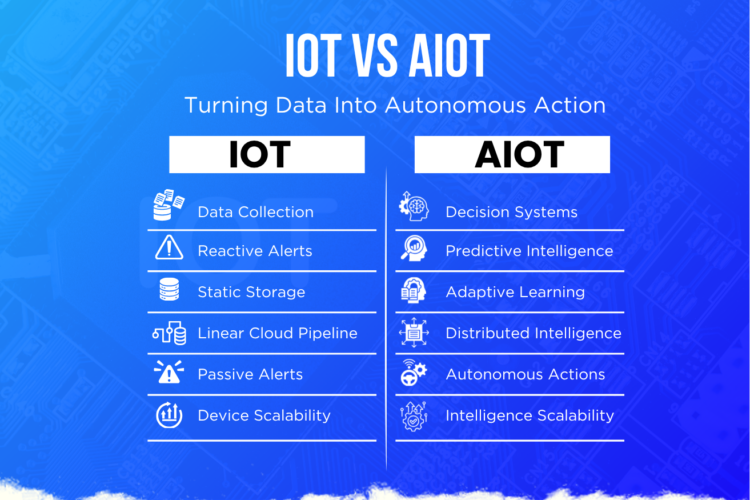
- 🔹 Hardware iterates slowly → ensuring rock-solid reliability
- 🔹 AI & software iterate quickly → enabling rapid innovation
This creates the perfect AIoT stack:
1. Strong Hardware Foundation
- Accurate sensors
- Optimized antenna + RF design
- Long battery life
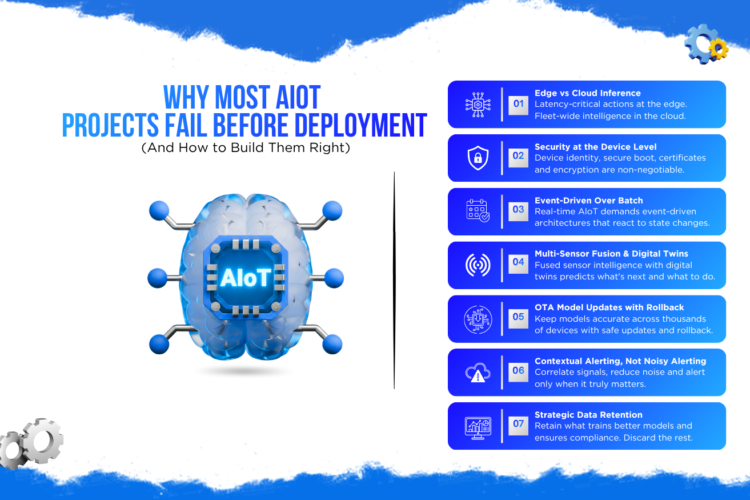
- Secure boot + OTA
- Tested across real-world conditions
2. Fast, Modular Software Layer
- Edge ML inference
- On-device anomaly detection
- AI-powered device tuning
- Cloud orchestration
With a stable device and flexible intelligence layer, you get long hardware life + fast evolving capabilities.
Why “Slow Hardware” Actually Makes Your AI Better
Limited memory, limited power, and on-device constraints force teams to build lean, efficient, purpose-built AI models.
This leads to:
- lower latency
- higher reliability
- reduced cloud dependency
- better privacy
- lower operational cost
In many cases, edge AI outperforms cloud AI because it’s optimized to a single task instead of being generic.
How IoT Companies Can Avoid the Software-Speed Trap
- 1. Respect Hardware Timelines — RF, power, mechanical, and environmental testing cannot be rushed.
- 2. Build Modular Architecture — Separate hardware, firmware, and AI for independent iteration.
- 3. Field-Test Early, Field-Test Often — Real networks and real users reveal real issues.
- 4. Plan for OTA From Day One — Devices must evolve safely after deployment.
- 5. Treat Power as a Feature — Battery drain kills IoT products faster than bugs.
Conclusion: The Future of IoT Belongs to Patient Builders
IoT success is not about matching software’s pace—it’s about mastering the intersection of physical hardware and digital intelligence.
The winners in the next era of AIoT will be companies that:
- build reliable hardware
- design efficient edge intelligence
- iterate AI rapidly
- ship durable, trustworthy systems
In IoT, slow is smooth, and smooth is fast.