



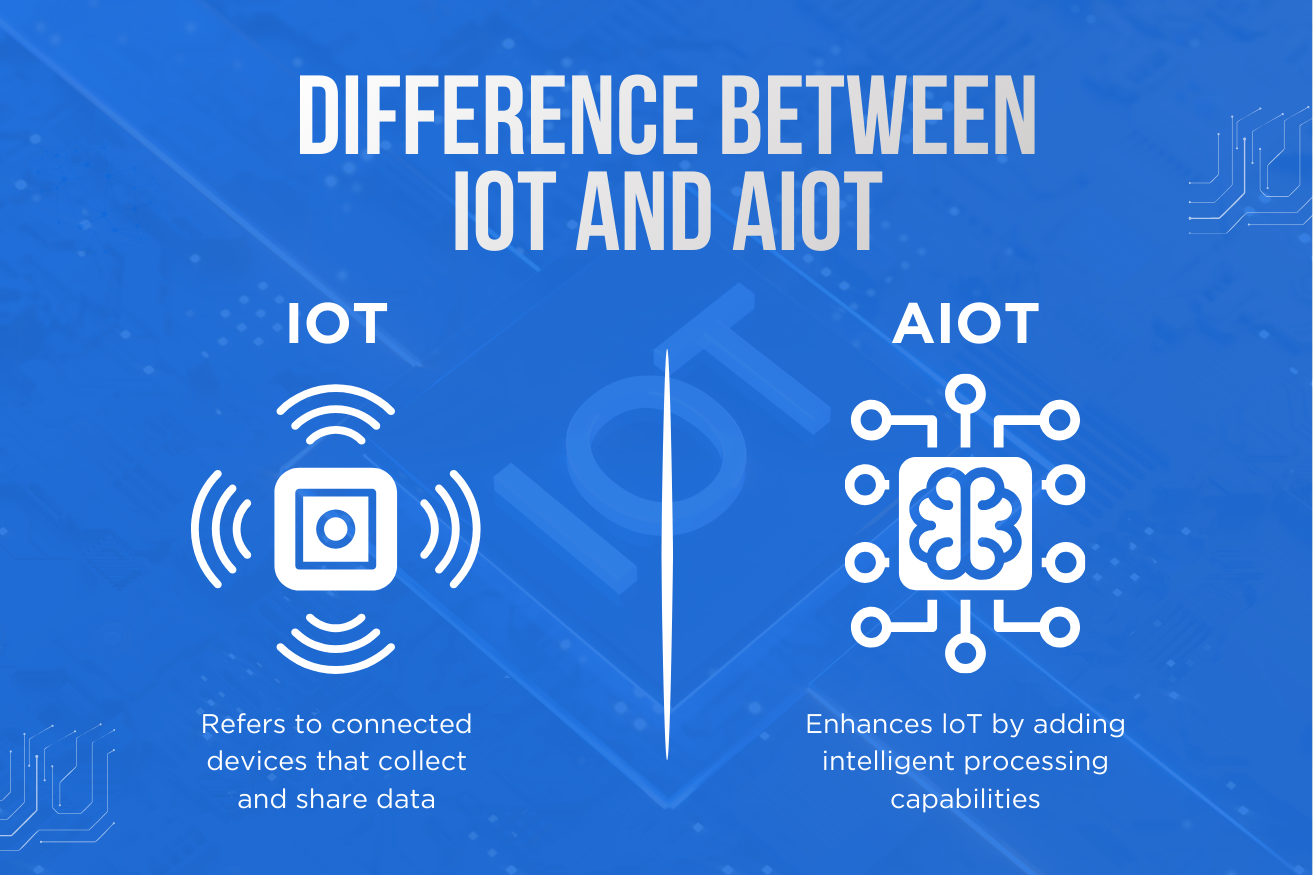
Traditional IoT and AIoT are often described as consecutive generations, as though one replaces the other. That framing is misleading and leads to bad decisions — particularly the decision to add machine learning to a system whose data cannot yet support it.
The honest comparison is narrower. Both architectures sense the physical world and both move data somewhere useful. They differ in one respect: whether a human or the system converts measurements into decisions. Everything else follows from that.
This guide compares the two directly — what each does well, what each costs, and a practical test for deciding which one your product actually needs.
What Traditional IoT Does
A traditional IoT system connects physical assets and makes their state visible. Sensors measure, data is transmitted, and dashboards, reports, and threshold alerts present it to people who decide what to do.
It is a mature, well-understood architecture, and its strengths are real:
- Deterministic. A threshold rule behaves identically every time and is trivially auditable.
- Explainable. When an alert fires, the reason is a single stated condition.
- Cheap to build. No training data, no model lifecycle, no retraining pipeline.
- Fast to deploy. Working visibility in weeks rather than quarters.
- Easy to certify. Regulated environments often require exactly this predictability.
Its limitation is equally clear: a fixed rule must be written in advance for every condition worth detecting, and someone has to read the output.
What AIoT Adds
An AIoT system performs the interpretation itself. Instead of comparing a value against a fixed limit, it learns what normal looks like for each asset and flags meaningful deviation — often across several signals at once.
That produces capabilities traditional IoT cannot reach:
- Detecting the unforeseen. Anomalies surface without anyone having written a rule for them.
- Per-asset baselines. Normal for one machine is not normal for another; learned baselines handle that automatically.
- Multivariate patterns. Real failures often appear as a change in the relationship between signals rather than in any single value.
- Anticipation. Predicting a likely future state rather than reporting a present one.
- Scale. The same criteria applied consistently across thousands of assets without proportional headcount.
The costs are equally real: training data, a model lifecycle, monitoring for drift, harder explainability, and constrained compute at the edge.
Traditional IoT vs AIoT: A Direct Comparison
| Traditional IoT | AIoT | |
|---|---|---|
| Core output | Visibility | Conclusions and predictions |
| Detection logic | Fixed thresholds and rules | Learned patterns and baselines |
| Handles unforeseen conditions | No — needs a rule in advance | Yes — deviation is detectable without a rule |
| Explainability | Complete | Requires deliberate design effort |
| Data requirement | Current readings | History, context, and recorded outcomes |
| Compute at the edge | Minimal | Meaningful — shapes hardware choice |
| Ongoing maintenance | Rule updates | Model monitoring and retraining |
| Time to first value | Weeks | Months |
| Cost as fleet grows | Human attention | Compute and model upkeep |
| Failure mode | Alert fatigue, ignored dashboards | Silent drift, unexplained decisions |
The final row deserves emphasis. Both architectures fail quietly, but differently. Traditional IoT keeps producing alerts nobody reads; AIoT keeps producing predictions nobody has verified. Each requires a specific defence — alert discipline in one case, recorded outcomes in the other.
Which One Does Your Product Need?
Three questions settle it in most cases.
Can the decision be written as a rule?
If the condition is genuinely simple and stable — a tank is full, a door is open, a temperature exceeds a legal limit — a threshold is better than a model. It is cheaper, faster, fully explainable, and it will not drift.
Machine learning earns its cost when the condition depends on context, varies per asset, or involves relationships between signals that no single rule can express.
Is the data foundation good enough yet?
Models require readings that carry device identity, firmware version, accurate event timestamps, and explicit gaps rather than interpolated ones. If a pipeline silently fills missing values, any model trained on it learns a world that never existed.
Where the foundation is weak, fixing it is the correct next investment — and it improves the traditional system immediately, regardless of whether AI ever follows.
Would an earlier answer change what you do?
The most useful test is about consequence. If the system flagged a problem seven days sooner, what specific action would follow, and what is that worth?
If there is a concrete answer — maintenance gets scheduled instead of emergency repair — AIoT has a business case. If the answer is vague, better visibility is the right investment and intelligence can wait.
The question is never which architecture is more advanced. It is whether anyone can act differently because of what the system concluded.
Moving From Traditional IoT to AIoT
Most organisations do not choose between the two. They start with visibility and add intelligence where it pays, which is the sensible sequence.
This progression is itself a well-defined path, described stage by stage in our guide to the IoT maturity model.
Frequently Asked Questions
Conclusion
Traditional IoT and AIoT are not generations. They are two answers to one question — who turns measurements into decisions — and the right answer depends on whether your conditions can be written as rules, whether your data can support learning, and whether an earlier answer would actually change what anyone does.
Most organisations need both. Visibility first, intelligence where it pays, and a data foundation good enough that adding a model is an improvement rather than a gamble.