




IoT is often described as smart hardware plus a mobile app. That description survives a prototype and collapses in production, because it hides the part that actually determines whether a system works: the boundaries between layers, and what each layer is allowed to assume about the others.
A layered architecture is not a diagram you draw after the fact. It is a set of contracts. Sensing promises the network a certain kind of data. The network promises processing a certain kind of delivery. Processing promises the application a certain kind of truth. When a system fails in the field, it is almost always because one of those promises was never written down.
This guide covers the four layers of IoT architecture as an engineering discipline — what each layer owes the one above it, how failures propagate, and the design decisions that separate systems that scale from systems that merely demo. If you are looking for a plain-language introduction to the pieces themselves, start with our primer on the 4 main components of IoT.
Why Thinking in Layers Changes the Outcome
Most IoT projects are not designed top-down or bottom-up. They are designed inside-out, starting with whichever part the team finds most familiar — usually the application, because that is what stakeholders can see.
The result is a system where responsibilities are smeared across tiers. Sensor calibration gets corrected in a cloud query. Retry logic lives in three places. Business rules end up in firmware because that was the fastest place to put them. Everything works, until one thing changes.
Layered design imposes a discipline that pays off in four specific ways:
- Failures become localisable. When each layer has a defined output, you can test whether it met its contract, instead of debugging the whole system at once.
- Changes stay contained. Swapping a sensor, a radio, or a cloud provider touches one layer rather than cascading through all four.
- Scaling becomes predictable. You can reason about load per layer instead of discovering limits by hitting them.
- Teams can work in parallel. Firmware, platform, and application work proceed independently once the interfaces are agreed.
An architecture is only real if you can state what each layer guarantees and what it refuses to assume.
The Four Layers of IoT Architecture
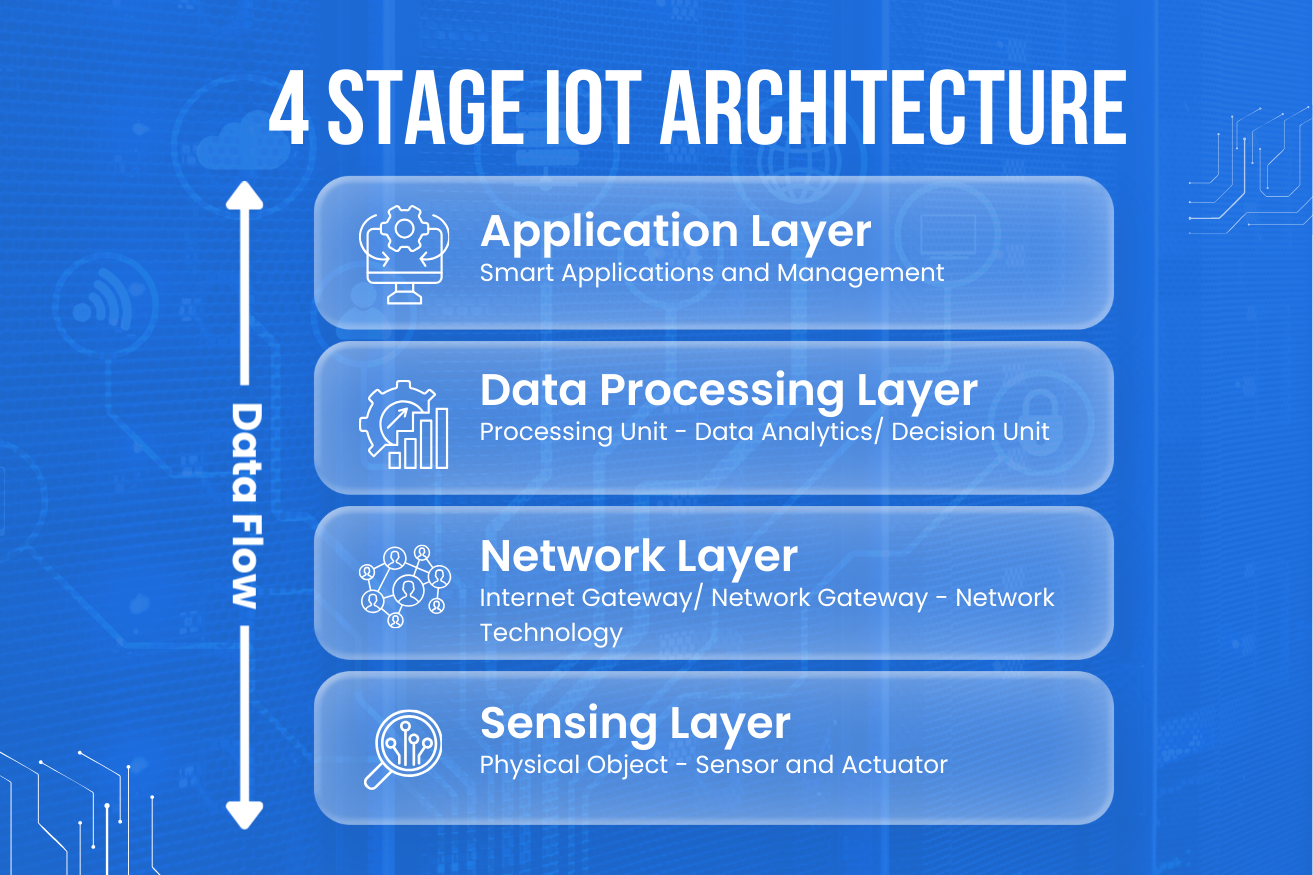
Every production IoT system decomposes into four layers. Each depends on the stability of the one beneath it, and each has a contract it must honour.
Sensing and Device Layer
Where physical reality becomes digital: sensors, embedded controllers, firmware, calibration, and signal conditioning.
Deliver measurements that are accurate within a stated tolerance, timestamped at the moment of measurement, and labelled with the identity and firmware version that produced them — or an explicit error if it cannot.
- Sensor placement that measures the wrong thing convincingly
- Electrical noise and ground loops corrupting readings intermittently
- Drift and ageing with no recalibration strategy
- Firmware that reports a default value instead of admitting a failure
The quality achieved here is the ceiling for the entire system. No processing layer can recover information a sensor never captured, and a plausible wrong number is far more damaging than a missing one.
Connectivity and Network Layer
Moving data from device to wherever it is processed: protocols such as MQTT, CoAP or HTTP, radio links including BLE, LoRaWAN, NB-IoT, Wi-Fi and cellular, plus gateways and ingestion endpoints.
Deliver every message eventually, exactly once, in a recoverable order, without altering meaning — and make loss visible when delivery is genuinely impossible.
- Outages treated as exceptions rather than the normal state
- Retries that duplicate data because messages are not idempotent
- Buffers that overflow silently and drop the oldest readings
- Bandwidth costs that only become visible at fleet scale
This layer fails more quietly than any other. Dashboards keep rendering, so nobody notices that the values behind them are hours old. Deciding how much this layer must tolerate is the core of any IoT connectivity architecture decision.
Data Processing and Intelligence Layer
Where measurements become meaning: validation, normalisation, aggregation, storage, rules, analytics, anomaly detection, and machine learning — at the edge, in the cloud, or split across both.
Turn raw readings into statements the application can act on, with the confidence and the context attached — and never invent data that was not measured.
- Interpolating across outages, which hides failures and corrupts training data
- Fixed thresholds standing in for conditions that are genuinely relative
- Placing all intelligence in the cloud, so nothing works during an outage
- No versioning, so a rule change silently rewrites the meaning of history
This is also the layer that decides operating cost. Filtering close to the source removes bandwidth and storage expense that no later optimisation can recover.
Application and Experience Layer
What people and other systems actually touch: dashboards, mobile and web applications, alerts, automation workflows, and APIs into business systems.
Present the system’s current understanding honestly — including its uncertainty and its gaps — and give users a way to act and to record what happened.
- Interfaces that render stale data identically to live data
- Alert volumes that exceed what any operator can process
- No path for a user to confirm or reject what the system concluded
- Business logic implemented here that belonged two layers down
A polished interface cannot compensate for weak layers beneath it. It can, however, disguise them for long enough to become expensive.
How a Weak Layer Corrupts Everything Above It
Layer problems do not stay in their layer. They surface higher up, disguised as something else — which is why so much IoT debugging is spent in the wrong place.
| Root cause | Layer | How it appears to the user |
|---|---|---|
| Sensor drift with no recalibration | Sensing | Analytics slowly become less accurate for no visible reason |
| Reporting a default on sensor error | Sensing | Confident dashboards showing conditions that never occurred |
| Non-idempotent retries | Connectivity | Duplicate events, inflated counts, double-triggered automations |
| Silent buffer overflow | Connectivity | History with invisible holes; reports that quietly understate |
| Interpolated gaps | Processing | Systems appearing healthiest during their worst outages |
| Unversioned rule change | Processing | Yesterday’s reports no longer reproducible |
| Stale data rendered as live | Application | Operators trusting a screen that stopped updating hours ago |
Notice the pattern: almost every one of these presents as an application or analytics problem. Teams that debug from the top down spend weeks on the wrong layer. Teams that verify each contract in order find the cause in hours.
Where to Put Logic — and Where Not To
The most consequential architectural question is not which layers exist but which layer owns each decision. A workable rule: push a decision as low as its inputs allow, and no lower.
Common Mistakes in Layered IoT Design
These mistakes share a root: a decision made for short-term convenience in the wrong layer. Each is cheap to avoid at design time and disproportionately expensive to unwind once devices are deployed — which is exactly why so many systems that pass their pilot struggle once they reach the field.
Where Security, Intelligence and Operations Fit
Four layers describe the data path. Three concerns cut across all of them and belong to no single tier.
- Security — device identity, encrypted transport, access control, and update integrity apply at every layer. A system is only as secure as its weakest tier, which is why device security cannot be added at the application layer.
- Intelligence — AIoT is not a fifth layer. It is a capability that can be placed within the processing layer at any tier, and moving it changes latency, cost, and resilience.
- Operations — provisioning, monitoring, firmware lifecycle, and support run alongside the whole stack. A system without an operational layer works right up until the moment it needs to change.
Some models split these out as five, six, or seven layers. The number matters far less than whether each responsibility has an owner and a stated contract.
Frequently Asked Questions
Conclusion
The four layers of IoT architecture are not a taxonomy to memorise. They are a way of assigning responsibility so that failures are findable, changes are containable, and growth is predictable.
Write down what each layer guarantees. Push every decision as low as its inputs allow. Give each decision exactly one owner. Instrument each layer separately. Systems built that way do not become fragile as they grow — they become easier to reason about, which is ultimately the only kind of architecture that survives production.