




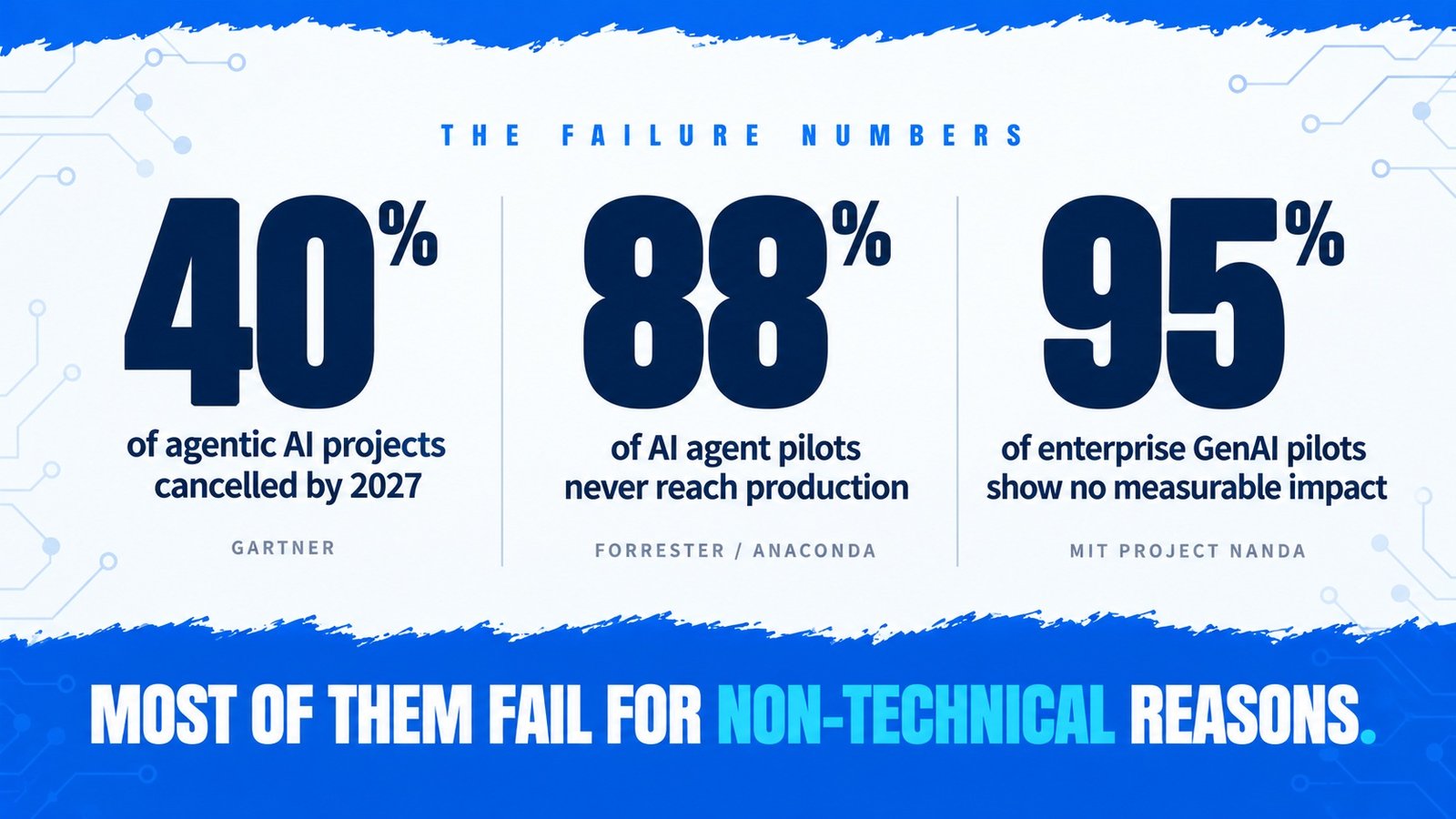
The failure numbers for AI automation in 2026 are unusually harsh. Gartner has predicted that more than 40 percent of agentic AI projects will be cancelled by 2027. Forrester research with Anaconda found that 88 percent of AI agent pilots never reach production. MIT’s Project NANDA study, “The GenAI Divide”, found that 95 percent of enterprise generative AI pilots produced no measurable revenue or cost impact within six months.
Those are not technology failures. The most cited blocker across all three is that nobody defined what “working” meant, followed by governance friction and missing evaluation. This guide covers the six reasons automation projects actually die, and what each one looks like early enough to fix.
Nobody Defined What Success Means
This is the single most reported cause. A pilot launches with a goal like “improve efficiency with AI”, which cannot be passed or failed, so the project never ends and never proves anything.
Evaluation gaps appear in roughly two-thirds of stalled agent projects. Without an agreed measure, three things follow: the scope keeps expanding, the team cannot say when to stop, and the budget review arrives with no evidence attached.
- The process: inbound order emails converted into ERP records
- The measure: percentage processed without human touch, and errors per hundred
- The threshold: 75 percent hands-off at under one error per hundred
- The owner: the operations manager who accepts the result
Early warning: if nobody can state the number the project must hit, it has already started failing.
The Wrong Process Was Chosen
Teams often pick the process that is most annoying rather than the one that is most automatable. Those are rarely the same thing.
| Good first candidate | Poor first candidate |
|---|---|
| Runs hundreds of times a month | Runs a few times a month |
| Rules are stable and written down | Experts disagree on the right answer |
| Input arrives in a consistent form | Every case is genuinely different |
| Mistakes are recoverable | A single error is a compliance event |
| The process is not about to change | It is being redesigned next quarter |
Early warning: if two experienced people handle the same case differently and both are right, no automation will resolve that — it will reproduce the disagreement inconsistently.
Choosing the process and choosing the technology are the same decision. AI automation vs RPA vs AI agents sets out which approach suits which kind of work, and what each typically costs.
It Was Never Connected to the System of Record
A demo that reads a document and produces a summary is impressive. A business change happens when the result lands in the ERP, the CRM, or the ticketing system where work is actually tracked.
Many pilots stop just short of that step, because integration is the slow, unglamorous part. The result is an automation that produces output a person then has to re-enter — which saves almost nothing and often feels like extra work.
Early warning: if the pilot output is a spreadsheet, an email or a dashboard rather than a record in a live system, it is not yet automation.
Exceptions Were Treated as an Afterthought
The happy path is perhaps half the work. Real inputs include scanned documents at an angle, missing fields, duplicates, cases that break the business rule, and inputs nobody anticipated.
When exceptions are not designed for, one of two things happens. Either the automation guesses and produces confident errors, or it fails silently and work disappears into a queue nobody monitors. Both destroy trust faster than slow manual processing ever did.
- A confidence threshold, below which the case goes to a person
- A visible queue of escalated cases with an owner
- Logging of what the system saw and why it escalated
- A measured exception rate — and alarm if it climbs
Nobody Would Take Responsibility for It Acting
Governance friction shows up in well over half of stalled projects, and it is usually misdiagnosed as bureaucracy. The real issue is that no individual was willing to be accountable for what an automated system does, because nothing in the design made that accountability survivable.
Organisations grant authority when four things exist: explicit limits on what the system may do, a complete audit trail, a tested way to switch it off, and a track record showing accuracy. Projects that skip straight to autonomy without those are declined at the final approval, after the money has been spent.
Early warning: if you cannot name the person who will sign off on the automation acting without review, build it as an advisory tool first.
The People Doing the Work Were Not Involved
Automation designed from a process document rather than from watching the work almost always misses something: the informal check someone does, the exception they handle by instinct, the reason a field is filled in a particular way.
There is also a trust dimension. If the team believes the project is about replacing them, you will not get accurate information about how the process really works — and that information is the project’s main input.
Early warning: if nobody who performs the process daily has reviewed the automation design, the design is based on a description rather than the work.
What the Successful Minority Do Differently
None of these are technical. That is the point — and it is consistent with what the research keeps finding, which is that leadership and definition problems account for far more failures than model quality does. We scope AI automation projects around exactly these checks.
Frequently Asked Questions
Conclusion
AI automation projects fail predictably, and almost never because the technology could not do the job. They fail because success was never defined, the wrong process was chosen, the output never reached a real system, exceptions were ignored, nobody would take responsibility, or the people doing the work were left out.
Every one of those is cheap to fix in week one and expensive to fix in month six. Write the success number, score the process honestly, integrate properly, design for exceptions, start advisory, and build it with the team — and you are already doing more than the majority of projects that get cancelled.