



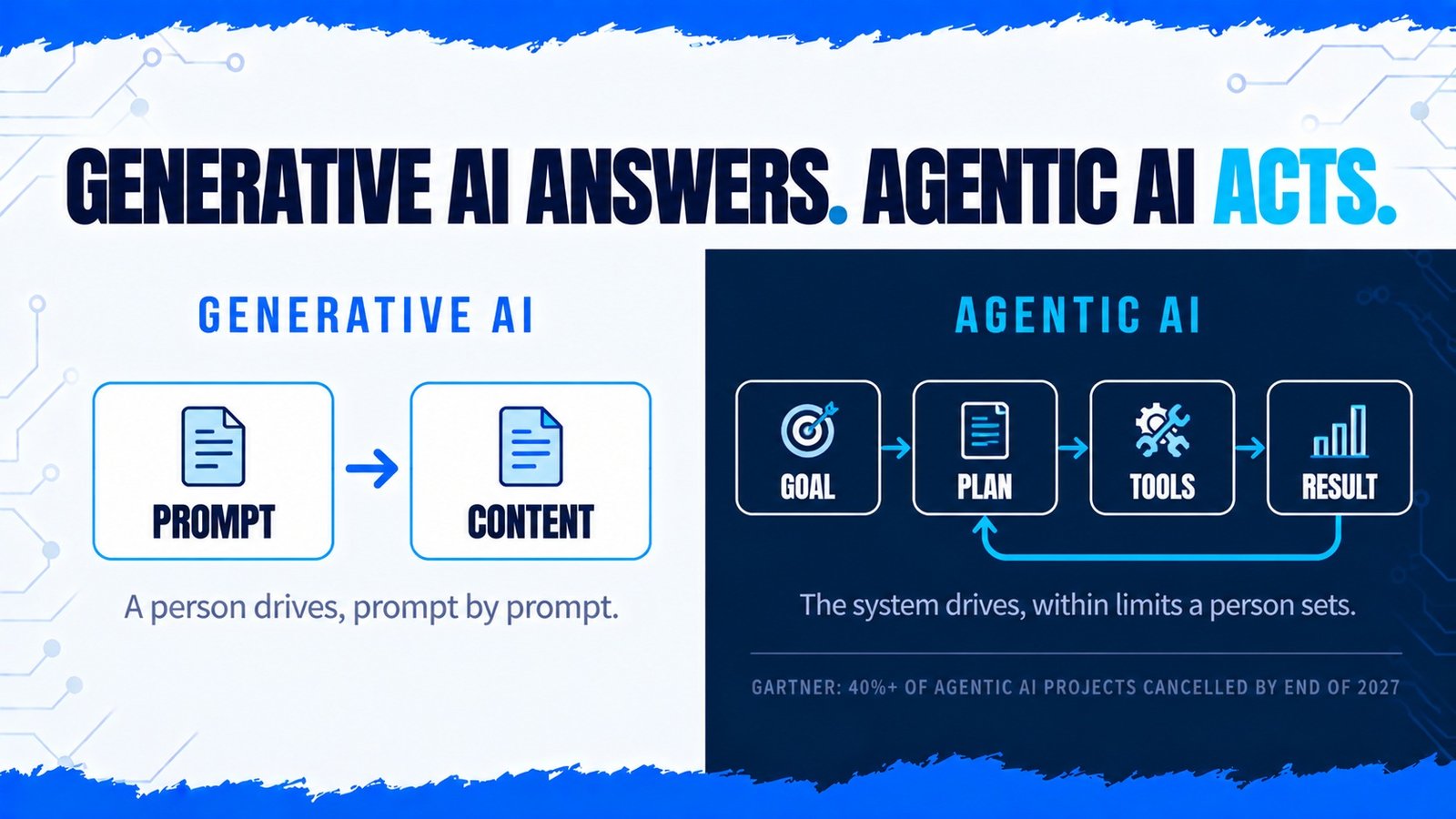
Generative AI creates content when asked: an email draft, a summary, an image, a block of code. Agentic AI pursues a goal: it plans steps, uses tools, checks results and keeps going until the job is done or it needs help. Most agentic systems use a generative model as their reasoning engine, so the two are not rivals. The difference is what surrounds the model, and how much it is allowed to do on its own.
This guide explains agentic AI vs generative AI with a side-by-side comparison, real examples of each, how agentic systems actually work, what the research says about projects in production, and how to decide which one a business problem needs.
Agentic AI vs Generative AI at a Glance
| Generative AI | Agentic AI | |
|---|---|---|
| What it does | Produces content in response to a prompt | Works towards a goal across several steps |
| Who drives | A person, prompt by prompt | The system, within limits a person sets |
| Output | Text, images, code, audio | Completed tasks and changes in other systems |
| Uses tools | Rarely, or not at all | Yes: search, APIs, databases, applications |
| Memory | Mostly the current conversation | Tracks task state, and sometimes longer-term memory |
| Main risk | Wrong or invented content | Wrong actions in real systems |
| Typical example | Drafting a reply to a customer complaint | Investigating the complaint, issuing a refund within policy and replying |
Generative AI answers. Agentic AI acts. The moment a system can act, the questions change from “is it accurate?” to “what is it allowed to do?”
What Is Generative AI?
Generative AI refers to models trained on large amounts of data that generate new content resembling it. Large language models generate text and code; diffusion models generate images; other models generate audio and video. You give an instruction, and it returns an output for a person to use.
Its strengths are breadth and speed: drafting, summarising, translating, classifying, extracting and explaining. Its limits are that it does not check its own work against the world unless something makes it, it can state wrong things confidently, and it does nothing after it answers.
What Is Agentic AI?
Agentic AI describes systems that use AI models to pursue goals with some autonomy. Given an objective, an agent breaks it into steps, chooses tools, observes what happens, adjusts, and repeats. The word “agentic” refers to that agency: the capacity to act, not just respond.
An AI agent is a single such system; agentic AI is the broader approach, and often involves several agents with different roles coordinating on a larger task. In practice the terms are used almost interchangeably.
It Is a Spectrum, Not a Switch
Real systems sit somewhere along a line of increasing autonomy. Knowing where a product sits says more than whether its marketing uses the word “agentic”.
Assistant
A chat interface that generates content on request. The person does everything else.
Copilot
Generative AI embedded in an application, suggesting the next step while the person stays in control of each action.
Workflow with an AI step
A fixed sequence designed by people, where a model handles one judgement inside it, such as classifying a document. Predictable and easy to audit.
Agent
The model decides which steps to take and in what order, using tools, within boundaries and with approval for risky actions.
Multi-agent system
Several specialised agents divide a task, hand work to each other and check each other’s output.
Many business problems are best solved at level 3, not level 4 or 5. The trade-offs between fixed automation, RPA and agents are covered in AI automation vs RPA vs AI agents.
Agentic AI Examples
- Drafting marketing copy, emails and reports
- Summarising long documents and meeting transcripts
- Generating images and product visuals
- Suggesting code as a developer types
- Extracting fields from documents for a person to review
How Agentic AI Works
An agent is a generative model wrapped in a loop with four additions.
Connecting agents to tools used to mean custom code for every pairing. The Model Context Protocol (MCP), introduced by Anthropic in November 2024, standardised that connection. In December 2025 Anthropic donated MCP to the Agentic AI Foundation, a new fund under the Linux Foundation co-founded with Block and OpenAI. By then there were more than 10,000 active public MCP servers, and the protocol was supported by products including ChatGPT, Gemini, Microsoft Copilot, Cursor and Visual Studio Code.
What the Research Says About Agentic AI
Expectations for agentic AI are high, and so is the failure rate. Gartner’s forecasts capture both sides:
- By 2028, 33 percent of enterprise software applications will include agentic AI, up from less than 1 percent in 2024, allowing 15 percent of day-to-day work decisions to be made autonomously.
- Over 40 percent of agentic AI projects will be cancelled by the end of 2027, because of rising costs, unclear business value or inadequate risk controls.
- Of the thousands of vendors marketing agentic AI, Gartner estimated that only about 130 offer genuine agentic capabilities. The rest is “agent washing”: chatbots, RPA and assistants rebranded.
The projects that survive tend to share traits: a narrow, well-defined task; tools scoped to that task; clear success measures; and a person approving anything costly or irreversible. The common failure causes are the same ones that sink other automation, covered in why AI automation projects fail.
When to Use Generative AI and When to Use Agentic AI
| If the task… | Use |
|---|---|
| Ends with content a person will review and use | Generative AI |
| Follows the same steps every time, with one judgement in the middle | A workflow with a generative AI step |
| Needs information gathered from several systems, in an order that depends on what is found | An agent |
| Involves actions that are expensive or impossible to undo | An agent with human approval, or a person |
| Must be fully predictable and auditable step by step | A deterministic workflow, perhaps with no AI at all |
Agents add capability and risk in equal measure. Before giving one real permissions, read AI agent security and decide where the approval step belongs using human-in-the-loop AI automation.
Frequently Asked Questions
Conclusion
Generative AI and agentic AI are layers, not alternatives. Generative AI produces content; agentic AI wraps it in goals, tools, memory and guardrails so it can complete tasks. The right choice depends less on the technology than on the task: how many steps it has, whether they vary, and what happens if an action is wrong.
Start with the lowest level of autonomy that solves the problem, and move up only when the task genuinely needs it. We build AI automation across that whole range, from a single AI step in an existing workflow to agents with bounded authority and full audit trails.