Artificial Intelligence of Things (AIoT) is rapidly transforming industries by combining connected devices, edge computing, cloud intelligence, and machine learning into intelligent operational systems.
But despite growing investment in AIoT platforms, many projects never move beyond pilot deployments.
Surprisingly, the problem is usually not the AI model.
👉 The real issue is poor architectural planning.
At MetaDesk Global, we’ve seen many organizations focus heavily on:
- Model accuracy
- Dashboard design
- Analytics pipelines
while overlooking the foundational decisions that determine whether the system can actually scale and survive in production.
This article explores:
- Why AIoT projects fail
- The architectural foundations of scalable AIoT systems
- Critical trade-offs between edge and cloud intelligence
- Best practices for building resilient production-grade AIoT platforms
What is AIoT?
AIoT (Artificial Intelligence of Things) combines:
- IoT infrastructure
- Embedded systems
- Artificial intelligence
- Edge computing
- Real-time analytics
- Automation
Traditional IoT systems mainly focus on:
- Data collection
- Device connectivity
- Dashboards and monitoring
AIoT systems go further by enabling:
- Autonomous decision-making
- Predictive maintenance
- Real-time optimization
- Continuous learning
This transforms connected devices into intelligent operational systems.
Why Most AIoT Projects Fail
Many AIoT initiatives succeed during demos and controlled pilots but fail during production scaling.
The reason is simple:
👉 Most systems are designed for visibility — not operational intelligence.
Teams often prioritize:
- Fancy dashboards
- High model accuracy
- Cloud analytics
while ignoring:
- Reliability
- Latency
- OTA infrastructure
- Device security
- Edge intelligence
- System resilience
Without strong architecture, even the best AI models become difficult to maintain in real-world environments.
AIoT is Not “IoT + AI”
A common misconception is that AIoT simply means adding machine learning to an IoT platform.
In reality, AIoT is a distributed intelligence architecture.
It requires coordination between:
- Edge devices
- Cloud systems
- Streaming infrastructure
- Automation workflows
- Secure firmware pipelines
- Continuous model lifecycle management
If any layer becomes unstable, the entire system becomes unreliable.
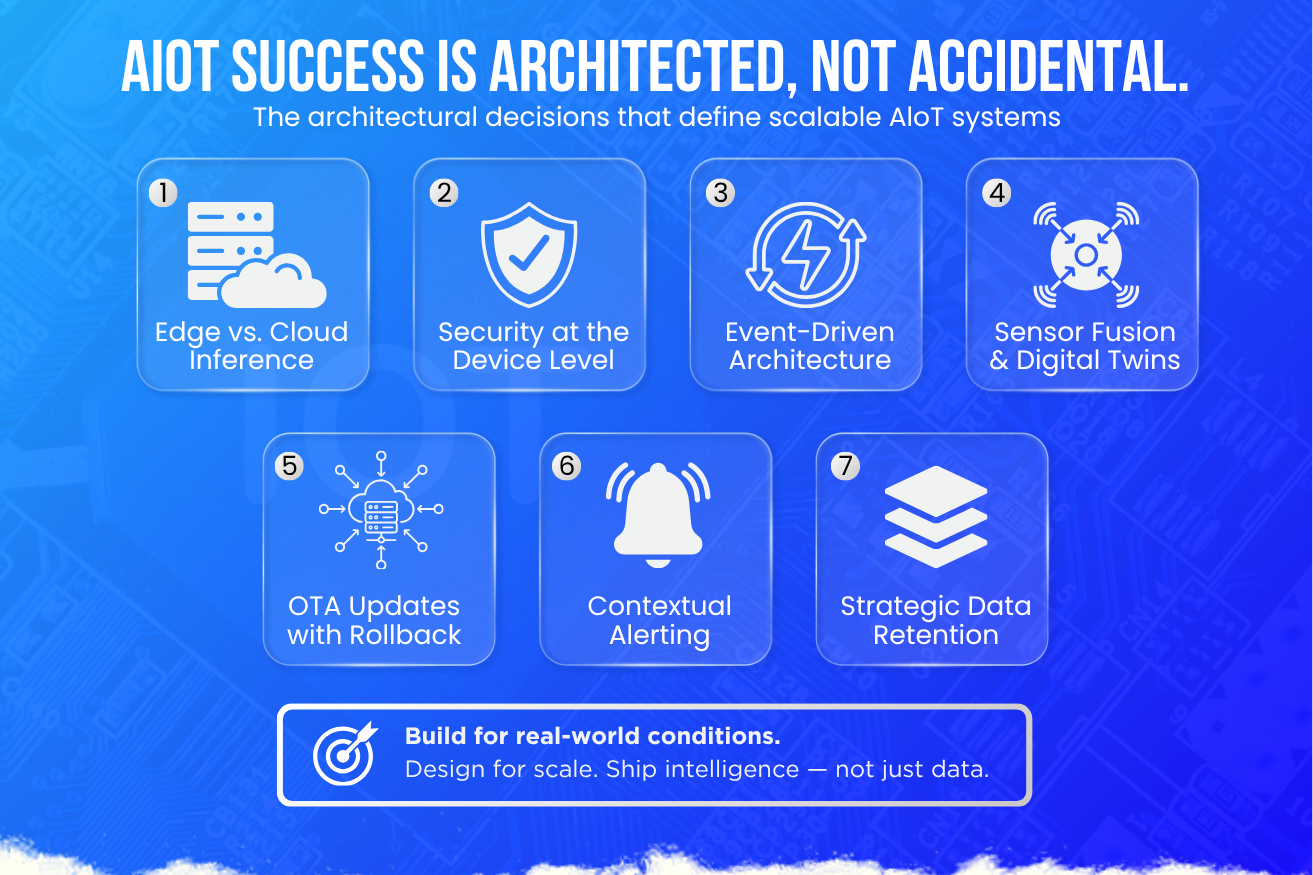
The Architectural Decisions That Define AIoT Success
Successful AIoT platforms are built around critical architectural choices made early in development.
1. Edge vs Cloud Inference
One of the most important AIoT decisions is determining where inference should happen.
Edge Inference
Edge AI enables devices to process data locally.
Advantages
- Low latency
- Offline operation
- Reduced bandwidth usage
- Faster real-time response
Ideal for:
- Industrial automation
- Robotics
- Smart cameras
- Predictive maintenance systems
Cloud Inference
Cloud AI enables:
- Large-scale analytics
- Fleet-wide optimization
- Centralized model training
Advantages
- High computational power
- Easier model retraining
- Global operational visibility
The Best Approach: Hybrid Intelligence
Production-grade AIoT systems typically use a hybrid architecture:
- Real-time decisions at the edge
- Fleet intelligence in the cloud
The goal is not choosing one or the other — but distributing intelligence intentionally.
2. Security Must Start at the Device
Many organizations focus security efforts on cloud APIs and backend systems.
In AIoT, security begins at the device level.
Essential Device Security Features
Secure Boot
Ensures only trusted firmware can execute.
Device Identity
Every device requires unique authentication credentials.
Certificate Management
Protects communication channels and device trust.
Flash Encryption
Prevents unauthorized firmware extraction.
Without device-level security:
- OTA systems become vulnerable
- Device spoofing becomes possible
- Entire fleets can be compromised
3. Event-Driven Architecture vs Batch Systems
Traditional enterprise systems often rely on scheduled batch processing.
Modern AIoT systems require:
- Real-time event handling
- Streaming pipelines
- Immediate state-based responses
Why Event-Driven Systems Matter
AIoT environments generate continuous streams of data.
Event-driven architecture enables:
- Instant anomaly detection
- Real-time automation
- Continuous operational awareness
Technologies commonly used include:
- Apache Kafka
- Apache Flink
- MQTT
- AWS Greengrass
4. Multi-Sensor Fusion and Contextual Intelligence
Single sensors provide isolated data points.
Advanced AIoT systems combine:
- Multiple sensor streams
- Environmental context
- Operational state information
This enables:
- Better anomaly detection
- Predictive insights
- More accurate decision-making
The Role of Digital Twins
Digital twin systems create virtual representations of physical environments.
When combined with sensor fusion, they allow systems to:
- Predict failures
- Simulate operational scenarios
- Optimize performance continuously
5. OTA Model Updates with Rollback Protection
Deploying AI models once is easy.
Maintaining them across thousands of devices is difficult.
Production AIoT Requires:
Secure OTA Updates
Firmware and models must update remotely and securely.
Version Control
Systems must track model and firmware compatibility.
Rollback Mechanisms
Devices need recovery paths if deployments fail.
Continuous Validation
Models must adapt to changing operational conditions.
Without strong OTA infrastructure, AIoT systems become impossible to maintain at scale.
6. Contextual Alerting Instead of Alert Fatigue
Traditional IoT systems often trigger alerts based on static thresholds.
This creates:
- Noise
- Operator fatigue
- Missed critical events
Intelligent Alerting Systems
Modern AIoT platforms correlate:
- Sensor data
- Operational context
- Historical patterns
- System state
This enables:
- Smarter escalation
- Reduced false positives
- Faster operational response
7. Strategic Data Retention
Many teams assume storing all data indefinitely is valuable.
In reality:
👉 Unstructured data growth becomes expensive and difficult to manage.
Production AIoT systems require intentional retention strategies.
Retain Data That:
- Improves AI models
- Supports compliance
- Enables diagnostics
- Creates operational insight
Discard:
- Redundant telemetry
- Low-value historical data
- Unused event streams
Smart retention policies improve:
- Scalability
- Performance
- Operational cost efficiency
Why AIoT Architecture Matters More Than Models
Even highly accurate AI models fail when:
- Latency is too high
- Connectivity is unstable
- Devices cannot update safely
- Edge systems lack resilience
- Infrastructure cannot scale
The organizations succeeding in AIoT are not simply building smarter models.
They are building:
- Reliable systems
- Distributed intelligence
- Adaptive infrastructure
- Scalable operational architectures
Best Practices for Building Scalable AIoT Systems
Organizations should focus on:
1. Design Hybrid Edge + Cloud Architectures
Balance:
- Real-time local intelligence
- Centralized fleet analytics
2. Prioritize Reliability Early
Include:
- Fail-safe modes
- Watchdogs
- Health monitoring
- Redundancy strategies
3. Build Secure OTA Infrastructure
Continuous deployment is essential for AIoT evolution.
4. Use Event-Driven Design Patterns
Real-time systems require real-time architectures.
5. Treat Security as Foundational
Security cannot be added later.
It must begin at:
- Hardware
- Firmware
- Connectivity
- Cloud infrastructure
Conclusion
Most AIoT projects do not fail because of weak AI models.
They fail because the architecture was never designed for:
- Real-world environments
- Distributed intelligence
- Scalability
- Reliability
- Long-term operation
Successful AIoT systems are built through intentional engineering decisions:
- ✔ Edge and cloud balance
- ✔ Secure device architecture
- ✔ Event-driven infrastructure
- ✔ OTA lifecycle management
- ✔ Intelligent automation
- ✔ Resilient operational design
👉 AIoT success is not defined by dashboards or connectivity.
It is defined by whether the system can operate reliably, scale intelligently, and continue improving over time.
About MetaDesk Global
MetaDesk Global specializes in embedded systems, AIoT platforms, edge intelligence, firmware development, PCB design, and production-grade IoT architectures.
We help organizations build intelligent systems that move beyond monitoring — and deliver real-world autonomous operational value.