AIoT: From Sensing to Intelligent Action
As the world becomes increasingly connected, businesses are moving beyond simply collecting data. Today, the goal is to create systems that sense, understand, and act intelligently in real time. This is where AIoT — the combination of Artificial Intelligence (AI) and the Internet of Things (IoT) — is transforming industries.
In this article, we break down what a complete AIoT system looks like, why it matters, and how organizations can leverage it to build scalable, secure, and intelligent products.
What is AIoT?
AIoT (Artificial Intelligence of Things) integrates IoT devices that collect data with AI models that analyze and act on that data — often directly at the edge. While IoT provides connectivity and sensing, AI provides decision-making and prediction.
- IoT = Collect Data
- AI = Understand Data
- AIoT = Take Action on Data
This shift turns simple connected devices into autonomous and intelligent systems.
Why AIoT Matters
Most traditional IoT systems rely heavily on the cloud. This leads to:
- High bandwidth usage
- Latency in critical decision-making
- Outages when network connectivity fails
With AI running on the device (Edge AI):
- Devices can respond instantly
- Systems continue functioning offline
- Privacy improves because less raw data is streamed to the cloud
AIoT enables faster, safer, and more resilient systems.
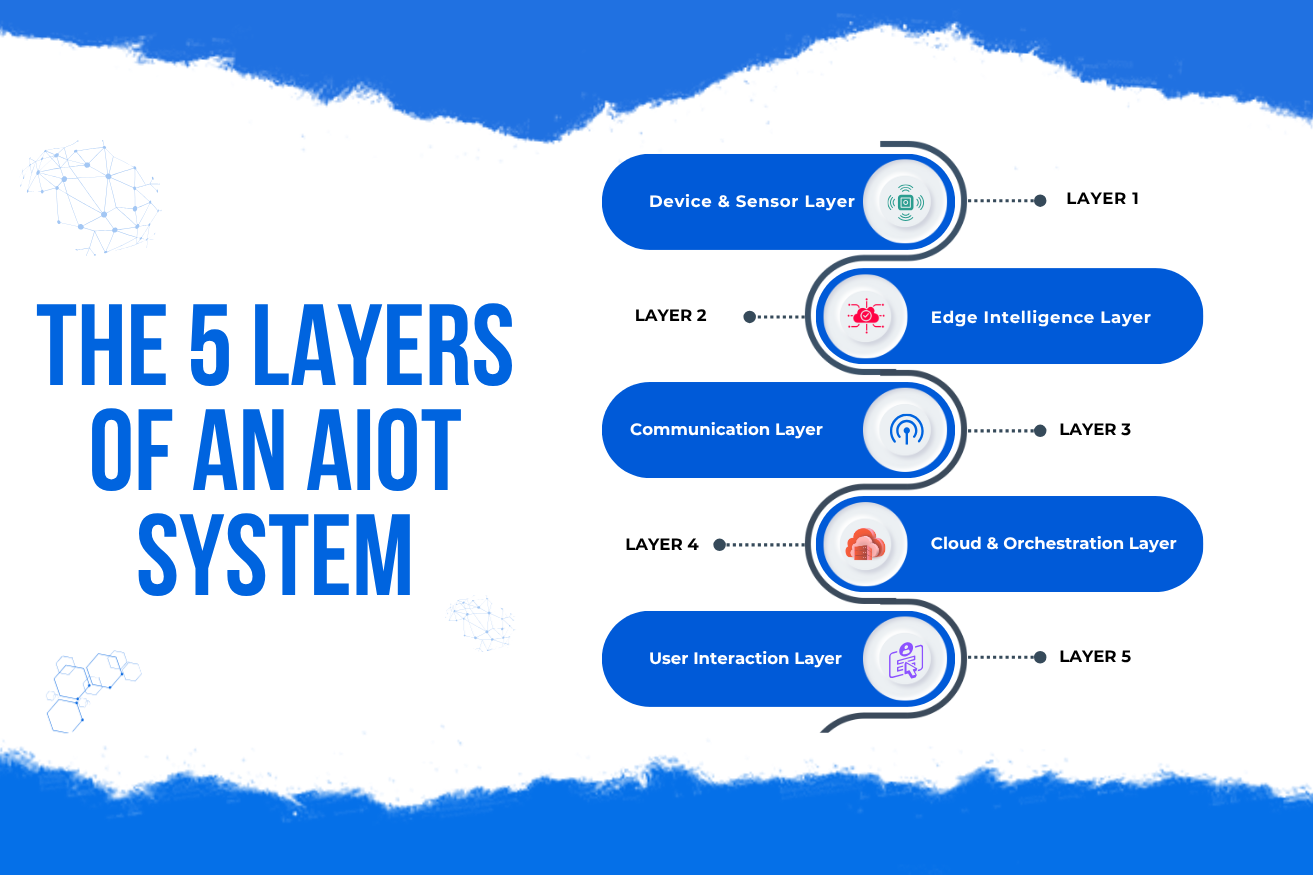
The 5 Layers of a Complete AIoT System Architecture
To successfully deploy AIoT, you need a clear multi-layer architecture.
1. Sensor Layer — Where Data Begins
This layer captures raw information from the real world:
- Temperature & humidity sensors
- IMUs / vibration sensors
- Cameras / microphones
- GPS modules
- Pressure / flow sensors
Key considerations:
- Signal quality
- Calibration
- Timestamping
- Low-power operation
If data quality is poor here, the entire system suffers.
2. Edge AI Layer — Intelligence on the Device
This layer runs AI or rule-based models locally on microcontrollers or edge computers such as:
- ESP32 / STM32 / NRF52 (TinyML)
- Raspberry Pi / Jetson Nano
- ARM Cortex cores
Benefits:
- Real-time decisions with minimal latency
- Works even without Internet
- Lower cloud and bandwidth costs
- Stronger privacy and data security
Examples:
- Detecting equipment failure from vibration patterns
- Recognizing objects from camera feeds
- Predicting energy demand in smart meters
3. Communication Layer — Secure Data Flow
This layer ensures reliable communication between devices and cloud using protocols like:
- MQTT (publish/subscribe messaging)
- LoRaWAN (long-range, low power)
- Wi-Fi / Ethernet
- 5G / LTE
- BLE (short-range low power)
Security is critical, with:
- TLS encryption
- Certificate-based authentication
- Role-based access control
4. Cloud Layer — Analytics, Management & Orchestration
While edge performs real-time decisions, the cloud handles:
- Long-term analytics
- Big data processing
- Retraining of ML models
- OTA firmware & model updates
- Device health monitoring
- User permissions and access control
The cloud is the command center of the AIoT system.
5. Application Layer — Where Users Interact
This layer exposes insights and controls through:
- Mobile apps
- Web dashboards
- Voice assistants
- APIs & automation workflows
An effective AIoT interface must:
- Show decisions, not just numbers
- Allow users to fine-tune automation rules
- Provide explainability and trust
Common Challenges in AIoT
| Challenge |
Solution |
| Unreliable connectivity |
Use edge intelligence and offline-first design |
| Power limitations |
Optimize firmware + sensor duty cycles |
| Data privacy concerns |
Local inference + encrypted communication |
| Hard to scale updates |
Implement OTA + remote fleet management |
| Debugging complex systems |
Build observability from day one |
How MetaDesk Global Helps Companies Build AIoT Systems
- ✔ Sensor & hardware integration
- ✔ Low-power firmware (ESP32, STM32, NRF52, Linux edge devices)
- ✔ TinyML & Edge AI optimization
- ✔ Secure MQTT / LoRa / 5G communication systems
- ✔ Cloud orchestration pipelines
- ✔ UI/UX dashboards for operators
We don’t just connect devices — we make them intelligent.
Conclusion
AIoT is transforming how organizations automate, optimize, and scale real-world operations. By leveraging a layered architecture — from sensors to edge AI to cloud orchestration — businesses can deploy systems that are:
- ✅ Faster
- ✅ More Reliable
- ✅ More Secure
- ✅ More Autonomous
The future of IoT isn’t just connectivity — it’s cognition. Devices that sense, think, and act.
Interested in building your AIoT solution?
Let’s talk. MetaDesk Global can help you architect, prototype, and deploy your system — end-to-end.
📩 Send a message or contact us via our website: MetaDesk Global