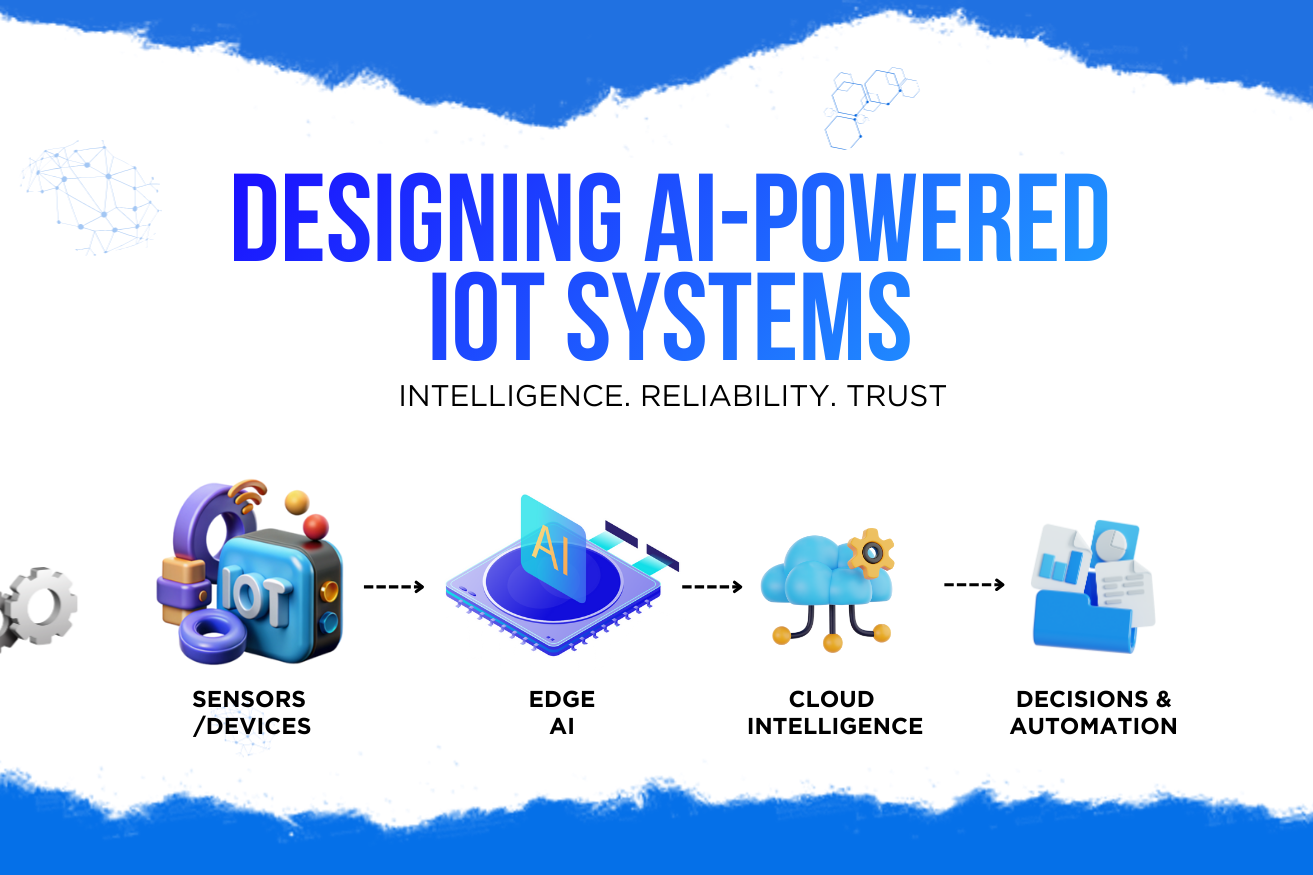
Blending Artificial Intelligence with IoT is no longer about simply connecting devices and adding analytics. Modern AIoT systems must deliver intelligence, reliability, and trust across every layer — from sensor input to automated decision-making.
Teams that treat AI as a bolt-on feature often struggle in production. The systems that succeed are designed holistically, with AI, data, and operations engineered together from day one.
This article breaks down the key considerations for building robust, real-world AIoT systems that scale beyond prototypes.
Why AIoT Requires a Different Design Approach
Traditional IoT systems focus on connectivity and monitoring. AIoT systems go further — they interpret data, make decisions, and act autonomously.
This shift introduces new challenges:
- Data quality directly impacts decisions
- Models must perform outside lab conditions
- Automation must be safe, explainable, and controllable
- Trust becomes a system requirement, not a feature
AIoT is not just an AI problem. It is a systems engineering problem.
Data Readiness — The Foundation of Intelligent Systems
AI is only as effective as the data it learns from.
In AIoT systems, data readiness means more than collecting telemetry. It includes:
- Accurate sensor measurements
- Consistent timestamps and synchronization
- Coverage across real operating environments
- Sensor metadata and contextual information
Both historical and real-time data are essential. Without well-structured, representative data, models become fragile and unreliable in production.
Choosing the Right Models for the Job
Not every AIoT problem requires deep learning.
Successful systems balance:
- Rule-based logic for deterministic behavior
- Machine learning for pattern recognition
- Deep learning where complexity truly demands it
Model selection should be driven by:
- Use-case requirements
- Maintainability over time
- Performance constraints
- Operational complexity
The best model is the one that solves the problem reliably, not the one that looks impressive on paper.
Edge AI vs Cloud AI — Where Should Intelligence Live?
One of the most critical decisions in AIoT architecture is where intelligence runs.
Key factors include:
- Latency requirements
- Available compute and memory
- Network reliability
- Power constraints
- Privacy and data sensitivity
Depending on the system, intelligence may live:
- Entirely at the edge
- Entirely in the cloud
- In a hybrid edge-cloud architecture
Designing this intentionally ensures systems remain responsive and functional even when connectivity is limited.
Model Evaluation in Real-World Conditions
High accuracy in controlled environments does not guarantee success in the field.
Production AIoT systems must be evaluated on:
- Consistency across environments
- Stability over time
- Sensitivity to noise and drift
- Long-term reliability
Continuous monitoring is essential to detect performance degradation and trigger retraining or adjustment before failures occur.
Interpretability — Building Trust in AI Decisions
As AI systems become more autonomous, trust becomes critical.
Operators and stakeholders need:
- Clear explanations of decisions
- Visibility into contributing factors
- Root-cause analysis for unexpected behavior
Explainable AI improves adoption, debugging, maintenance, and regulatory compliance. If users cannot understand why a system acted, they cannot trust or fix it.
Automation Strategy — Balancing Autonomy and Control
Automation should be intentional, not automatic.
AIoT systems must clearly define:
- When to alert humans
- When to recommend actions
- When to execute actions autonomously
The right balance depends on safety, risk tolerance, operational workflows, and regulatory requirements.
Designing AIoT Systems for the Long Term
Production AIoT systems must plan for:
- Model updates and versioning
- OTA deployment and rollback
- Governance and auditability
- Security across devices and data flows
Updating AI models in deployed devices is a release engineering challenge, not just a data science task. Planning for this early prevents costly failures later.
Intelligence and Reliability Must Be Designed Together
AIoT success is not defined by how advanced a model is — but by how well the entire system works together.
The most effective AIoT products:
- Start with strong data foundations
- Choose models pragmatically
- Place intelligence where it makes sense
- Validate performance continuously
- Build trust through transparency and control
At MetaDesk Global, we design AIoT systems where intelligence, reliability, and trust are engineered together — from sensor to decision.
Final Thoughts
Smart IoT systems are not created by adding AI at the end. They are built by designing every layer with intelligence in mind.
When data, models, infrastructure, and automation align, AIoT moves from experimentation to real-world impact.