Every successful IoT product begins the same way — not with hardware, dashboards, or cloud platforms, but with a clear problem and rapid iteration.
Teams that skip this foundation often end up with over-engineered demos that never translate into real-world impact.
This guide outlines a practical, step-by-step approach to building IoT solutions that move efficiently from idea to prototype — and eventually to production.
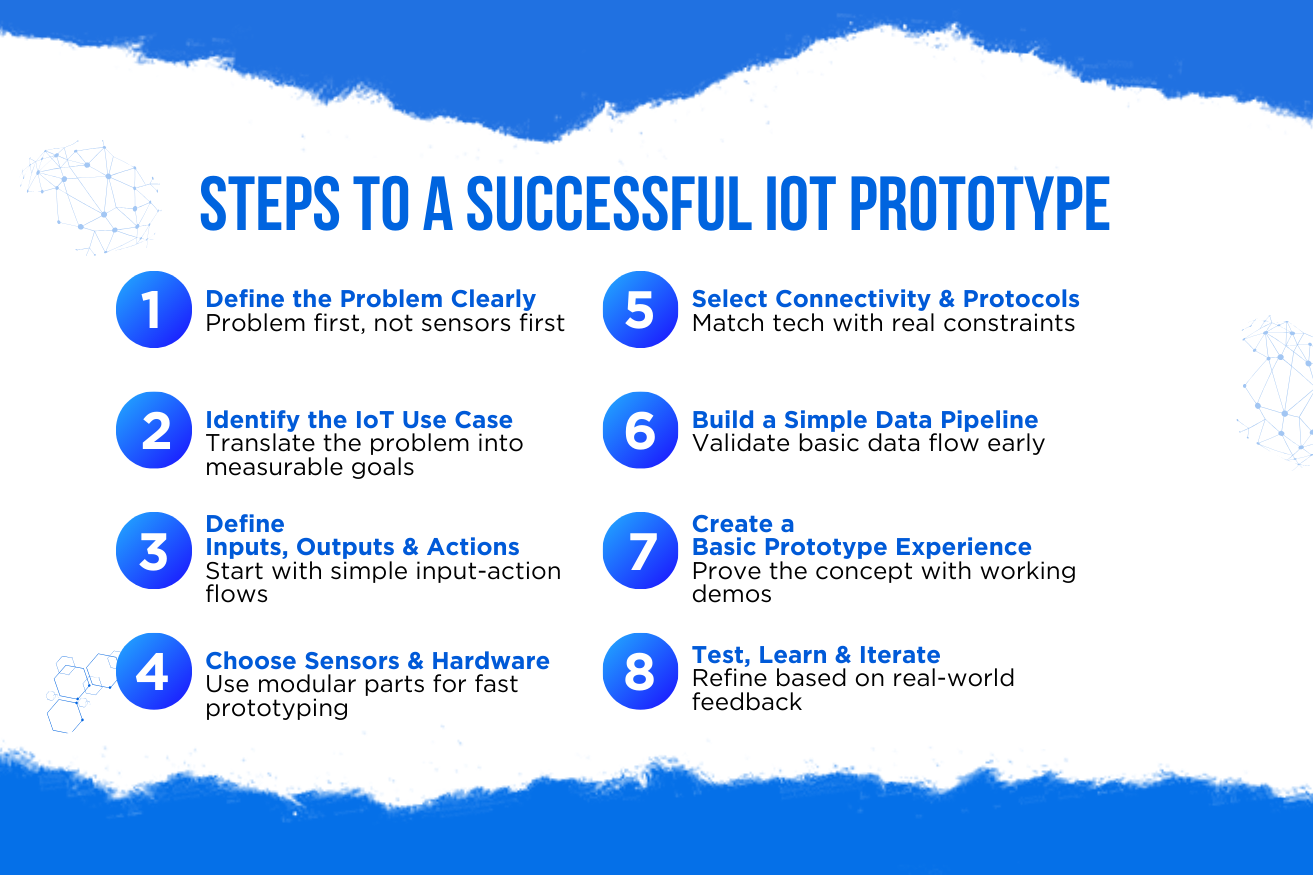
Start With the Problem, Not the Technology
The first step in any IoT project is defining why the system exists.
Before choosing sensors or platforms, identify:
- Who experiences the problem
- What currently fails or costs time, money, or effort
- Why existing solutions are insufficient
Clear problem definition prevents unnecessary complexity and ensures IoT is being used where it truly adds value.
Translate the Problem Into an IoT Use Case
Once the problem is understood, convert it into measurable objectives.
Ask:
- What needs to be observed or measured?
- How frequently does data need to be captured?
- What outcome should the data enable?
An effective IoT use case focuses on signals that drive decisions, not data for data’s sake.
Define Inputs, Outputs, and Actions Early
A simple data flow diagram goes a long way.
Define:
- Inputs: Sensors, events, or external data
- Processing: Local logic, rules, or analytics
- Outputs: Alerts, dashboards, control actions, or reports
Keeping this flow simple at the beginning helps validate system behavior before adding advanced automation or AI.
Choose Sensors and Hardware for Rapid Prototyping
Early-stage hardware decisions should prioritize speed and flexibility, not perfection.
Good practices include:
- Selecting sensors that are easy to integrate and replace
- Using development boards or modular edge devices
- Avoiding custom hardware until requirements stabilize
This approach reduces iteration time and lowers early development risk.
Select Connectivity and Communication Protocols
Connectivity should be chosen based on real-world constraints, not popularity.
Consider:
- Power consumption
- Range and coverage
- Data throughput requirements
- Reliability and deployment environment
Protocols like MQTT, HTTP, BLE, or LoRaWAN each serve different needs — matching them correctly is key to long-term success.
Build a Minimal Data Pipeline First
At the prototype stage, keep the data pipeline lightweight.
Focus on:
- Verifying reliable data flow
- Basic storage or logging
- Simple visualization or alerts
Advanced analytics and scaling can come later — first confirm that the system behaves correctly end to end.
Create a Functional Prototype Experience
A prototype should answer one key question:
Does this system solve the intended problem?
Prioritize:
- Functional clarity over visual polish
- Meaningful outputs over feature completeness
- Usability for the target user
A working demo that delivers insight is more valuable than a polished interface with unproven value.
Test, Learn, and Iterate in Real Conditions
Real-world testing reveals what simulations cannot.
Use feedback to:
- Adjust sensor placement or sampling rates
- Improve reliability and error handling
- Refine data interpretation and actions
Each iteration reduces uncertainty and moves the system closer to a production-ready solution.
Why Iteration Beats Perfection in IoT Development
IoT systems interact with physical environments — and those environments are unpredictable.
Teams that succeed:
- Start simple
- Learn quickly
- Improve continuously
Iteration turns assumptions into validated decisions and transforms early prototypes into scalable products.
From Prototype to Production
Once the core system proves its value, teams can confidently:
- Optimize hardware design
- Harden security and OTA update mechanisms
- Scale cloud infrastructure
- Introduce analytics or AI capabilities
This progression ensures resources are invested where they matter most.
Building IoT Solutions That Create Real Impact
At MetaDesk Global, we help teams move from idea to prototype to production by focusing on clarity, modular design, and fast iteration.
Whether you’re validating a new concept or preparing for scale, starting small — and iterating intelligently — is the fastest path to impact.