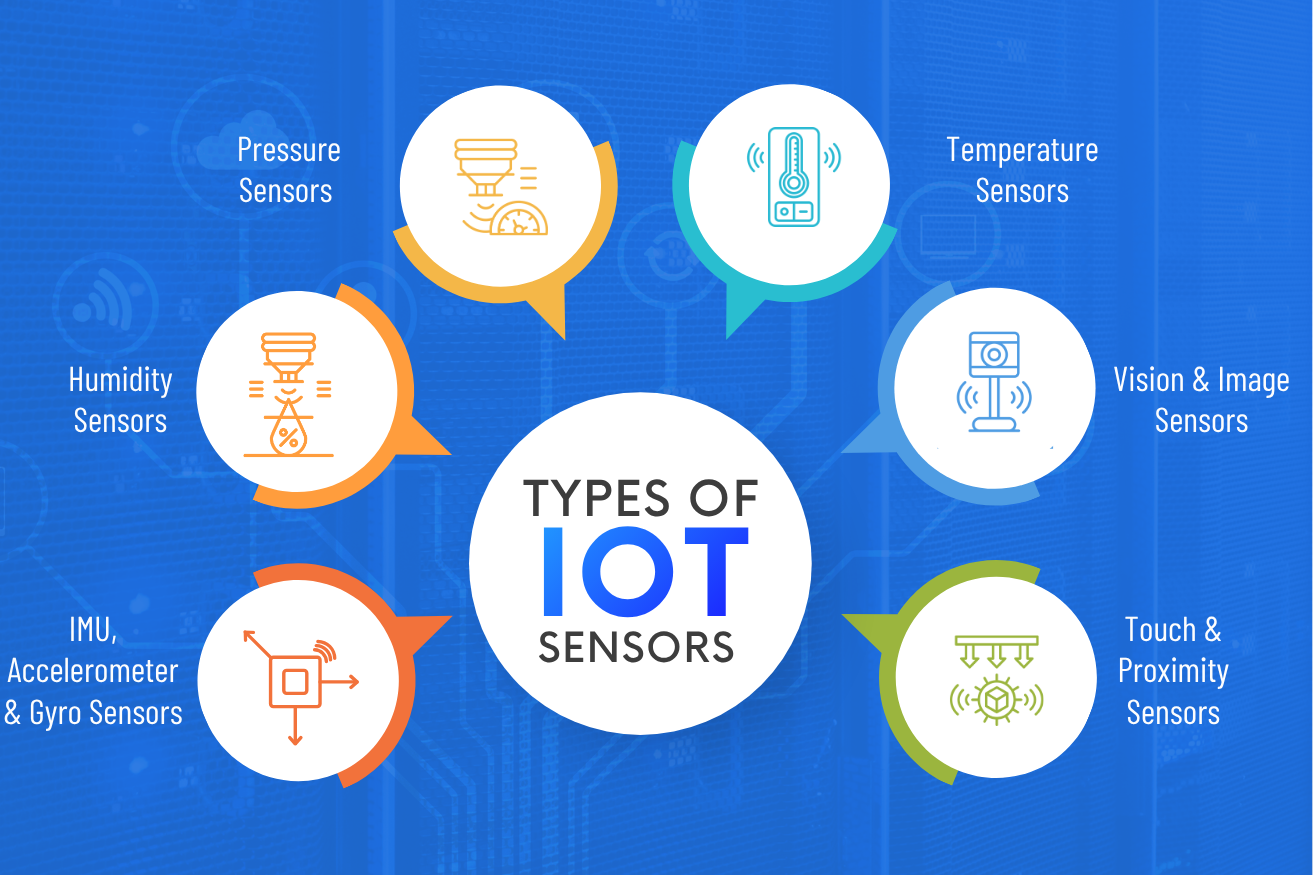
Sensors are where every IoT system begins, and where most of them are quietly limited. A platform can only ever be as good as the measurements feeding it — no amount of cloud processing or machine learning recovers information a sensor never captured correctly.
Choosing one is rarely about finding the most accurate part. It is about matching a sensing principle to the physical quantity, the environment, the power budget, and the price the product can bear.
This guide covers the main sensor types used in connected products, the specifications that actually matter, and the mistakes that produce confident but wrong data.
The Categories
Types of IoT Sensors
| Sensor | Measures | Typical use | Watch out for |
|---|
| Temperature | Heat, via thermistor, RTD or digital IC | Cold chain, HVAC, equipment health | Self-heating; measuring the board, not the air |
| Humidity | Relative moisture in air | Storage, agriculture, building comfort | Drift over time; condensation damage |
| Pressure | Gas or liquid pressure, altitude | Water networks, pneumatics, weather | Temperature cross-sensitivity |
| Accelerometer / IMU | Motion, vibration, orientation | Asset tracking, machine monitoring, wearables | Mounting stiffness changes the signal entirely |
| Current / power | Electrical consumption | Energy monitoring, motor condition | Isolation and safety requirements |
| Proximity / distance | Presence and range, via IR, ultrasonic or ToF | Level measurement, people counting, parking | Surface reflectivity and ambient light |
| Gas and air quality | CO₂, VOCs, particulates | Indoor air, safety, environmental monitoring | Frequent recalibration; cross-sensitivity |
| Optical / camera | Images and light | Inspection, counting, recognition | Lighting dominates accuracy |
| GNSS | Position | Fleet and asset tracking | Very high power; poor indoors |
A useful instinct: the harder a quantity is to measure directly, the more likely the right answer is to infer it from something easier. Motor health is often read from current rather than vibration; tank level from pressure rather than ultrasound.
Specifications
The Specs That Actually Matter
Datasheets lead with accuracy. In deployed systems, four other numbers usually matter more.
Resolution vs accuracy
Resolution is the smallest change a sensor reports; accuracy is how close it is to the truth. A sensor can report to 0.01°C and still be 2°C wrong. Decide which one your use case needs — detecting change often needs resolution, compliance needs accuracy.
Drift over time
Most sensors age. Gas and humidity sensors drift noticeably within a year. If the product life is five years, either plan recalibration or accept the error band in the business case.
Temperature coefficient
Nearly every sensor’s output shifts with its own temperature. Outdoors that can dwarf the signal you care about, so compensation is usually required rather than optional.
Power profile, not average current
What matters is current while active, how long it takes to stabilise after power-up, and sleep current. A sensor needing 500 ms to settle may cost more energy than the radio transmission that follows.
Interface and ecosystem
Digital sensors (I2C, SPI) handle conversion internally and are far easier to get right than analogue parts, which expose you to noise, reference voltage, and ADC quality. Prefer digital unless there is a clear reason not to.
Installation
Placement Beats Precision
The most common cause of bad IoT data is not a bad sensor. It is a good sensor measuring the wrong thing.
- A temperature sensor near a door measures the door, not the room.
- A vibration sensor on a machine guard measures the guard, not the bearing.
- A humidity sensor next to a warm regulator reads the heat of your own board.
- A CO₂ sensor beside a vent measures the vent, not the occupants.
These failures are dangerous precisely because the data looks completely normal. There is no error, no gap, no alarm — just numbers that describe something nobody intended to measure. The practical defences are a commissioning check that validates plausibility on site, and comparing each asset against similar assets to flag outliers automatically.
A sensor in the wrong place produces confident, well-formatted, useless data — and it will be trusted for months.
Practice
Choosing and Deploying Sensors Well
1Start from the decision, not the sensor
Write down the decision the data must support and the smallest change that would alter it. That defines the resolution and accuracy you actually need, and usually rules out expensive over-specification.
2Specify the environment before the part
Temperature range, humidity, vibration, chemical exposure, and electrical noise determine which sensors survive. A part chosen before this is a guess.
3Prefer digital sensors with built-in compensation
They remove entire classes of analogue problems and usually cost less in engineering time than the component price difference.
4Sample at the rate the physics requires
Oversampling burns power and bandwidth for no information; undersampling misses the event entirely. Let the phenomenon set the rate, then apply
data reduction on top.
5Report faults, never defaults
When a sensor read fails, send an explicit error code. A firmware that substitutes zero or the last good value turns a visible problem into a silent corruption of your data.
6Plan calibration into the lifecycle
Record calibration state with every reading, and decide up front whether drift is corrected in firmware, during service visits, or statistically against peer assets.
Everything above sets the ceiling for the rest of the system: the sensing layer is the foundation of the layered IoT architecture, and every tier above inherits whatever quality it produces.
FAQ
Frequently Asked Questions
What are the main types of IoT sensors?
The common categories are temperature, humidity, pressure, accelerometers and IMUs, current and power, proximity and distance, gas and air quality, optical or camera, and GNSS positioning. Each suits different quantities, environments, and power budgets.
What is the difference between sensor resolution and accuracy?
Resolution is the smallest change a sensor can report; accuracy is how close its reading is to the true value. A sensor can report temperature to 0.01°C while being 2°C off. Detecting change needs resolution; compliance reporting needs accuracy.
Should you use analogue or digital sensors?
Digital sensors using I2C or SPI are usually the better choice. They handle conversion and often compensation internally, avoiding noise, reference-voltage, and ADC-quality problems that analogue parts expose you to. Choose analogue only when there is a specific reason.
Why does sensor placement matter so much?
Because a correctly functioning sensor in the wrong position produces plausible data about the wrong thing — a temperature sensor near a door measures the door. There is no error or gap to notice, so the readings get trusted for months before anyone questions them.
How often do IoT sensors need recalibration?
It depends on type. Gas and humidity sensors can drift noticeably within a year, while a quality digital temperature sensor may hold its specification for the product’s life. Record calibration state with every reading so drift can be detected and corrected.
What should a device do when a sensor fails?
Report an explicit error code rather than a default value. Substituting zero or the last good reading hides the fault and silently corrupts analytics and any model trained on the data — a missing value is far safer than a convincing wrong one.
Wrapping Up
Conclusion
IoT sensors set the ceiling for everything a connected system can achieve. The right choice comes from the decision the data must support, the environment the device will live in, and the power it can spend — not from the highest accuracy figure on a datasheet.
Get the placement right, prefer digital parts with built-in compensation, sample at the rate the physics demands, and make devices report faults rather than defaults. Those four habits prevent most of the data quality problems that surface years later as “the analytics don’t look right”.