The agriculture industry is rapidly adopting connected technologies to improve productivity, animal welfare, and operational efficiency. Among the most promising innovations in smart farming are IoT livestock monitoring collars, commonly used for cows and dairy cattle.
These smart collars allow farmers to track animal health, detect behavioral changes, and improve herd management through continuous monitoring.
However, designing a reliable IoT cow collar device is far more complex than it appears. Behind the simple idea of attaching a device to an animal lies a series of engineering challenges involving power consumption, connectivity, sensor accuracy, and rugged hardware design.
In this article, we explore how smart livestock collars work, the technologies behind them, and the key challenges engineers must solve to build a scalable livestock IoT solution.
What Is a Smart Cow Collar?
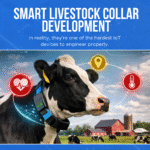
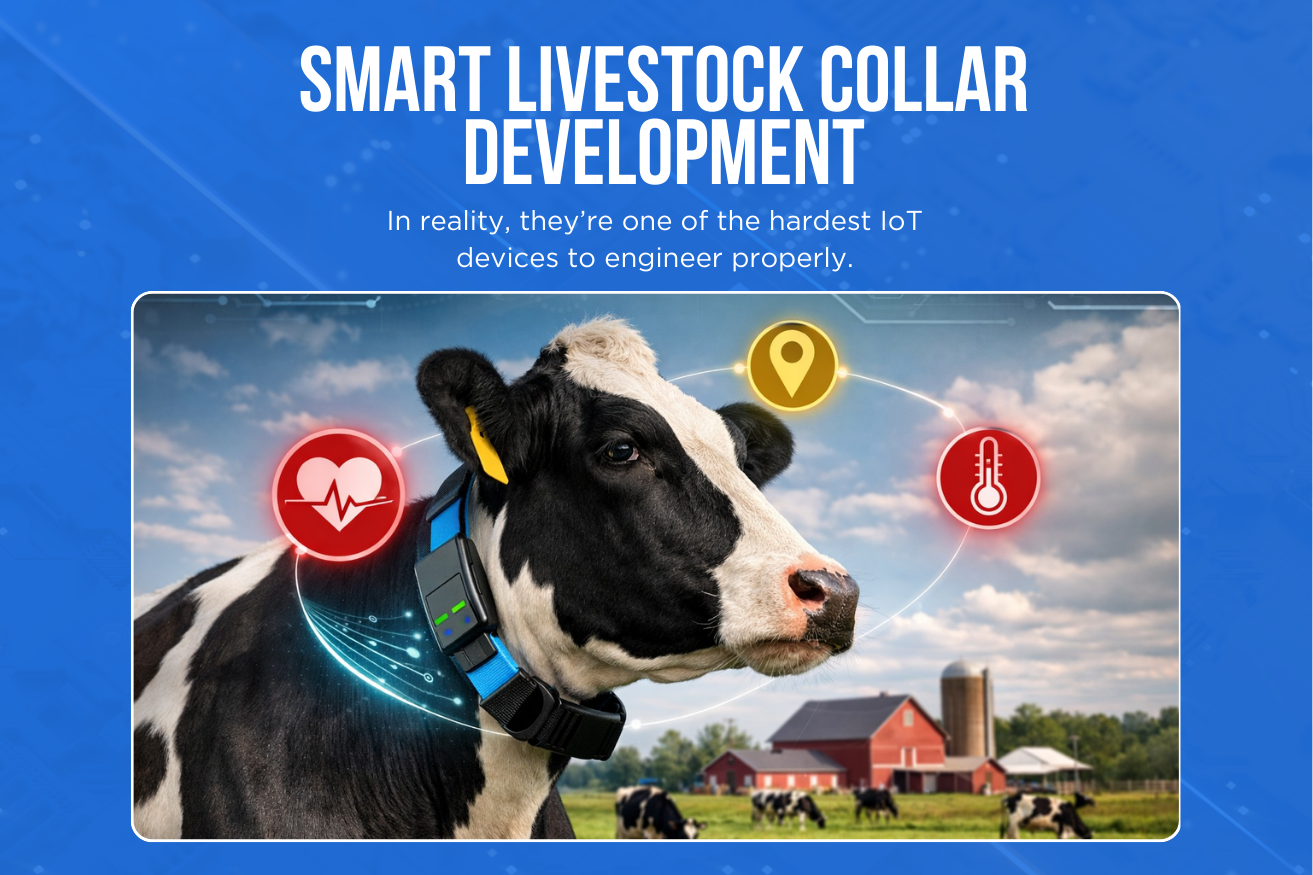
A smart cow collar is an IoT-enabled wearable device designed to monitor cattle behavior and health in real time.
These devices typically use a combination of sensors, wireless communication, and cloud analytics to provide actionable insights to farmers.
Smart livestock collars can monitor:
- Animal activity and movement patterns
- Rumination (chewing) behavior
- Feeding cycles and grazing habits
- Body temperature changes
- Location tracking within large farms
- Health indicators and stress signals
By analyzing these data points, farmers can detect health issues early, optimize breeding cycles, and improve herd productivity.
How IoT Livestock Monitoring Systems Work
A typical livestock monitoring system includes three major components:
1. Wearable IoT Device (Cow Collar)
The collar contains sensors and an embedded microcontroller that continuously collects data about the animal’s behavior and environment.
Common sensors include:
- Accelerometers for activity tracking
- Temperature sensors for health monitoring
- GPS or location modules for tracking
- Motion and posture detection sensors
The firmware processes this data and transmits it periodically.
2. Wireless Communication Network
Livestock farms are often located in rural areas where connectivity is limited. As a result, choosing the right communication technology is critical.
Common connectivity options include:
- LoRa / LoRaWAN: Long-range, low-power communication suitable for large farms.
- NB-IoT or LTE-M: Cellular-based connectivity that leverages existing telecom infrastructure.
- BLE Gateways: Local gateways collect data from nearby collars and forward it to the cloud.
Each communication method has trade-offs in power consumption, coverage, and infrastructure cost.
3. Cloud Analytics Platform
Once data reaches the cloud, analytics platforms process the information to identify patterns and anomalies.
Advanced systems use machine learning algorithms to detect:
- Early signs of illness
- Heat cycles for breeding optimization
- Reduced feeding or rumination behavior
- Abnormal activity levels
This information is then presented through mobile dashboards or farm management software.
The Engineering Challenges of Livestock IoT Devices
While the concept sounds simple, building a commercial-grade livestock monitoring collar requires solving several difficult engineering problems.
Multi-Year Battery Life
One of the biggest requirements for livestock IoT devices is long battery life.
Farmers cannot replace batteries every few weeks across hundreds of animals. A well-designed device must operate 1–2 years on a single battery.
Achieving this requires:
- Ultra-low-power microcontrollers
- Event-driven firmware architecture
- Optimized wireless transmission intervals
- Deep sleep power modes
- Efficient sensor sampling
Power optimization often determines whether the product is viable at scale.
Connectivity in Rural Environments
Livestock farms are often located in remote areas with limited network infrastructure.
Engineers must design systems that can operate reliably despite:
- Weak cellular signals
- Large geographic areas
- Interference from terrain and buildings
Hybrid architectures combining LoRa gateways and cellular backhaul are commonly used.
Harsh Environmental Conditions
Livestock collars must withstand extreme conditions such as:
- Dust and mud
- Rain and humidity
- Physical impact from animal movement
- Temperature variations
This requires rugged enclosure design, waterproof sealing, and industrial-grade components.
Animal Comfort and Ergonomic Design
Unlike traditional IoT devices, livestock wearables must also prioritize animal comfort.
The collar must be:
- Lightweight
- Non-irritating to the animal
- Durable enough for daily farm conditions
Mechanical design becomes as important as electronics.
Reliable Sensor Interpretation
Collecting sensor data is easy. Interpreting it correctly is not.
Animal movement is unpredictable, and raw accelerometer signals often contain noise.
Advanced algorithms must filter and interpret this data to distinguish between:
- Normal grazing behavior
- Rumination patterns
- Resting periods
- Abnormal activity that may indicate illness
Accurate behavioral modeling is essential for useful insights.
Why Livestock IoT Is Growing Rapidly
Global demand for dairy and livestock products is increasing, pushing farms to adopt technology that improves efficiency.
IoT livestock monitoring systems help farmers:
- Detect diseases earlier
- Reduce veterinary costs
- Optimize breeding cycles
- Increase milk production
- Improve animal welfare
As a result, smart farming and livestock IoT solutions are becoming a key part of the future of agriculture.
The Future of Smart Livestock Monitoring
The next generation of livestock monitoring systems will likely include:
- Edge AI models running directly on wearable devices
- Advanced behavior recognition algorithms
- Energy harvesting technologies for longer device life
- Integration with farm automation systems
These advancements will make livestock IoT devices even more powerful and scalable.
Building Reliable AgriTech IoT Solutions
At MetaDesk Global, we work with companies building IoT-enabled products for real-world environments, including agriculture, industrial automation, and smart infrastructure.
Our expertise includes:
- Embedded firmware development
- Low-power IoT device design
- Sensor integration and edge intelligence
- Wireless connectivity optimization
- IoT product architecture for scalable deployments
Designing hardware that works reliably outside the lab requires careful engineering across hardware, firmware, and system architecture.
Conclusion
Smart cow collars represent a powerful example of how IoT technology is transforming agriculture.
But behind every successful livestock monitoring device is a complex engineering effort involving power optimization, rugged hardware design, reliable connectivity, and intelligent data processing.
As smart farming continues to grow, well-designed IoT devices will play a critical role in improving both productivity and animal welfare.